
Introduction
Keeping a production system running smoothly takes more than writing good code. Engineers also need to watch systems, handle incidents, automate repeated tasks, and understand what happens when traffic or system load changes.
That is where Site Reliability Engineering, or SRE, becomes useful. SRE combines software engineering and operations practices to improve the reliability, performance, and scalability of production systems.
SRESchool.in focuses on helping learners understand these areas through SRE Training, SRE Courses, tutorials, tools, and practical reliability concepts. The goal is to help beginners and working professionals connect theory with real production challenges.
What Is Site Reliability Engineering and Why Does It Matter?
Site Reliability Engineering is an engineering approach for keeping software systems reliable while allowing teams to develop and release changes.
An SRE team may work on monitoring, automation, incident response, capacity planning, cloud infrastructure, and system performance.
Consider a web application that becomes slow whenever many users access it. Developers may need to check the application, while infrastructure engineers may inspect servers, databases, networks, and resource usage. SRE brings these areas together around reliability.
SRE matters because small problems can become large production incidents. Clear reliability goals, useful monitoring, and automation can help teams detect and handle such problems more effectively.
What Can You Learn Through SRE Training?
A useful SRE Training program should connect basic concepts with practical engineering work.
Learners may study:
- Monitoring and alerting
- Metrics, logs, and traces
- SLOs, SLIs, and SLAs
- Error budgets
- Incident response
- Troubleshooting
- Automation
- Cloud reliability
- Capacity planning
- Production systems
For example, instead of simply learning what an alert means, a learner can understand why too many alerts create noise and how teams can create alerts that need human attention.
Practical learning also helps engineers understand how reliability affects development, infrastructure, deployment, and daily operations.
What Is SRE Certification and Why Do Professionals Consider It?
SRE Certification can provide a structured way to check knowledge of reliability engineering concepts. Certification requirements, exams, recognition, and learning objectives can differ between providers.
A certification may help a professional organize learning around topics such as reliability, monitoring, incident management, automation, and production operations.
However, certification is only one part of professional development. Practical experience also matters. An engineer may understand error budgets from a course but still need hands-on practice to apply them during a real production problem.
Professionals should therefore look at certification content, practical coverage, prerequisites, assessment style, and provider details before choosing a certification.
How to Choose an SRE Course
An SRE Course should give learners a clear path from basic ideas to practical work.
Before choosing one, check whether it covers:
- Core SRE principles
- Monitoring and observability
- Incident management
- SLOs and error budgets
- Automation
- Cloud and infrastructure
- Troubleshooting
- Capacity planning
- Production examples
A good course should explain not only what a tool does but also why an SRE team might use it.
Learning style also matters. Some people prefer guided lessons, while others learn better through tutorials and hands-on exercises. The right choice depends on the learner’s current knowledge, goals, available time, and preferred learning method.
What Is Site Reliability Engineering Training?
Site Reliability Engineering Training helps learners understand how reliability fits into software and infrastructure work.
Instead of treating production operations as a separate task, SRE training shows how developers and operations teams can use engineering methods to solve recurring problems.
For example, manually restarting a failed service every day may solve the immediate problem, but automation and root-cause analysis can address the repeated work.
Training can also introduce concepts such as service-level objectives, observability, incident response, capacity planning, deployment reliability, and cloud infrastructure.
The exact depth of training varies by course and provider, so learners should review the actual curriculum before enrolling.
Understanding Site Reliability Engineering Certification
Site Reliability Engineering Certification generally focuses on knowledge related to reliability engineering and production systems.
Certification can help learners create a structured study plan. It may also encourage them to review important areas such as monitoring, SLOs, incident response, automation, and system reliability.
However, certification does not replace practical experience. An SRE Engineer needs to understand how systems behave under real conditions, how teams respond to incidents, and how engineering decisions affect reliability.
Professionals should also remember that certification recognition varies by provider, employer, region, and role. There is no single certification requirement that applies to every SRE position.
How SRE Tutorials Can Help You Learn
An SRE Tutorial can make difficult ideas easier by explaining one concept at a time.
For example, a tutorial about error budgets can start with a simple question: how much unreliability can a service accept while still meeting its reliability goal?
Another tutorial may explain how logs, metrics, and traces help engineers investigate a slow application.
Tutorials can also cover cloud infrastructure, DevOps, Kubernetes, Terraform, deployment, monitoring, and automation.
The biggest benefit comes from connecting each lesson with a practical problem. Instead of memorizing definitions, learners can ask how a concept would help them detect, understand, prevent, or recover from a production issue.
Understanding SRE Tools and Their Uses
SRE Tools help teams observe systems, manage infrastructure, respond to incidents, and automate operational work.
Different tools serve different purposes. Common categories include:
| Tool area | General purpose |
|---|---|
| Metrics | Track system and application measurements |
| Logs | Record useful events and messages |
| Tracing | Follow requests across services |
| Monitoring | Watch system health and behavior |
| Alerting | Notify teams about important conditions |
| Incident management | Organize response to production issues |
| Infrastructure as code | Manage infrastructure through configuration |
| Deployment tools | Support controlled software releases |
| Cloud tools | Manage cloud resources and services |
No single tool fits every organization. Tool choices depend on architecture, technology, team skills, budget, and operational needs.
What Are SRE Best Practices?
SRE Best Practices help teams build repeatable ways to manage reliability.
Useful practices include:
- Set clear reliability goals.
- Define useful SLIs and SLOs.
- Use error budgets to balance reliability and change.
- Improve monitoring and observability.
- Reduce unnecessary manual work.
- Automate suitable repeated tasks.
- Prepare clear incident procedures.
- Review incidents without focusing on blame.
- Write useful postmortems.
- Plan capacity before systems become overloaded.
- Improve deployment reliability.
These practices should not become rigid rules. Each organization has different systems, users, risks, and business needs. Teams should adapt SRE practices to their environment.
What Does an SRE Engineer Do?
An SRE Engineer may work across software, infrastructure, cloud, and production operations.
The role can include:
- Building automation
- Monitoring applications and infrastructure
- Troubleshooting production problems
- Responding to incidents
- Improving system performance
- Supporting deployments
- Managing reliability goals
- Planning system capacity
- Working with cloud infrastructure
- Reducing repeated operational work
An SRE Engineer may write software, review infrastructure, investigate failures, and work with development teams.
There is also no single path into SRE. People can move toward the role from software development, DevOps, system administration, cloud engineering, infrastructure, or related technical backgrounds.
Understanding SLOs, SLIs, SLAs, and Error Budgets
These four terms often appear together, but they have different meanings.
SLI: A Service Level Indicator measures something about a service. Examples include request success rate, latency, or availability.
SLO: A Service Level Objective defines the reliability target for an SLI.
SLA: A Service Level Agreement describes a formal service commitment, often between a provider and customer.
Error budget: An error budget represents the amount of unreliability allowed by an SLO.
For example, a team may decide that a service should meet a particular reliability target. The exact target depends on the service, users, business needs, and technical requirements.
These concepts help teams discuss reliability using measurable goals instead of vague statements such as “the system should be reliable.”
How Monitoring and Observability Help SRE Teams
Monitoring tells engineers what is happening through measurements and alerts. Observability helps engineers investigate why a system behaves in a particular way.
Three important sources are metrics, logs, and traces.
Metrics can show that response time has increased. Logs may reveal application errors. Traces can help engineers follow a request across several services.
Alerts then bring important conditions to the team’s attention.
Good monitoring does not mean creating an alert for every small change. Too many alerts can create noise and make important problems harder to notice.
SRE teams therefore need useful signals that help people understand system health and take appropriate action.
Understanding Incident Management and Incident Response
Incidents are a normal part of operating production systems. Incident management provides a structured way to handle them.
A typical response may involve:
- Detecting the problem.
- Understanding its impact.
- Alerting the right people.
- Investigating the cause.
- Restoring service.
- Communicating clearly.
- Recording what happened.
- Learning from the event.
A postmortem can help the team understand what happened and what changes could reduce the chance or impact of similar incidents.
The goal should focus on learning and system improvement rather than blaming an individual for a complex production failure.
How Automation Can Reduce Repeated Work
SRE teams often look for tasks that people perform again and again.
Imagine an engineer manually checking a service, restarting it, and reviewing the same logs every morning. If the task follows clear rules, automation may reduce this repetitive work.
Automation can support deployments, infrastructure changes, monitoring responses, testing, scaling, backups, and routine operational tasks.
However, not every task should become automated immediately. Teams should consider the risk, complexity, maintenance effort, and possible impact of automation before using it in production.
Good automation should make work safer or easier without creating a new source of operational problems.
Understanding Cloud Reliability and Distributed Systems
Cloud environments allow teams to run applications across different services, regions, networks, and infrastructure resources. This flexibility also creates new reliability challenges.
Distributed systems can fail in unexpected ways because many components depend on each other.
SRE work can involve understanding:
- Service dependencies
- Resource limits
- Network behavior
- Scaling
- Failure recovery
- Data availability
- Capacity planning
- Monitoring
Cloud reliability therefore requires more than simply moving an application to a cloud platform. Engineers need to understand how the complete system behaves when individual components become slow, unavailable, or overloaded.
How Kubernetes and Terraform Can Support SRE Work
Kubernetes helps teams manage containerized applications. It can support tasks such as scheduling workloads, managing services, and handling application scaling.
Terraform is an infrastructure-as-code tool that lets teams describe infrastructure through configuration. This can make infrastructure changes more repeatable and easier to review.
Both technologies can support SRE work, but neither is required for every SRE role.
An organization may use different container platforms, cloud services, deployment systems, or infrastructure tools based on its architecture and needs.
The important SRE skill is understanding the reliability problem first and then selecting suitable technology.
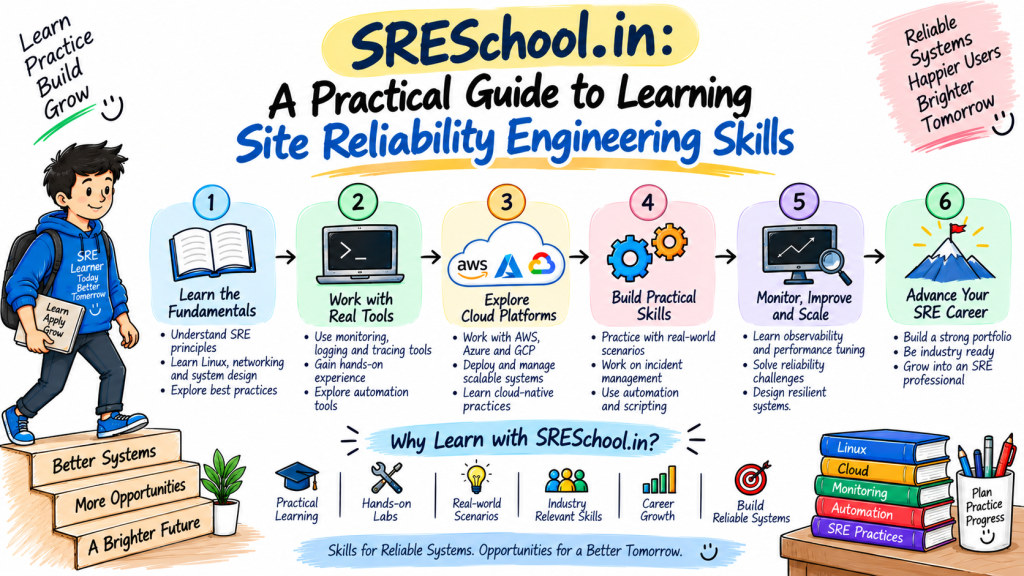
How to Build a Simple SRE Learning Path
A learner can build SRE knowledge step by step instead of trying to understand everything at once.
A practical path can look like this:
- Start with Linux, networking, and basic software concepts.
- Learn DevOps and production fundamentals.
- Study monitoring, metrics, logs, and alerting.
- Understand SLIs, SLOs, SLAs, and error budgets.
- Learn incident response and troubleshooting.
- Practice automation.
- Explore cloud infrastructure.
- Study containers and Kubernetes if relevant.
- Learn infrastructure as code, such as Terraform.
- Practice with small production-style projects.
The exact order can change based on existing skills. Someone with a strong software background may need more infrastructure practice, while an infrastructure professional may focus more on programming and automation.
Understanding SRE Training in India
SRE Training in India can help technology professionals develop knowledge across software engineering, cloud, DevOps, infrastructure, automation, and reliability.
Learners may use training to strengthen existing technical skills or understand how different areas connect in production systems.
When comparing training options, look at the syllabus, practical exercises, teaching method, tools covered, learning support, and current skill level.
Do not choose a course only because it promises career outcomes. Job requirements vary between organizations, and practical skills often matter alongside formal learning.
The most useful approach is to build knowledge that can be applied to real systems and technical problems.
How SRESchool.in Supports SRE Learning
SRESchool.in is positioned as a learning platform focused on Site Reliability Engineering and related production technology topics.
Its subject areas can help learners explore SRE Training, SRE Certification concepts, SRE Courses, tutorials, tools, best practices, cloud reliability, monitoring, automation, and production operations.
The platform can be useful as a learning resource for someone who wants to understand how software and infrastructure work together to support reliable systems.
Learners should still compare course content, certification requirements, and practical learning options based on their individual goals.
The promotional value of any learning platform depends on the quality and relevance of the material for the learner’s specific needs.
Why Learning SRE Is Becoming More Useful
Reliable software requires more than successful deployment. Teams also need to understand what happens after an application reaches production.
SRE brings together software development, infrastructure, monitoring, automation, incident response, and reliability.
These skills can help professionals understand problems such as slow applications, repeated outages, noisy alerts, difficult deployments, resource shortages, and manual operational work.
Learning SRE can also improve communication between development and operations teams because reliability becomes a shared engineering concern.
The most useful learning approach combines concepts with practice. Reading about SLOs or observability is helpful, but applying those ideas to realistic system problems builds deeper understanding.
Frequently Asked Questions About SRESchool.in
1. What is SRESchool.in?
SRESchool.in is a learning platform focused on Site Reliability Engineering, reliability, monitoring, automation, cloud systems, incident management, and related production topics.
2. What can I learn through SRE Training?
SRE Training may cover monitoring, observability, SLOs, SLIs, error budgets, incident response, automation, troubleshooting, cloud reliability, capacity planning, and production systems.
3. Is SRE Certification required to become an SRE Engineer?
No single certification is required for every SRE role. Requirements vary by organization, while practical engineering skills and relevant experience can also matter.
4. What should an SRE Course include?
A useful SRE Course can include SRE fundamentals, monitoring, observability, incident management, automation, reliability goals, cloud infrastructure, troubleshooting, and practical production concepts.
5. What is Site Reliability Engineering Training?
Site Reliability Engineering Training teaches learners how to apply software engineering and operations practices to improve the reliability, performance, and scalability of production systems.
6. What are SRE Tools used for?
SRE Tools can support monitoring, metrics, logging, tracing, alerting, incident management, infrastructure management, deployment, cloud operations, and automation.
7. How can SRE Tutorials help beginners?
SRE Tutorials can explain difficult topics step by step. They can help beginners understand concepts such as SLOs, observability, incidents, automation, Kubernetes, and infrastructure management.
8. What are some important SRE Best Practices?
Useful practices include setting clear reliability goals, using SLOs and SLIs, reducing manual work, improving observability, preparing for incidents, learning from failures, and planning system capacity.
9. Do SRE Engineers need Kubernetes and Terraform?
Not always. Kubernetes and Terraform can be useful in many environments, but tool requirements depend on the organization’s architecture, infrastructure, technology stack, and role.
10. Is SRE Training in India enough to guarantee a job?
No. Training can help develop relevant knowledge and skills, but employment depends on factors such as practical ability, experience, role requirements, interview performance, and the organization.
Final Thoughts
SRE is easier to understand when you connect each concept with a real production problem. Monitoring helps teams see system behavior. SLOs create clear reliability goals. Incident response provides a way to handle failures. Automation reduces suitable repetitive work.
SRESchool.in can serve as a learning resource for people exploring these areas through SRE Training, SRE Courses, tutorials, tools, and reliability concepts.
Whether you are a beginner or an experienced IT professional, focus on understanding the reason behind each SRE practice. Build practical skills step by step, test your knowledge through realistic problems, and adapt your approach to the systems you actually work with.

