
Introduction
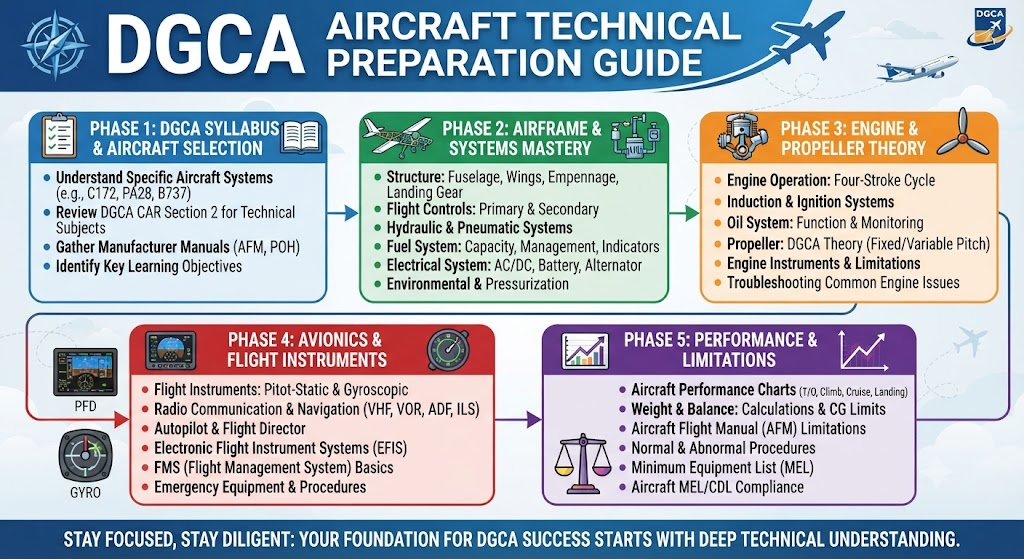
Aircraft Technical is an important part of pilot training because it helps students understand how an aircraft is built, powered, controlled, and operated.
For DGCA aspirants, technical preparation requires more than memorizing aircraft components and system definitions.
Students need to understand how individual systems work and how they support safe aircraft operation.
A structured study plan can make complex technical subjects easier to understand, revise, and apply during examination preparation.
Understanding the DGCA Aircraft Technical Subject
Aircraft Technical preparation introduces student pilots to the basic engineering and operational principles behind an aircraft. It connects theoretical knowledge with what a pilot sees and manages during flight.
The DGCA’s Central Examination Organisation conducts examinations for Flight Crew and Aircraft Maintenance Engineer licensing, with Flight Crew examinations administered through the DGCA examination system. The current DGCA Pariksha portal provides examination information, including syllabus and examination schedules.
For a pilot, technical knowledge is not simply about knowing the names of aircraft components. A student should understand the purpose of a system, its major components, how it normally operates, what indications are available to the pilot, and what can happen when something does not operate as expected.
This approach makes Aircraft Technical easier to connect with practical flying.
Major Areas Students Should Prepare
Aircraft General Knowledge
Start with the overall aircraft before studying individual systems. Learn the basic terminology used to describe an aircraft and understand how its major sections fit together.
Important areas include:
- Aircraft fuselage
- Wings
- Empennage
- Landing gear
- Flight controls
- Powerplant
- Propeller, where applicable
- Cockpit and instruments
- Aircraft systems
A good foundation makes later topics easier because students can understand where each component is located and what role it performs.
Aircraft Structure
Aircraft structure refers to the physical framework that allows the aircraft to withstand aerodynamic, operational, and environmental loads.
Students should understand the basic purpose of:
- Fuselage
- Wings
- Horizontal stabilizer
- Vertical stabilizer
- Rudder
- Elevators
- Ailerons
- Landing gear attachment structures
The objective at the preparation stage is not to become an aircraft structural engineer. Instead, students should understand the function of the major structural parts and the terminology associated with them.
Flight Controls
Flight controls allow the pilot to control the aircraft’s attitude and flight path.
Primary flight controls generally include:
Ailerons: Used primarily to control roll.
Elevator: Used primarily to control pitch.
Rudder: Used primarily to control yaw.
Students should also understand secondary or supplementary controls such as flaps, slats, spoilers, and trim systems.
Understanding the difference between primary control surfaces and devices used for lift, drag, or trim is particularly important.
Aircraft Engine Basics
Engine knowledge is a major part of technical preparation. Students should first understand the basic operating principle of the engine type relevant to their training.
For piston engines, preparation may involve concepts such as:
- Cylinders
- Pistons
- Crankshaft
- Connecting rods
- Intake and exhaust
- Ignition
- Carburetion or fuel injection
- Cooling
- Lubrication
For turbine engines, students should understand the basic relationship between components such as:
- Compressor
- Combustion chamber
- Turbine
- Exhaust
- Accessory systems
Students should concentrate on understanding the sequence of operation rather than memorizing component names independently.
Propellers
For aircraft equipped with propellers, students should understand how a propeller converts engine power into thrust.
Important concepts include:
- Propeller blades
- Blade angle
- Pitch
- Fixed-pitch propellers
- Variable-pitch propellers
- Constant-speed operation
- Propeller governing
Students should understand how changing blade angle affects propeller operation and why different operating conditions require appropriate propeller settings.
Fuel System
The fuel system provides the engine with the fuel required for operation.
Students should understand the basic purpose of:
- Fuel tanks
- Fuel lines
- Fuel pumps
- Fuel selectors
- Fuel filters
- Fuel quantity indications
- Fuel vents
Do not study these components as isolated definitions. Follow the path of fuel through the system and understand how it reaches the engine.
Electrical System
Modern aircraft depend on electrical power for many instruments, systems, and cockpit functions.
Basic preparation should cover:
- Battery
- Alternator or generator
- Electrical buses
- Circuit protection
- Switches
- Electrical indications
- Distribution of electrical power
Students should understand where electrical power originates, how it is distributed, and why circuit protection is necessary.
Hydraulic and Pneumatic Systems
Hydraulic systems use pressurized fluid to transmit force, while pneumatic systems use compressed air or other air pressure.
Depending on the aircraft, these systems can support functions such as:
- Landing gear operation
- Braking
- Flight controls
- Actuation of aircraft equipment
- Other aircraft-specific functions
The exact arrangement varies between aircraft types, so students should always distinguish general principles from aircraft-specific system design.
Landing Gear and Braking System
Landing gear supports the aircraft during ground operations, takeoff, and landing.
Students should understand:
- Fixed and retractable landing gear
- Nose wheel and main landing gear
- Gear extension and retraction
- Landing gear indications
- Wheel brakes
- Anti-skid principles
- Basic braking operation
The purpose is to understand how the system works and what information is available to the pilot.
Flight Instruments
Flight instruments provide essential information about aircraft performance, attitude, altitude, speed, and direction.
Students should understand the basic purpose and operating principles of instruments such as:
- Airspeed indicator
- Altimeter
- Vertical speed indicator
- Attitude indicator
- Heading indicator
- Turn coordinator
- Magnetic compass
It is useful to study instruments together with the information they provide. For example, instead of simply memorizing the definition of an airspeed indicator, understand what pressure information it uses and what the displayed airspeed represents.
Aircraft Systems and Safety
Technical knowledge directly supports safe flight operations.
A pilot who understands aircraft systems can better interpret indications, recognize abnormal conditions, follow appropriate procedures, and communicate technical problems accurately.
Technical preparation should therefore focus on understanding the relationship between:
System → Components → Operation → Indications → Abnormal condition → Pilot response
This way of thinking is more useful than memorizing disconnected facts.
How to Prepare for DGCA Aircraft Technical
1. Understand the Examination Requirements
Begin by checking the current DGCA examination information and applicable syllabus rather than relying on old notes or outdated information. The DGCA Pariksha portal currently provides a dedicated syllabus section and publishes Flight Crew examination information.
Examination requirements and schedules can change, so students should verify current information through the official DGCA examination system.
2. Build Basic Concepts First
Do not begin with the most complicated aircraft system.
Start with:
- Aircraft terminology
- Aircraft structure
- Basic aerodynamics related to aircraft operation
- Flight controls
- Engine fundamentals
- Aircraft systems
- Instruments
- System indications and abnormal conditions
A strong foundation reduces confusion later.
3. Study One System at a Time
Avoid studying several systems simultaneously.
For example, while studying the electrical system, concentrate on its power sources, distribution, protection, indications, and basic operation before moving to another major system.
4. Use Diagrams
Aircraft systems are often easier to understand visually.
When studying a diagram, identify:
- Input
- Source of power
- Main components
- Flow or movement
- Control mechanism
- Output
- Indications
- Protection or backup features
A student who can explain a diagram in their own words usually has a better understanding of the system.
5. Connect Theory With the Cockpit
Whenever possible, connect technical theory with what a pilot actually observes.
For example, when studying the electrical system, identify the corresponding switches, circuit breakers, gauges, annunciators, and indications in the aircraft used for training.
This makes theoretical information easier to remember.
6. Make Short Revision Notes
Do not rewrite entire textbooks.
Instead, create concise notes containing:
- Important definitions
- System functions
- Component names
- Operating principles
- Important comparisons
- Commonly confused concepts
- Important instrument indications
These notes can then be used during final revision.
7. Practice Questions Regularly
Question practice helps identify weak areas.
After answering questions, do not only check whether an answer is correct. Ask why the correct answer is correct and why the other options are incorrect.
This method develops conceptual understanding.
8. Review Mistakes
Maintain a small mistake log.
For every incorrect answer, identify whether the problem came from:
- Lack of knowledge
- Confusion between two concepts
- Misreading the question
- Forgetting a technical detail
- Incorrect interpretation of a diagram
Reviewing these mistakes regularly can improve preparation efficiency.
Practical Explanation: How to Study an Aircraft System
A simple system-study method can be applied to almost any aircraft system.
Step 1: Identify the Purpose
Ask: Why does this system exist?
For example, the electrical system exists to provide electrical power for aircraft equipment and systems.
Step 2: Identify the Main Components
List the important components and understand the function of each one.
Step 3: Understand the Source
Determine where the system gets its power or operating input.
Step 4: Follow the Operation
Trace how the system works from beginning to end.
Step 5: Understand Pilot Indications
Identify what the pilot can see, monitor, or control.
Step 6: Consider Abnormal Operation
Ask what could happen if a major component fails or the normal source becomes unavailable.
Step 7: Connect It to Aircraft Operation
Finally, consider how the system affects normal flight, abnormal situations, or emergency procedures.
For example, when studying an aircraft’s electrical system, do not memorize the battery, generator, buses, and circuit breakers as separate definitions. Instead, understand how electrical power is produced, distributed, protected, monitored, and used.
Study Materials and Revision Strategy
Students should build their preparation around reliable and current study material.
Useful resources can include:
- Applicable DGCA syllabus
- Approved or recognized study material
- Aircraft technical textbooks
- Aircraft manuals relevant to training
- Instructor notes
- Aircraft system diagrams
- Practice questions
- Mock examinations
- Personal revision notes
The DGCA examination portal provides access to current examination information and syllabus resources. Students should check the current official material before relying on older examination guidance.
A good revision cycle can be divided into three stages.
First stage: Understand the topic.
Second stage: Practice questions and diagrams.
Third stage: Revise weak areas and test yourself without looking at notes.
Aircraft Technical Preparation Areas
| Technical Area | What to Understand | Suggested Preparation Focus |
|---|---|---|
| Aircraft Structure | Major structural components and their functions | Learn terminology and use diagrams |
| Flight Controls | Control surfaces and their effects | Understand pitch, roll, yaw, and trim |
| Engines | Basic engine operation and components | Follow the operating sequence |
| Propellers | Pitch and thrust concepts | Understand fixed and variable pitch |
| Fuel System | Fuel storage, flow, and supply | Trace fuel movement through the system |
| Electrical System | Power generation and distribution | Understand sources, buses, and protection |
| Instruments | Aircraft performance and attitude indications | Learn operating principles |
| Landing Gear | Extension, retraction, and braking | Understand normal operation and indications |
Common Mistakes Students Should Avoid
Trying to Memorize Everything
Aircraft Technical contains many technical terms, but memorizing without understanding makes the subject difficult to retain.
Better approach: Understand the function and relationship of each component.
Ignoring Diagrams
Students sometimes focus entirely on written notes.
Better approach: Study system diagrams and explain the flow of a system in your own words.
Studying Only Question Banks
Practice questions are useful, but they should not replace conceptual study.
Better approach: Use questions to test knowledge after learning the underlying concept.
Neglecting Basic Concepts
Advanced systems become difficult when the fundamentals are weak.
Better approach: Strengthen basic aircraft, engine, instrument, and system concepts before moving to complex material.
Mixing Up Similar Systems
Students can confuse components or functions that appear similar.
Better approach: Create comparison notes and clearly identify differences.
Avoiding Difficult Topics
Leaving difficult topics until the last few days can create unnecessary pressure.
Better approach: Identify difficult areas early and revise them repeatedly.
Not Reviewing Incorrect Answers
Simply checking the correct answer does not guarantee learning.
Better approach: Understand the reason behind the error.
Studying Inconsistently
Long study sessions followed by several days without revision can reduce retention.
Better approach: Use regular study sessions with frequent short revisions.
Depending on Shortcuts
Shortcuts may help with revision, but they should not replace understanding.
Better approach: Learn the underlying technical principle first.
Better Approaches to Common Preparation Problems
| Common Mistake | Why It Creates Problems | Better Approach |
| Memorizing without understanding | Information is difficult to retain | Understand the system’s purpose and operation |
| Ignoring diagrams | System relationships remain unclear | Study and redraw simplified diagrams |
| Using only question banks | Knowledge may remain superficial | Learn concepts before practicing questions |
| Leaving difficult topics for later | Revision becomes stressful | Start difficult areas early |
| Not reviewing mistakes | The same errors may return | Maintain a mistake log |
| Studying inconsistently | Retention becomes weaker | Follow a regular revision schedule |
| Confusing similar systems | Technical answers become inaccurate | Make comparison notes |
| Using outdated material | Information may no longer reflect current requirements | Check current official DGCA information |
Important Considerations for DGCA Aircraft Technical Preparation
Use Current Information
DGCA examination schedules, procedures, and regulatory information can change. Students should check the current DGCA examination portal and applicable official material rather than depending entirely on old preparation guides. The current Pariksha portal is used for Flight Crew examination administration and publishes examination-related information.
Understand Aircraft-Specific Differences
General aircraft knowledge and aircraft-specific technical knowledge are not always identical.
Different aircraft can use different:
- Engine configurations
- Electrical architectures
- Flight control systems
- Fuel systems
- Instrumentation
- Landing gear arrangements
Therefore, students should avoid assuming that every aircraft uses exactly the same system design.
Pay Attention to Technical Terminology
Small differences in technical terminology can change the meaning of a question.
Create a personal glossary of important terms and review it regularly.
Learn Through Relationships
Instead of remembering isolated facts, connect them.
For example:
Component → Function → System → Indication → Operational effect
This approach improves both understanding and recall.
Revise Regularly
Technical knowledge becomes easier to retain when students revisit it repeatedly.
A practical revision pattern is:
- Learn a new topic.
- Review it shortly afterward.
- Practice related questions.
- Revisit it after several days.
- Include it in later mock tests.
Keep Safety in Mind
Aircraft Technical is not only an examination subject. Technical knowledge helps pilots understand the aircraft they operate.
The ultimate objective should therefore be sound technical understanding that supports safe and disciplined flight operations.
How to Improve Technical Understanding
Draw Simple System Diagrams
Take a complex system and reduce it to its major components. Draw arrows showing the direction of fuel, electrical power, hydraulic pressure, air, or mechanical movement.
Explain the System Aloud
After studying a topic, close the book and explain it as if you were teaching another student.
If you cannot explain it without looking at your notes, revisit the topic.
Compare Similar Concepts
Create simple comparisons for concepts that are frequently confused.
For example, compare:
- Aileron and rudder
- Alternator and battery
- Fixed-pitch and variable-pitch propeller
- Primary and secondary flight controls
- Hydraulic and pneumatic systems
Practice Scenario-Based Questions
Instead of asking only “What is this component?”, consider questions such as:
- What happens if this component fails?
- What indication would the pilot see?
- What is the purpose of this backup?
- Why is this system designed in this way?
This encourages deeper technical reasoning.
Use Cockpit Familiarization
When training on an aircraft, relate theoretical knowledge to the actual cockpit.
Identify the relevant switches, controls, indicators, circuit breakers, gauges, and system controls where appropriate.
Frequently Asked Questions
1. What is Aircraft Technical preparation for DGCA examinations?
Aircraft Technical preparation involves learning the basic structure, systems, engines, instruments, controls, and operating principles needed for the relevant Flight Crew examination and pilot training.
2. Why is Aircraft Technical knowledge important for pilots?
It helps pilots understand how the aircraft operates, interpret system indications, recognize abnormal conditions, and apply appropriate operational procedures.
3. Which aircraft systems should students study first?
Beginners should generally establish a foundation in aircraft structure, flight controls, engine fundamentals, instruments, and basic aircraft systems before moving into more complicated topics.
4. How can beginners understand aircraft systems easily?
Study one system at a time and follow the sequence of purpose, components, source, operation, indications, and abnormal conditions. Diagrams can make complex systems easier to understand.
5. Is memorization enough for Aircraft Technical preparation?
No. Memorization has a role in learning terminology and important facts, but understanding how systems work makes technical knowledge easier to retain and apply.
6. How should students use aircraft diagrams while studying?
Students should identify the major components, follow the direction of flow or movement, and understand how the components interact. Redrawing a simplified diagram can also improve understanding.
7. How can students improve their technical question-solving skills?
Study the underlying concept first, practice questions regularly, analyze incorrect answers, and understand why each option is correct or incorrect.
8. How often should Aircraft Technical topics be revised?
Regular revision is more effective than waiting until the examination. Students should revisit previously studied topics throughout their preparation and include them in practice tests.
9. What are the most common mistakes in Aircraft Technical preparation?
Common mistakes include memorizing without understanding, ignoring diagrams, relying only on question banks, avoiding difficult topics, using outdated material, and failing to review mistakes.
10. How can students connect technical theory with practical flying?
Students can relate textbook concepts to the aircraft they train on by identifying relevant controls, instruments, indicators, and systems during ground lessons and aircraft familiarization.
Conclusion
DGCA Aircraft Technical preparation becomes more manageable when students approach it as a study of how an aircraft actually works rather than as a collection of facts to memorize. A strong foundation in aircraft structure, flight controls, engines, instruments, and major systems can make later topics easier to understand.
Consistent revision, system diagrams, practice questions, and analysis of mistakes can improve technical knowledge significantly. Students should also distinguish general aircraft principles from aircraft-specific information and use current examination information when planning their preparation.
Most importantly, Aircraft Technical knowledge should be viewed as part of becoming a knowledgeable and safety-conscious pilot. Understanding the aircraft, its systems, and its indications can support better decision-making both during training and throughout a pilot’s professional career.

