
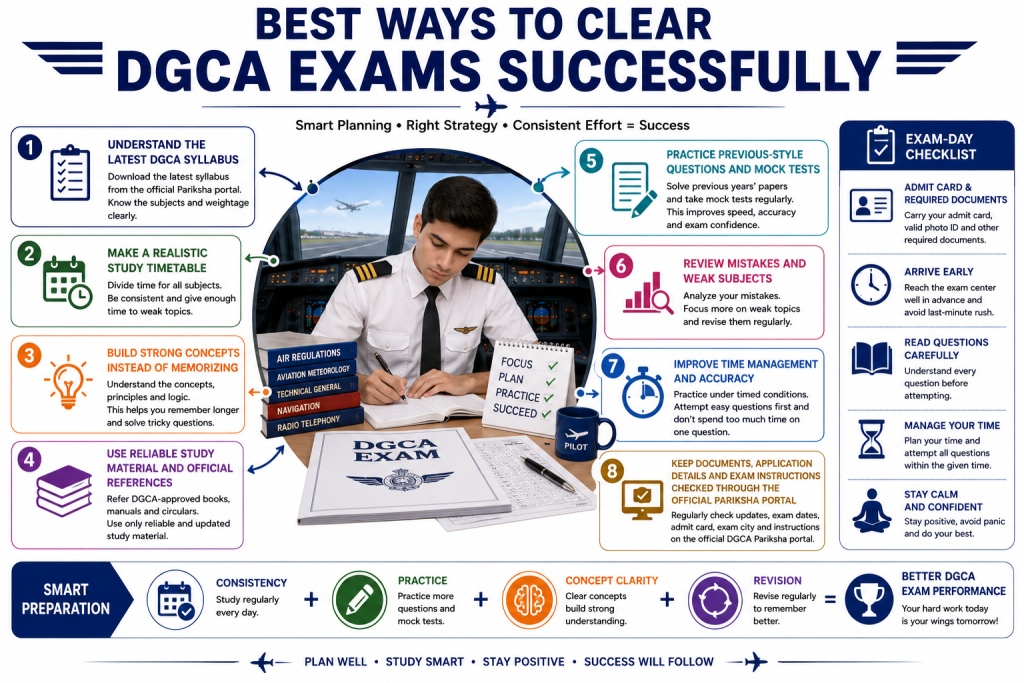
Introduction
Clearing DGCA examinations is an important part of the journey for aspiring pilots in India. While flight training develops practical flying skills, DGCA examinations help students build the theoretical knowledge required to understand aviation, aircraft operations, safety, regulations, and other important subjects.
For many students, the biggest challenge is not simply the amount of material to study. It is knowing where to begin, how to organize the syllabus, which topics require more attention, and how to prepare effectively for the examination.
A good preparation strategy can make the process more manageable. Instead of depending entirely on last-minute study or memorization, students can focus on understanding concepts, practicing questions, revising regularly, and learning from their mistakes.
Understanding DGCA Exams
Before starting preparation, students should understand the examination requirements that apply to their particular pilot training pathway.
The exact subjects, syllabus, examination process, eligibility requirements, and applicable rules can change. Therefore, students should always verify current information through the appropriate DGCA channels and official examination instructions.
Understanding the requirements in advance helps students create a realistic preparation plan.
Students should identify:
- Subjects they need to prepare.
- Current syllabus and examination requirements.
- Topics included in each subject.
- Areas they already understand.
- Topics that require additional study.
- Available examination preparation time.
Having this information at the beginning can prevent confusion later.
Know the Syllabus Before You Start
One of the most useful preparation habits is to understand the syllabus before opening multiple books or starting random question practice.
The syllabus gives students a framework for their preparation. Instead of treating a subject as one large topic, students can divide it into smaller sections.
For example, a student can create separate study areas for:
- Basic concepts.
- Important definitions.
- Rules and procedures.
- Calculations and formulas.
- Technical topics.
- Practical applications.
- Difficult or frequently misunderstood areas.
Breaking the syllabus into smaller sections makes progress easier to measure.
It also helps students identify weak areas early instead of discovering them just before the examination.
Create a Realistic Study Plan
A study plan does not have to be complicated. The most useful plan is one that a student can follow consistently.
Start by deciding how much time is realistically available each day. Then divide the available time between subjects according to their difficulty and the student’s current level of understanding.
A practical study plan can include:
- Daily study targets.
- Weekly subject goals.
- Dedicated revision periods.
- Question-practice sessions.
- Mock examinations.
- Additional time for difficult topics.
Students should avoid creating schedules that require them to study for extremely long hours every day if they cannot maintain that routine.
Consistency is generally more useful than studying intensely for a few days and then losing momentum.
Study the Concepts Instead of Memorizing Everything
Memorization has a place in aviation studies, especially when learning definitions, formulas, facts, or specific information.
However, relying entirely on memorization can make preparation more difficult.
Students should first try to understand the principle behind a topic.
Ask questions such as:
- Why does this rule exist?
- How does this aviation principle work?
- Where would this concept apply during actual flight operations?
- What is the relationship between different parts of the topic?
- Why is a particular answer correct?
Understanding the reasoning behind a concept makes it easier to recall information later.
It can also help students deal with questions that are presented in an unfamiliar way.
Use Reliable Study Materials
The quality of study material matters.
Students may find numerous books, websites, videos, notes, question banks, and discussion forums while preparing for DGCA examinations. However, not every source is equally reliable or up to date.
Useful study resources may include:
- Official information and guidance.
- Standard aviation textbooks.
- Reputable training material.
- Instructor-provided notes.
- Reliable question banks.
- Personal revision notes.
Students should be cautious when using random online material, especially when it contains regulatory information.
If two sources provide different information, students should not simply choose the answer that appears more convenient. They should verify the information using an authoritative source or discuss it with a qualified instructor.
Practice DGCA Questions Regularly
Question practice is an important part of exam preparation.
After studying a topic, students should attempt relevant questions to check whether they can apply what they have learned.
Regular practice can help students:
- Understand how questions are presented.
- Identify weak areas.
- Improve speed.
- Recognize recurring mistakes.
- Become more comfortable with examination conditions.
- Develop better time management.
However, students should not simply memorize question-and-answer combinations.
When an answer is incorrect, take the time to understand why it was wrong and why the correct answer is appropriate.
This approach turns question practice into another learning opportunity.
Focus on Weak Subjects and Topics
It is natural for students to spend more time on subjects they enjoy or understand easily.
The problem is that this can create a false sense of preparation.
A student may feel confident because they perform well in familiar topics while still having significant gaps in difficult areas.
Practice tests can help identify these weaknesses.
Once a difficult topic is identified, students can:
- Review the underlying concept.
- Read the relevant study material again.
- Make a short summary.
- Solve related questions.
- Review mistakes.
- Test themselves again later.
This cycle can gradually turn a weak area into a stronger one.
Make Effective Revision Notes
Good revision notes can save considerable time during the final stages of preparation.
Students do not need to rewrite entire textbooks. Instead, they can create concise notes containing the information they are most likely to need during revision.
Useful notes may include:
- Important definitions.
- Key formulas.
- Important concepts.
- Rules and procedures.
- Short explanations.
- Diagrams.
- Frequently confused points.
- Common mistakes.
Writing information in your own words can also improve understanding.
As preparation progresses, these notes can become a compact revision resource that is easier to review than several large textbooks.
Use Mock Tests as a Progress Check
Mock tests can help students understand how well their preparation is progressing.
A mock examination can reveal problems that may not be obvious during normal study.
For example, a student may understand individual topics but struggle when questions from multiple areas are mixed together.
Mock tests can help identify:
- Knowledge gaps.
- Time-management problems.
- Careless mistakes.
- Frequently confused concepts.
- Topics requiring further revision.
Students should analyze their performance after each mock test rather than focusing only on the score.
The goal is to understand why mistakes happened and prevent them from happening again.
Learn From Your Mistakes
Mistakes are a normal part of exam preparation.
Instead of simply correcting an answer and moving on, students can maintain a mistake log.
A useful mistake log can include:
- The topic involved.
- The question that caused difficulty.
- The answer selected.
- The correct answer.
- The reason the original answer was incorrect.
- The concept that needs to be remembered.
Reviewing this information regularly can reveal patterns.
For example, if a student repeatedly makes mistakes involving the same formula or concept, that topic probably requires additional study.
Improve Time Management During the Exam
Knowing the subject is important, but students also need to manage their examination time effectively.
During the examination, students should read questions carefully and avoid rushing through them.
If a particular question is taking too long, it may be better to move forward and return to it later when the examination format and instructions allow.
Good time management includes:
- Reading each question carefully.
- Understanding exactly what is being asked.
- Avoiding unnecessary overthinking.
- Keeping track of available time.
- Not spending excessive time on one difficult question.
- Reviewing answers when sufficient time remains.
Careless mistakes can sometimes occur simply because a student is rushing.
Avoid Common DGCA Exam Preparation Mistakes
Starting Preparation Too Late
Leaving most of the preparation until the final days can create unnecessary pressure.
Starting earlier provides more time for understanding concepts, practicing questions, and revising difficult areas.
Studying Without Understanding the Syllabus
Without a clear understanding of the syllabus, students may spend too much time on less important areas while overlooking topics that require attention.
Depending Entirely on Memorization
Memorizing answers without understanding the underlying concept can make unfamiliar questions more difficult.
Using Outdated Material
Aviation information, regulations, and examination requirements can change. Students should make sure their study material is current and appropriate for their examination.
Ignoring Difficult Subjects
Avoiding difficult topics does not make them disappear. Students should identify challenging areas early and give them additional attention.
Not Practicing Enough Questions
Reading theory alone does not always prepare students for the experience of answering examination questions.
Regular question practice helps reveal whether the material has actually been understood.
Skipping Revision
Studying a topic once is rarely enough. Regular revision helps students retain information and identify areas that need another review.
Ignoring Mistakes in Mock Tests
A mock-test score is only useful if students learn from the mistakes behind it.
Simply taking one test after another without reviewing errors can limit the benefit of practice.
Trying to Learn Everything at the Last Minute
Last-minute revision can be useful for refreshing familiar information, but it should not replace proper preparation.
Prepare Yourself Mentally and Physically
Exam preparation is not only about books and question banks.
Students also need enough rest and a routine that allows them to study effectively.
Useful habits include:
- Getting adequate sleep.
- Taking short breaks during long study sessions.
- Maintaining a consistent routine.
- Eating regularly.
- Staying appropriately hydrated.
- Avoiding unnecessary distractions.
- Managing examination-related stress.
A tired student may spend several hours studying but retain much less information than expected.
A balanced routine can make study sessions more productive.
What to Do the Day Before the DGCA Exam
The day before the examination should generally be used for controlled revision rather than trying to learn an entire subject from the beginning.
Students can focus on:
- Reviewing concise notes.
- Revising important formulas and concepts.
- Checking commonly confused topics.
- Reviewing previous mistakes.
- Preparing required documents and examination essentials.
- Checking the latest examination instructions.
- Planning travel arrangements.
- Getting adequate sleep.
Trying to cover a large amount of completely new material at the last minute can increase stress without necessarily improving understanding.
What to Do on Exam Day
Exam day is the time to apply the preparation that has already been completed.
Students should arrive prepared and allow enough time for necessary formalities.
During the examination:
- Read the instructions carefully.
- Read each question properly.
- Avoid rushing.
- Manage time throughout the examination.
- Stay calm when encountering difficult questions.
- Follow the permitted procedures for reviewing or changing answers.
- Use remaining time sensibly.
Encountering a difficult question does not necessarily mean that the entire examination is going badly.
Students should remain focused and continue working through the examination systematically.
What If You Do Not Clear the Exam on the First Attempt?
Not clearing an examination on the first attempt can be disappointing, but it does not have to end a student’s progress.
Instead of simply repeating the same preparation strategy, students should analyze what went wrong.
Consider:
- Which topics were difficult?
- Were there knowledge gaps?
- Was time management a problem?
- Were mistakes caused by misunderstanding or carelessness?
- Was the study schedule realistic?
- Was enough question practice completed?
The next preparation cycle should address the specific weaknesses identified from the previous attempt.
A more focused strategy can be more useful than simply increasing the number of study hours.
Frequently Asked Questions
1. How should I start preparing for DGCA exams?
Start by understanding the current syllabus, applicable examination requirements, and subjects relevant to your training pathway. Then divide the syllabus into smaller topics and create a realistic study schedule.
2. How many hours should I study for DGCA exams?
There is no single number of study hours that works for every student. The appropriate amount depends on the subject, existing knowledge, available preparation time, and individual learning pace. Consistent and focused study is more important than simply counting hours.
3. Is it necessary to understand the DGCA syllabus before studying?
Yes. Understanding the syllabus helps students organize their preparation and ensures that important areas are not overlooked.
4. Are mock tests useful for DGCA exam preparation?
Yes. Mock tests can help students identify knowledge gaps, improve time management, become familiar with question formats, and identify recurring mistakes. Their value increases when students carefully review incorrect answers afterward.
5. How can I improve my performance in difficult subjects?
First identify the specific topics causing difficulty. Review the underlying concepts, use reliable study material, make concise notes, practice relevant questions, and test yourself again after revision.
6. Should I memorize aviation formulas and facts?
Some aviation information needs to be remembered, but students should also understand how and why the information is used. Conceptual understanding can make it easier to apply formulas and facts correctly.
7. How can I avoid repeating the same mistakes?
Maintain a mistake log. Record the topic, the error you made, the correct concept, and why your original answer was incorrect. Review this information regularly.
8. What should I do one day before the DGCA exam?
Focus on concise revision rather than trying to learn an entire syllabus. Review important concepts, formulas, difficult areas, and previous mistakes. Also prepare your examination essentials and get adequate rest.
9. How important is revision for DGCA exams?
Revision is essential because it helps reinforce information and identify areas that may have been forgotten. Regular revision throughout the preparation period is generally more useful than relying entirely on last-minute revision.
10. What should I do if I do not clear a DGCA exam on my first attempt?
Review your preparation honestly and identify the reasons for the result. Focus on weak subjects, recurring mistakes, question practice, and time management before preparing for the next attempt.
Conclusion
Clearing DGCA examinations requires more than simply studying for long hours. Effective preparation involves understanding the syllabus, building a realistic study plan, learning concepts, using reliable study material, practicing questions, revising regularly, and learning from mistakes.
Students should also pay attention to their physical and mental well-being during the preparation period. Adequate sleep, reasonable breaks, good time management, and a consistent routine can make studying more sustainable.
Most importantly, students should avoid looking for shortcuts or relying entirely on memorized answers. A structured preparation strategy gives aspiring pilots a better foundation for understanding aviation subjects and approaching examinations with greater confidence.
DGCA examination requirements and regulatory information can change, so students should always verify current requirements and official instructions through the appropriate DGCA sources before making important decisions about their examination preparation.

