
Introduction
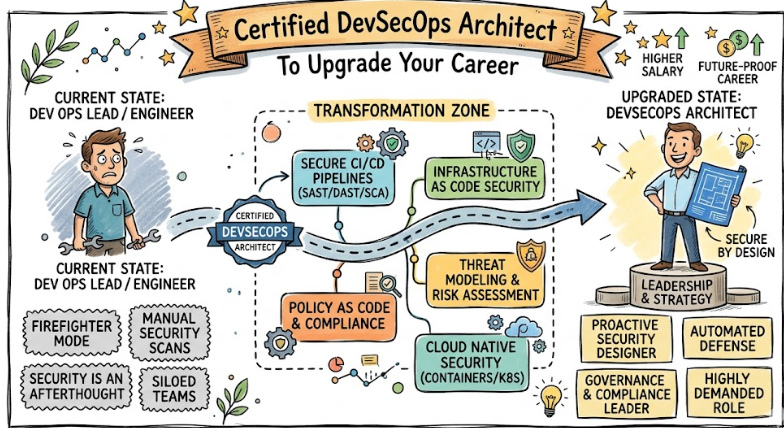
Software teams ship faster than ever, but many still bolt security on at the end. That leads to vulnerable pipelines, misconfigured clouds, and painful audits. The Certified DevSecOps Architect program exists to fix this by teaching you how to design secure‑by‑default DevOps and cloud ecosystems, not just add a few tools.
This guide is written for working engineers and managers in India and globally. It explains the Certified DevSecOps Architect certification in simple terms: what it covers, who should take it, which skills you gain, how to prepare in 7–14, 30, or 60 days, and how it supports long‑term careers in DevOps, security, SRE, AIOps/MLOps, DataOps, and FinOps.
What Is Certified DevSecOps Architect?
The Certified DevSecOps Architect is an advanced, architecture‑level certification from DevSecOpsSchool. It proves that you can design, review, and guide secure DevOps ecosystems across applications, CI/CD pipelines, platforms, and cloud environments.
The program focuses on:
- Moving security from the “end of the pipeline” into every stage of the SDLC.
- Designing secure CI/CD pipelines, cloud platforms, and Kubernetes environments.
- Applying security as code, compliance as code, and risk‑aware architecture decisions.
You learn to think like an architect who balances speed, safety, compliance, and cost in real organisations, not just someone who wires tools together.
Who Should Take Certified DevSecOps Architect?
This certification is aimed at mid‑ to senior‑level professionals who already understand DevOps and cloud and now want to lead security‑driven transformations.
Good target roles:
- Senior DevOps / DevSecOps Engineers.
- SREs and Platform Engineers running production platforms.
- Cloud Engineers and Cloud Architects.
- Security Engineers working closely with DevOps teams.
- Engineering Managers, Tech Leads, and Heads of DevOps/SRE.
Recommended prerequisites:
- Solid DevOps and CI/CD understanding.
- Experience with at least one cloud (AWS/Azure/GCP).
- Basic AppSec concepts (OWASP‑style risks, SAST/DAST/SCA).
- Some exposure to containers, Kubernetes, and Infrastructure as Code.
Certified DevSecOps Architect
What it is
The Certified DevSecOps Architect program proves that you can architect secure DevOps and cloud ecosystems end to end. It goes beyond individual tools and teaches you to design secure pipelines, platforms, and application landscapes where security is built into every layer.
Who should take it
- Senior DevOps / DevSecOps engineers who want to move into architecture roles.
- SREs and platform engineers responsible for secure, reliable platforms.
- Security engineers who want deeper DevOps and cloud context.
- Architects and managers leading DevOps, platform engineering, or security transformation.
Skills you’ll gain
By the end of the program, you should be able to:
- Understand DevOps and DevSecOps culture, roles, and processes.
- Design secure CI/CD pipelines with gates and checks at each stage.
- Use SAST, DAST, SCA, IAST, and secret scanning effectively in pipelines.
- Architect secure container images, registries, and Kubernetes clusters.
- Implement secrets management and secure configuration patterns.
- Secure Infrastructure as Code (Terraform, Ansible, etc.) and cloud resources.
- Perform threat modelling and risk analysis for systems and pipelines.
- Use security as code and compliance as code to automate policy checks.
- Build security dashboards, alerts, and incident response workflows.
Real‑world projects you should be able to do after it
Examples of projects you should handle confidently:
- Design and document a secure CI/CD pipeline that includes SAST, DAST, SCA, and secret scanning and integrates with change management.
- Define an architecture for secure container and Kubernetes deployment with policies, admission controls, and runtime protections.
- Implement a secrets management solution (e.g., Vault‑style) and remove hard‑coded secrets from apps and pipelines.
- Introduce IaC security and policy‑as‑code to block risky Terraform or cloud configuration changes before deployment.
- Build a security health dashboard and alerting system for cloud, pipelines, and applications tied to risk priorities.
Preparation Plan for Certified DevSecOps Architect
7–14 Days – Fast Track
Best if you already work in DevOps and security and just need to structure your knowledge.
- Days 1–2: Refresh DevOps fundamentals, CI/CD stages, and cloud security basics.
- Days 3–4: Focus on DevSecOps concepts, shift‑left patterns, and secure pipeline reference architectures.
- Days 5–7: Practise SAST, DAST, SCA, and secret scanning in at least one full pipeline; document your architecture.
- Days 8–10: Run labs on container and Kubernetes security: images, registries, admission controls, runtime checks.
- Days 11–14: Build 1–2 small end‑to‑end DevSecOps reference architectures and map them to the Architect syllabus.
30 Days – Balanced Plan
Good if you know DevOps and cloud basics but have limited security depth.
- Week 1:
- DevOps + DevSecOps overview: culture, SDLC security touchpoints, shared responsibility models.
- Map your current pipelines and note where security is missing.
- Week 2:
- Application security fundamentals; SAST/DAST/SCA/secret scanning tools and patterns.
- Secrets management, secure configuration, and repository scanning (e.g., git hooks, pre‑commit).
- Week 3:
- Container, Kubernetes, and IaC security (Terraform, Ansible, Helm), plus cloud security controls.
- Introduce policy‑as‑code for pipelines and infrastructure.
- Week 4:
- Threat modelling, risk analysis, and compliance as code; tie into monitoring and incident response.
- Complete a mini‑project: design a secure DevOps architecture for one real or sample product.
60 Days – Deep‑Dive / Transition Plan
Best if you are newer to DevOps or security and want to grow into an architect role.
- Weeks 1–2: Linux, Git, basic CI/CD, and simple application deployments.
- Weeks 3–4: Security basics (OWASP‑style risks, authn/authz, encryption) and SAST/DAST concepts.
- Weeks 5–6: Cloud basics, Docker, Kubernetes fundamentals.
- Weeks 7–8: DevSecOps concepts, pipeline security, secrets management, and scan types.
- Weeks 9–10: IaC and policy‑as‑code, cloud and container hardening patterns.
- Weeks 11–12: Two end‑to‑end DevSecOps architecture projects plus exam revision and practice tests.
Common Mistakes in DevSecOps Architect Preparation
- Focusing only on tools and not on architecture and trade‑offs.
- Ignoring culture and process (ownership, approvals, threat modelling) and staying purely technical.
- Over‑engineering pipelines with too many checks that kill developer productivity.
- Under‑estimating cloud, Kubernetes, and IaC security depth.
- Not practising end‑to‑end design documents and diagrams that explain decisions to managers and auditors.
Best Next Certification After DevSecOps Architect
Based on guidance aligned with Gurukul Galaxy and recent DevSecOps roadmaps:
- Same track (deep DevSecOps)
- Certified DevSecOps Expert / Professional – to go deeper into hands‑on DevSecOps implementation and tool mastery.
- Cross‑track (visibility and reliability)
- Master in Observability Engineering (MOE) – to gain full‑stack visibility and connect security with reliability and SLOs.
- Leadership track
- Engineering Manager Master‑Class / DevOps Architect – to move into head‑of‑engineering or director roles, using your DevSecOps architecture skills to influence strategy and governance.
Choose Your Path: 6 Learning Paths Around DevSecOps Architect
DevOps path
You start with DevOps and CI/CD skills, then use DevSecOps Architect to design secure pipelines and platforms that still enable fast delivery. You become the person who can say “yes, but safely” to new features.
DevSecOps path
Here DevSecOps Architect is your core identity. You combine architecture knowledge with hands‑on DevSecOps Engineer‑level skills to build security‑as‑code patterns, standard reference architectures, and guardrails for all teams.
SRE path
As an SRE, you focus on reliability and availability. DevSecOps Architect adds security architecture to your toolkit so you can make reliability and security trade‑offs explicit and design secure systems that still meet SLOs.
AIOps/MLOps path
In AIOps and MLOps, you run pipelines for data and models. With DevSecOps Architect, you can design secure ML pipelines, protect training data, secure model registries, and integrate security checks into automated operations.
DataOps path
DataOps teams handle sensitive data flows, pipelines, and analytics. DevSecOps Architect helps you design secure data pipelines, implement policy‑as‑code for data access, and manage compliance (like GDPR‑style rules) as part of normal delivery.
FinOps path
Security has a direct cost impact. With DevSecOps Architect plus FinOps skills, you can design architectures that reduce breach risk and audit pain, while explaining and optimising the cost of security controls and tooling.
Role → Recommended Certifications
| Role | Recommended path with DevSecOps Architect |
|---|---|
| DevOps Engineer | DevOps/Cloud fundamentals → DevSecOps Engineer → DevSecOps Architect → cloud/DevOps architect |
| SRE | SRE foundations → DevSecOps Architect → Observability/MOE or SRE leadership programs |
| Platform Engineer | Cloud + Kubernetes → DevSecOps Architect → platform / security architecture certifications |
| Cloud Engineer | Cloud associate → DevSecOps Architect → cloud solutions architect & security tracks |
| Security Engineer | AppSec / cloud security basics → DevSecOps Engineer → DevSecOps Architect → advanced security certs |
| Data Engineer | Data platform basics → DevSecOps‑style data security → DevSecOps Architect / DataOps‑security programmes |
| FinOps Practitioner | Cloud and cost basics → DevSecOps awareness → DevSecOps Architect + FinOps/cost governance |
| Engineering Manager | DevOps & cloud overview → DevSecOps Architect → Engineering Manager / DevOps Architect leadership tracks |
Top Training Partners for Certified DevSecOps Architect
DevSecOpsSchool
DevSecOpsSchool is the primary provider for the Certified DevSecOps Architect program. The training emphasises security‑as‑code, real architecture patterns, and hands‑on labs, led by industry experts with many years in DevOps and security.
DevOpsSchool
DevOpsSchool offers DevOps, cloud, Kubernetes, and security courses that create a strong foundation before or alongside DevSecOps Architect. Many learners use DevOpsSchool for core skills and DevSecOpsSchool for architecture‑focused training.
Cotocus
Cotocus builds structured career paths that combine DevOps, cloud, SRE, and DevSecOps certifications. This is a good option if you want Certified DevSecOps Architect as part of a multi‑step journey to platform or security architecture roles.
Scmgalaxy
Scmgalaxy focuses on practical DevOps and automation with real project scenarios. Its content helps connect DevSecOps architecture ideas with CI/CD, container, and infrastructure pipelines in everyday work.
BestDevOps
BestDevOps curates DevOps and cloud‑native courses where security and DevSecOps topics can be layered on top. It is useful for practitioners who want a balanced mix of hands‑on engineering and high‑level architecture learning.
sreschool.com
SRESchool specialises in SRE, reliability, and observability. Its learning paths complement DevSecOps Architect by helping you design platforms that are both secure and reliable, with well‑defined SLOs and incident practices.
aiopsschool.com
Focuses on AIOps and MLOps certifications and training, including AIOps Foundation, Certified AIOps Engineer/Professional/Architect/Manager, plus MLOps tracks. It is aimed at people who want to use AI and ML to automate IT operations, observability, and predictive analytics.
dataopsschool.com
Dedicated to DataOps training, certifications, and consulting for data, ML, and analytics teams. It helps organisations build reliable, high‑velocity data platforms using DevOps and SRE principles such as automation, observability, and continuous improvement.
finopsschool.com
Specialises in FinOps certification and training for cloud cost management and financial accountability. It offers courses like FinOps Architect, Engineer, Manager, and Professional to help engineers and leaders align cloud spend with business value using dashboards, policies, and continuous optimisation.
FAQs – Certified DevSecOps Architect
- Is Certified DevSecOps Architect very difficult?
It is an advanced program that expects you to already understand DevOps, cloud, and basic security; with structured study and projects it is challenging but realistic for experienced professionals. - How long should I plan to prepare?
Many engineers spend 6–12 weeks combining theory, labs, and at least one or two end‑to‑end architecture projects before they feel confident. - Do I need to be a security expert first?
You don’t need to be a pure security specialist, but you should know fundamental AppSec and cloud security concepts; DevSecOps Architect then adds architecture depth and patterns. - How is DevSecOps Architect different from DevSecOps Engineer?
DevSecOps Engineer is more implementation‑focused (tools and pipelines), while DevSecOps Architect focuses on designing overall secure ecosystems, making trade‑offs, and guiding multiple teams. - Is this certification valuable for managers?
Yes, it helps managers understand what “good” secure pipelines and platforms look like, how to ask the right questions, and how to support security‑by‑design across teams. - Can a developer benefit from DevSecOps Architect?
Senior developers and tech leads benefit a lot, especially if they are responsible for system design or want to move into architecture or security leadership. - What is the main career benefit?
It positions you as someone who can make architecture‑level security decisions in DevOps and cloud environments, which is highly valued for lead engineer, architect, and head‑of‑DevSecOps roles. - Does this certification focus only on one toolset?
No, the emphasis is on patterns and architectures; tools like SAST, DAST, SCA, Vault, Kubernetes security, and IaC scanners are used as examples, not the only options. - How does it relate to cloud provider security certifications?
Cloud security certs go deep on one vendor; DevSecOps Architect sits above that, showing how to design secure pipelines and patterns that can work across clouds and tools. - Is self‑study enough, or do I need guided training?
Self‑study is possible if you have strong experience and good discipline, but most professionals find that structured courses, labs, and reviews accelerate their progress. - What sequence should I follow with other DevSecOps certifications?
A typical route is: DevOps/Cloud fundamentals → DevSecOps Engineer/Professional → Certified DevSecOps Architect → leadership or specialised security certifications. - How does this compare to other “top” security or DevOps certifications?
Many certifications focus either on pure security or pure DevOps; DevSecOps Architect specifically targets the intersection, where secure architecture and fast delivery meet, which is a key gap in many organisations.
Conclusion
The Certified DevSecOps Architect program is designed for professionals who want to move from “adding security tools” to designing secure DevOps and cloud ecosystems end to end. It combines secure SDLC, pipeline security, cloud and Kubernetes hardening, IaC security, and compliance as code into a practical, architecture‑level view of modern software delivery.
For working engineers and managers in India and across the world, this certification fits naturally into longer paths in DevOps, DevSecOps, SRE, AIOps/MLOps, DataOps, and FinOps, and pairs well with cloud, observability, and leadership‑oriented credentials. If you want to be the person who can say, “Yes, we can move fast—and stay secure,” Certified DevSecOps Architect is a strong, future‑ready choice.

