
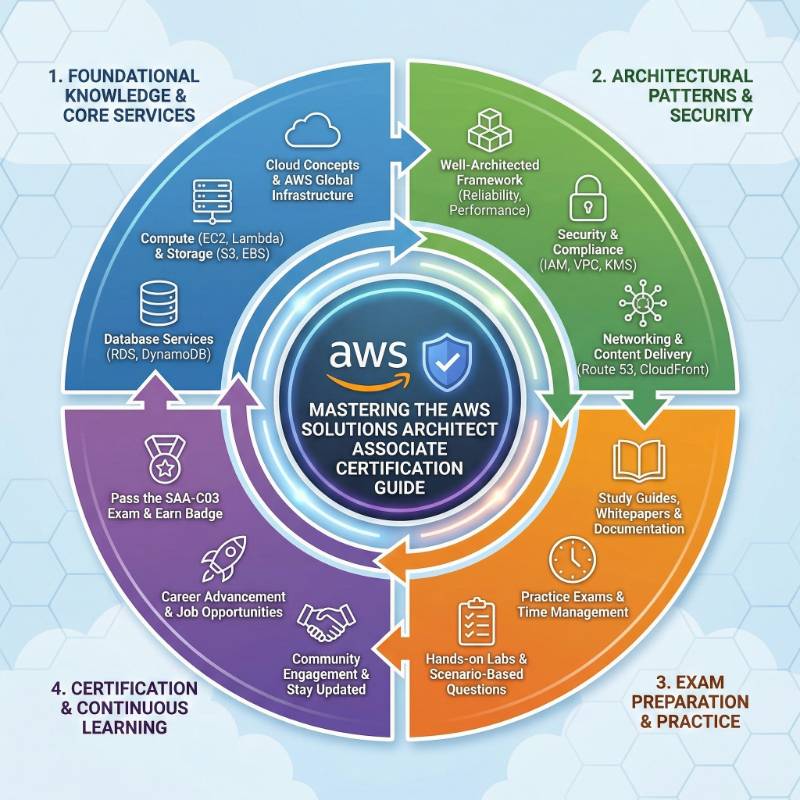
Introduction
Having worked in the technology industry since the days when we had to manually rack and stack physical servers in cold data centers, I have seen many trends come and go. One thing that has stayed constant is the need for solid architecture. In today’s world, that architecture lives in the cloud.
For working engineers and managers, especially those in fast-growing tech hubs in India and across the globe, the AWS Certified Solutions Architect – Associate (CSAA) is the most important credential you can hold. It isn’t just a badge; it is a proof that you understand how to build systems that don’t break when traffic hits or when a data center goes down.
In this guide, I will break down everything you need to know about this certification, how to prepare for it, and where it can take your career.
The AWS Certification Landscape
Before you jump into one specific exam, you need to see the big picture. AWS has structured its certifications to help you grow from a beginner to a specialized expert. Here is a breakdown of the primary tracks available today.
| Track | Level | Who it’s for | Prerequisites | Skills Covered | Recommended Order |
| Cloud Foundations | Foundational | Freshers, Sales, Non-tech Managers | None | Basic Cloud, Billing, Security | 1st |
| Architecting | Associate | Software Engineers, Architects | Basic AWS knowledge | Designing Resilient Systems | 2nd |
| Developing | Associate | Software Developers | Programming skills | CI/CD, SDKs, Serverless code | 3rd |
| Operations | Associate | SysAdmins, SREs | Admin experience | Automation, Monitoring, Governance | 3rd |
| Architecting | Professional | Senior Architects, Leads | CSAA recommended | Complex Migrations, Multi-account | 4th |
| DevOps | Professional | DevOps/SRE Leads | Developer or SysOps Assoc. | SDLC Automation, High Availability | 4th |
| Specialty | Specialty | Security/Data Experts | Associate Level cert | Security, Data, Machine Learning | 5th |
| Data Engineer | Associate | Data Engineers | SQL/Data basics | Data Pipelines, Storage, Analytics | 2nd or 3rd |
Deep Dive: AWS Certified Solutions Architect – Associate
This is the “bread and butter” certification of the AWS world. It is the one that most hiring managers look for because it covers the widest range of practical knowledge.
What it is
The AWS CSAA validates your ability to design and deploy robust and secure applications on AWS. It focuses on the Well-Architected Framework, which is a set of rules for building systems that are cost-effective, secure, and reliable. It’s not about memorizing buttons; it’s about solving business problems with cloud tools.
Who should take it
- Software Engineers who want to understand the infrastructure where their code lives.
- Engineering Managers who need to validate technical decisions and manage cloud costs.
- System Administrators moving from physical or virtualized local servers to the cloud.
- Solutions Architects who need an industry-standard credential to prove their skills to global clients.
Skills you’ll gain
- Network Design: You will learn how to build Virtual Private Clouds (VPC) that keep your data safe.
- Scaling: Understanding how to use Auto Scaling and Load Balancers so your app handles millions of users.
- Storage Strategy: Learning when to use S3, EBS, or EFS based on speed and cost requirements.
- Database Management: Knowing the difference between SQL (RDS) and NoSQL (DynamoDB) and when to use each.
- Serverless Computing: Using AWS Lambda to run code without managing any servers.
Real-world projects you should be able to do
- High-Availability Web App: Build a website that stays online even if an entire AWS data center goes offline.
- Data Migration: Move a large company database from a local server to the AWS cloud with zero data loss.
- Cost-Efficient Backup: Set up an automated system to back up company files to S3 Glacier for long-term storage at a very low cost.
- Static Website Hosting: Use S3 and CloudFront to host a fast website globally without using any servers.
Preparation Plan
- 7–14 Days (Fast Track)
- Days 1–2: Exam style + IAM (roles, policies, least privilege, MFA)
- Days 3–4: VPC (subnets, routing, IGW/NAT, SG vs NACL, endpoints basics)
- Days 5–6: Compute (EC2, scaling, ALB/NLB, serverless basics)
- Days 7–8: Storage (S3 classes/lifecycle/encryption, EBS vs EFS)
- Days 9–10: Databases (RDS/Aurora, Multi-AZ, replicas, DynamoDB basics)
- Days 11–12: HA/DR + monitoring + security + cost basics
- Days 13–14: 1–2 full mocks + revision of weak topics
- Target: 150–250 practice questions + review mistakes.
- 30 Days (Most Practical)
- Week 1: IAM + VPC fundamentals + daily practice questions
- Week 2: Compute + storage decision patterns + 1 mini lab
- Week 3: Databases + HA/DR + monitoring basics + scenario questions
- Week 4: 3–5 mocks + fix weak areas + final revision sheet
- Target: 300–450 practice questions.
- 60 Days (Deep Confidence)
- Weeks 1–2: Foundations (IAM + VPC)
- Weeks 3–4: Compute + storage + hands-on labs
- Weeks 5–6: Databases + HA/DR + monitoring/logging
- Weeks 7–8: Mocks + revision + 2–3 mini projects
- Target: 500–800 practice questions..
Common Mistakes
- Skipping the Labs:
You cannot pass this exam by just reading. You must build things in the AWS console. - Ignoring IAM:
Many people fail because they don’t understand how permissions (Identity and Access Management) work. - Focusing on One Service:
AWS is an ecosystem. You need to understand how S3, EC2, and RDS work together, not just in isolation.
Best next certification after this
Once you have this, the most logical step is either the AWS Certified Solutions Architect – Professional to go deeper into architecture or the AWS Certified Security – Specialty to focus on the growing demand for cloud security.
Choose Your Path: 6 Specialized Learning Tracks
Architecting is just the start. Based on your career goals, you can take this knowledge into various specialized fields:
- DevOps Path:
Focus on automation. Learn how to use AWS CodePipeline and CloudFormation to deploy code automatically without manual work. - DevSecOps Path:
The “Security First” approach. Learn to integrate GuardDuty, WAF, and Shield into your architecture to block hackers in real-time. - SRE Path:
Site Reliability Engineering. Focus on CloudWatch and X-Ray to monitor your systems and ensure 99.99% uptime. - AIOps/MLOps Path:
Use AWS SageMaker and Rekognition to build and deploy machine learning models that can “see,” “hear,” and “predict” user behavior. - DataOps Path:
Focus on the flow of data. Use AWS Redshift and Glue to build massive data warehouses for business intelligence. - FinOps Path:
The “Money” path. Use AWS Cost Explorer and Budgets to help your company save thousands of dollars on cloud bills.
Role → Recommended Certifications Mapping
If you have a specific job role in mind, here is what your certification journey should look like:
| Role | Recommended Certifications |
| DevOps Engineer | CSAA → SysOps Associate → DevOps Engineer Professional |
| SRE | CSAA → Developer Associate → DevOps Engineer Professional |
| Platform Engineer | CSAA → SysOps Associate → Security Specialty |
| Cloud Engineer | CSAA → Developer Associate → Advanced Networking Specialty |
| Security Engineer | CSAA → Security Specialty → SysOps Associate |
| Data Engineer | CSAA → Data Engineer Associate → Data Analytics Specialty |
| FinOps Practitioner | Cloud Practitioner → CSAA → Business Financials Training |
| Engineering Manager | Cloud Practitioner → CSAA → Solutions Architect Professional |
Next Certifications to Take
After you finish your Associate level, you should look at the broader industry. Based on the latest trends for software engineers, here are three strong options:
- Option 1: Same Track (Deep Dive) AWS Certified Solutions Architect – Professional. This is for those who want to reach the top level of AWS expertise. It covers complex topics like multi-account strategy and large-scale migrations.
- Option 2: Cross-Track (Broadening) Certified Kubernetes Administrator (CKA). Most modern cloud systems run on containers. Knowing AWS is great, but knowing how to manage Kubernetes (EKS) makes you much more valuable in the global market.
- Option 3: Leadership (Management) Project Management Professional (PMP). For those who want to move into Director or VP roles, combining cloud knowledge with professional project management is a winning combination.
Top Training Institutions for AWS Certification
Choosing where to learn is as important as what you learn. Here are the top institutions that provide high-quality training and certification support:
- DevOpsSchool
This is one of the most respected names in the industry. They offer deep-dive training led by experts like Rajesh Kumar. They focus on hands-on labs and real-world scenarios, ensuring you don’t just pass the test but actually know how to work on the job. - Cotocus
Cotocus is known for its customized corporate training and implementation-led learning. They help working professionals bridge the gap between their current skills and what is required for high-level AWS architecture roles. - Scmgalaxy
A massive resource for anyone in the Software Configuration Management and DevOps space. They provide a wealth of community support, technical blogs, and guided paths for cloud certification aspirants. - BestDevOps
This institution focuses on the practical side of cloud operations. Their courses are designed to help you master the tools and techniques needed to succeed in a modern DevOps environment using AWS. - devsecopsschool.com
As security becomes a top priority, this school offers specialized training that integrates security into every layer of the AWS architecture. It is perfect for those aiming for the Security Specialty. - sreschool.com
Focused specifically on Site Reliability Engineering. They teach you how to use AWS services to build reliable, scalable, and observable systems that meet strict Service Level Agreements (SLAs). - aiopsschool.com
For those looking toward the future, this school bridges the gap between AI and Operations. They focus on using machine learning to automate and improve cloud infrastructure management. - dataopsschool.com
This is the place for aspiring Data Engineers. They focus on building data pipelines, managing data lakes, and using AWS analytics services to drive business value. - finopsschool.com
Cloud costs can spiral out of control. This school teaches you the art of Cloud Financial Management, helping you ensure that your AWS architecture is as cost-effective as possible.
General FAQs on Career and Value
1. Is the AWS CSAA exam very difficult?
It is challenging because it is scenario-based. You won’t get questions like “What is S3?” Instead, you get “A company needs to store data that is rarely accessed but must be available in minutes; which storage do you choose?” It requires thinking like an architect.
2. How much time do I need to study if I am working full-time?
Most working engineers find that 1 to 2 hours a day for 6 to 8 weeks is enough. This allows you to balance work and learning without burning out.
3. Are there any prerequisites for this exam?
There are no formal requirements, but I always suggest having a basic understanding of IP addresses, servers, and databases before you start.
4. What is the recommended sequence for AWS exams?
I usually recommend starting with the Solutions Architect – Associate. It gives you the best foundation. After that, you can branch out into Developer or SysOps depending on your daily work.
5. Is this certification worth the money?
Yes. In the current market, certified architects often earn 20-30% more than their non-certified peers. It is also a requirement for many government and enterprise contracts.
6. What are the common career outcomes?
Most people move into roles like Cloud Engineer, Solutions Architect, or Technical Lead. For managers, it provides the authority to lead cloud transformation projects.
7. How long does the certification stay valid?
It is valid for 3 years. After that, you can either retake the exam or take the Professional level exam to renew it automatically.
8. Do I need to know how to code to pass?
You don’t need to be a professional programmer, but you should be able to read simple code snippets and understand concepts like JSON, which is used for AWS policies.
9. Can I take the exam online?
Yes, you can take it from your home or office through an online proctored system. You just need a stable internet connection and a quiet room.
10. What is the passing score for the CSAA?
The passing score is 720 out of 1000. The questions are weighted, so some are worth more than others.
11. How much does the exam cost?
The exam fee is $150 USD. If you pass, AWS usually gives you a 50% discount voucher for your next exam.
12. Will this certification help me if my company uses Azure or Google Cloud?
Yes. The core principles of cloud—like load balancing, networking, and object storage—are the same across all providers. Learning them on AWS makes it very easy to pick up other clouds.
AWS Certified Solutions Architect – Associate Specific FAQs
1. What is the main focus of the current CSAA (SAA-C03) exam?
The current version focuses heavily on four areas: Designing Resilient Architectures, Designing High-Performing Architectures, Designing Secure Applications, and Designing Cost-Optimized Architectures.
2. How many questions are in the exam?
There are 65 questions, and you have 130 minutes to complete them.
3. What is the “Well-Architected Framework”?
It is a set of 6 pillars (Security, Reliability, Efficiency, Cost, Sustainability, and Excellence) that AWS uses to judge if a cloud setup is “good.” You must know these pillars well.
4. How much hands-on experience should I have?
AWS suggests one year of experience, but many people pass with 2-3 months of dedicated hands-on lab practice.
5. Which service should I study the most?
VPC (Networking), EC2 (Computing), S3 (Storage), and IAM (Security) are the most important. If you master these four, you are halfway to passing.
6. Does the exam cover Serverless technology?
Yes, quite a bit. You need to understand when to use AWS Lambda instead of traditional EC2 servers.
7. What is the difference between the Associate and Professional levels?
The Associate level asks “How do we build this?” while the Professional level asks “How do we build this for 50 different departments with complex legal requirements?”
8. Should I use exam dumps to study?
I strongly advise against it. AWS updates its question bank regularly. If you rely on dumps, you might fail when the questions change. Use practice tests that explain why an answer is correct instead.
Conclusion
AWS Certified Solutions Architect – Associate is one of the strongest certifications for engineers and managers who want real cloud architecture skills, not just AWS service knowledge. If you prepare with a clear plan, focus deeply on IAM and VPC, and practice scenario-based questions, you start thinking like an architect—choosing services based on reliability, security, performance, and cost. After passing, don’t stop at the certificate. Build one or two small architecture projects, write down your design decisions, and practice explaining trade-offs like an interview. Then pick your next step based on your path—DevOps for delivery speed, SRE for reliability, DevSecOps for secure automation, DataOps for data workflows, AIOps/MLOps for intelligent operations, or FinOps for cost ownership.

