
Introduction
Google Cloud has become a core platform for applications, data analytics, and AI solutions in many organizations. Companies now expect engineers and leaders to understand how to design, secure, and operate workloads on GCP in a disciplined way.
Professional‑level Google Cloud certifications are built for this purpose. They validate advanced abilities across roles such as architect, DevOps engineer, security specialist, network engineer, and data expert. These credentials signal that you can handle real production responsibilities, not just theory.
This guide explains the Google Cloud Professional Engineer certification family in clear, simple language. You will see what these certifications cover, who should consider them, what skills they build, how to plan your preparation, frequent mistakes, possible learning paths, role‑based suggestions, training options, and key FAQs about difficulty, time, prerequisites, sequence, value, and career impact.
What Do We Mean by “Google Cloud Professional Engineer”?
In this article, Google Cloud Professional Engineer refers to the group of Professional‑level Google Cloud certifications aimed at experienced practitioners. Each certification targets a specific job role, but they all share the same goal: proving that you can work effectively with real workloads on Google Cloud.
Google advises that Professional‑level certifications are suitable for people with solid industry experience and at least a year of hands‑on work with GCP. These are not beginner credentials; they are designed to confirm advanced, practical capability.
Main Google Cloud Professional‑Level Certification Tracks
There are multiple Professional‑level certifications under the Google Cloud umbrella. Key options include:
- Professional Cloud Architect
- Professional Cloud Developer
- Professional Cloud Security Engineer
- Professional Cloud Network Engineer
- Professional Cloud DevOps Engineer
- Professional Data Engineer
- Professional Machine Learning Engineer
- Professional Cloud Database Engineer
In this master guide, we look at these as a group so you can understand the overall landscape and then decide which specific track to pursue next.
Who Should Target Google Cloud Professional‑Level Certifications?
These certifications are designed for professionals who already have some cloud exposure or want to move into more senior cloud roles. They are particularly relevant for:
- Software and Cloud Engineers building services on GCP
- DevOps Engineers and SREs driving delivery and reliability
- Security, Network, and Data Engineers working with Google Cloud
- Architects and Platform Engineers designing shared platforms
- Engineering Managers who need technical depth in GCP environments
If your work touches GCP today or will do so soon, a Professional‑level certification helps you stand out as someone trusted with complex, business‑critical systems.
Core Skills Gained Across Professional Tracks
While each Professional certification focuses on a different role, they share several core skill themes.
- Architecture and solution design
- Turn business goals into practical architectures on GCP
- Select the right services for compute, storage, networking, and data
- Plan for security, reliability, performance, and cost from the start
- Implementation and automation
- Deploy and manage resources using scripts or infrastructure‑as‑code tools
- Build and refine CI/CD pipelines where relevant to the role
- Integrate GCP services and third‑party components cleanly
- Operations and reliability
- Use Cloud Operations to track metrics, logs, and traces
- Configure alerts and dashboards for healthy operations
- Handle incidents and improve systems based on what you learn
- Security and governance
- Apply IAM, VPC security, and encryption tools correctly
- Design for least privilege, segmentation, and compliance
- Support auditing and regulatory requirements in the cloud
- Optimization and continuous improvement
- Spot and fix performance bottlenecks
- Reduce unnecessary spend without breaking SLAs or UX
- Evolve architectures as scale and business needs change
What It Is
A Google Cloud Professional‑level certification confirms that you can perform advanced tasks for a specific role on GCP, such as Architect, DevOps Engineer, or Data Engineer. It tests your ability to design, build, secure, and run solutions in real‑world scenarios, not just memorize features.
Who Should Take It
- Engineers already building or operating workloads on GCP
- Professionals who have moved beyond fundamentals and want proof of higher‑level skill
- Architects and technical leads guiding cloud initiatives
- Managers seeking stronger technical grounding to support teams and decisions
Skills You’ll Gain
- Deeper understanding of GCP services relevant to your role
- Confidence in designing and evaluating cloud solutions
- Stronger ability to automate, monitor, and optimize workloads
- Better communication when explaining trade‑offs to stakeholders
Real‑World Projects You Should Handle Afterward
Post‑certification, you should be ready to:
- Design and document GCP solutions that meet specific business goals
- Lead or actively drive migrations and new cloud projects
- Review existing environments and suggest improvements
- Work across teams to deliver and operate services with fewer surprises
Preparation Plan (7–14 / 30 / 60 Days)
Use this as a generic preparation framework and adjust topics for your chosen Professional track.
7–14 Days: Fast Track (If You Are Already Strong in GCP)
- Days 1–3: Read the exam guide for your chosen certification and refresh key GCP services and patterns for that role.
- Days 4–7: Focused hands‑on practice for each exam domain using labs and scenario‑style exercises.
- Days 8–10: Work through realistic end‑to‑end case studies and practice tying services together.
- Days 11–14: Attempt practice tests under time pressure and deeply review any wrong or uncertain answers.
30 Days: Balanced Plan for Working Professionals
- Week 1: Refresh GCP basics (resource hierarchy, IAM, compute, storage, networking).
- Week 2: Dive into the main domains for your target exam (for example, architecture design, dev operations, data modeling, or security controls).
- Week 3: Do structured labs and small projects to apply what you have learned.
- Week 4: Solve case‑study questions, work on exam‑style questions, and refine weak areas.
60 Days: Deep Plan (If You Are Newer to GCP or the Role)
- Month 1: Build a strong foundation in GCP basics plus general Linux, networking, and cloud architecture ideas.
- Month 2: Cover all exam domains methodically, complete several small end‑to‑end projects, and take multiple practice exams with detailed post‑analysis.
Common Mistakes When Preparing
- Booking the exam before having enough real or lab experience on GCP.
- Ignoring the official exam guide and focusing only on random topic lists.
- Relying purely on video content without doing hands‑on work.
- Treating case‑study questions as purely technical, instead of considering business goals and trade‑offs.
- Avoiding timed practice questions and then getting surprised by the exam format and time pressure.
Best Next Certification After a Professional‑Level GCP Exam
Based on common certification strategies for software professionals:
- Staying in the same track (deeper expertise):
- Choose another Professional‑level certification in a closely related area to strengthen your profile in that vertical (for example, Architect plus Security).
- Expanding across tracks (wider skill set):
- Add a Professional‑level certification from a nearby domain to cover more of the lifecycle (for example, DevOps plus Data or Architect plus DevOps).
- Moving into leadership (architecture and strategy):
- Focus on architecture‑oriented certifications and leadership‑focused learning that help you design systems and mentor teams at scale.
Choose Your Path: Six Learning Paths
DevOps Path
In this path, you combine a Professional‑level GCP certification with advanced skills in CI/CD, automation, containers, and infrastructure as code. You become responsible for end‑to‑end delivery pipelines and runtime environments on Google Cloud.
DevSecOps Path
In the DevSecOps path, you apply Google Cloud security controls, policies, and automation inside your delivery process. You integrate security checks and guardrails into pipelines and platforms so that security moves at the same speed as development.
SRE Path
In the SRE path, you apply SLOs, SLIs, and error budgets to workloads on GCP. Professional‑level skills help you design systems that remain reliable while still evolving quickly and help you handle incidents calmly and effectively.
AIOps / MLOps Path
In the AIOps and MLOps path, you focus on ML and data‑driven systems. Google Cloud Professional‑level skills let you build robust pipelines for training, serving, and monitoring ML models and data flows.
DataOps Path
In the DataOps path, you manage the lifecycle of data platforms and pipelines. Professional‑level certifications in data, DevOps, or architecture help you ensure these systems are reliable, observable, secure, and easy to change.
FinOps Path
In the FinOps path, you prioritize cost, value, and governance. Deep technical understanding from Professional‑level certifications helps you design architectures and operations that deliver business value without uncontrolled cloud spending.
Role → Recommended Certifications Mapping
| Role | How Professional‑level GCP certs help | Recommended move after first Professional‑level cert |
|---|---|---|
| DevOps Engineer | Strengthens automation, pipeline, and operations skills on GCP | Add Architect or Security‑oriented certifications for broader control and influence |
| SRE | Deepens reliability and observability capabilities on GCP | Combine with Architect and sometimes Security for end‑to‑end resilience and risk coverage |
| Platform Engineer | Helps design and run shared platforms consumed by many teams | Move toward Architect and Network / Security Professional tracks |
| Cloud Engineer | Upgrades from basic provisioning to lifecycle ownership | Grow into Architect or DevOps Professional certifications |
| Security Engineer | Enables security design and governance at cloud scale | Pair with Architect and DevOps to shape secure systems and processes |
| Data Engineer | Supports secure, reliable data and analytics platforms | Add Data, ML, or Architect Professional certifications to strengthen impact |
| FinOps Practitioner | Clarifies technical factors behind cloud cost and value | Mix with Architect‑type credentials to support governance and cost decisions |
| Engineering Manager | Improves technical insight into how teams build and run on GCP | Combine Architect and DevOps/SRE tracks for strong leadership foundations |
Leading Institutions for Google Cloud Professional Engineer Preparation
DevOpsSchool
DevOpsSchool delivers structured training for cloud and DevOps roles, including Google Cloud‑focused programs. Their approach typically blends live teaching, guided labs, real case studies, and interview preparation, so learners can connect certification topics with day‑to‑day work.
Cotocus
Cotocus provides consulting and training around DevOps and cloud adoption. For Professional‑level GCP paths, they help participants understand how exam concepts map to actual migration, modernization, and platform programs inside organizations.
Scmgalaxy
Scmgalaxy specializes in CI/CD, configuration management, and DevOps tooling. This is valuable for candidates targeting Professional roles that require strong automation and pipeline expertise on GCP, such as DevOps Engineer or Architect.
BestDevOps
BestDevOps builds community and knowledge across the broader DevOps ecosystem. When you are preparing for Professional‑level GCP certifications, this network helps with shared experiences, patterns, and peer learning.
devsecopsschool.com
devsecopsschool.com focuses on secure software delivery and DevSecOps culture. Combining this with Professional‑level GCP preparation helps you design delivery and platform patterns where security is integrated from the start.
sreschool.com
sreschool.com is dedicated to Site Reliability Engineering practices. Together with a GCP Professional track, this helps you apply SRE ideas more effectively on Google Cloud, from setting SLOs to running postmortems.
aiopsschool.com
aiopsschool.com trains engineers in AIOps and automation‑driven operations. When combined with Professional‑level GCP skills, you can build smarter, more automated operations pipelines driven by telemetry and machine learning.
dataopsschool.com
dataopsschool.com focuses on the DataOps world—data pipelines, quality, and governance. This aligns well with Professional‑level GCP paths for data and architecture, helping you deliver reliable, compliant data platforms.
finopsschool.com
finopsschool.com centers on FinOps and cloud financial management. Paired with Professional‑level GCP knowledge, this allows you to design and govern solutions that balance cost, performance, and risk.
FAQs on Google Cloud Professional Engineer Certifications
1. How challenging are Google Cloud Professional‑level exams?
They are advanced‑level exams. Google recommends significant industry experience plus solid time working with GCP, so they expect strong applied knowledge rather than basic familiarity.
2. How much preparation time is usually needed?
Most working professionals spend anywhere from several weeks to a few months preparing, depending on background, role, and how many hours per week they can study.
3. Do these exams have official prerequisites?
There are no formal exam prerequisites, but you should have firm GCP fundamentals and real project or lab experience before attempting a Professional‑level certification.
4. What is a sensible sequence for Google Cloud certifications?
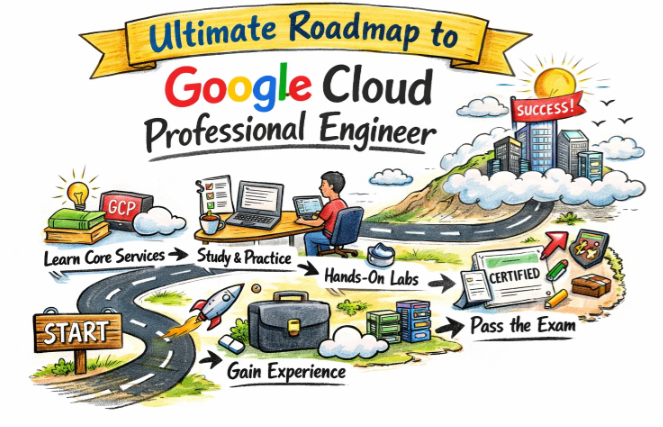
A common approach is: learn GCP fundamentals → gain some practical experience → take your first Professional‑level exam in your main role → optionally add another Professional or cross‑domain certification afterward.
5. Are these certifications useful for software developers?
Yes. They help developers understand how their code runs in production on GCP—deployment, scaling, security, and observability—which is essential for modern engineering teams.
6. What kind of career benefit can I expect?
Professional‑level certifications show that you can handle high‑impact responsibilities on Google Cloud. This often supports progression into senior engineer, lead, architect, or manager roles.
7. Is it realistic to prepare while working full‑time?
It is. Many people follow a 30‑ or 60‑day plan, combining short study sessions with labs and practice questions, without needing a full‑time study break.
8. What if I skip practical labs and do only theory?
Skipping hands‑on work is risky. Scenario‑based and case‑study questions are easier when you have actually tried the services, so labs and small projects are vital for real understanding.
9. Are these certifications still helpful if my current company is not on GCP?
Yes. They are most valuable if you work with GCP, but many concepts—architecture patterns, reliability, security, and cost awareness—translate well to other cloud providers too.
10. Will Google Cloud Professional‑level credentials remain relevant?
As organizations keep investing in cloud solutions, advanced GCP skill will remain important. Google also updates exam content as services and best practices evolve.
11. Do these certifications help with technical leadership positions?
They do. Professional‑level knowledge gives you the depth needed to guide architecture decisions, review designs, and support teams as a tech lead, architect, or manager.
12. How do they compare to other software engineering certifications?
Many certifications focus narrowly on coding or individual tools. Google Cloud Professional‑level certifications validate wider abilities across design, security, operations, and optimization on a major cloud platform.
Conclusion
Google Cloud Professional‑level certifications are a strong way to show that you can really work with GCP in real projects, not just learn it from books. For engineers, managers, and software developers, they give a clear step‑by‑step path from basic cloud skills to owning important systems and platforms with confidence.
If you follow a simple study plan, do regular hands‑on labs, and take help from good training providers, these certifications can support your long‑term growth in DevOps, SRE, architecture, data, security, and cloud leadership roles.

