
Introduction
Cloud adoption is now standard, but managing that cloud infrastructure reliably and at scale is still a major challenge for most teams. Infrastructure as Code (IaC) solves this by turning infrastructure into versioned, testable, and reviewable code instead of ad‑hoc console clicks.
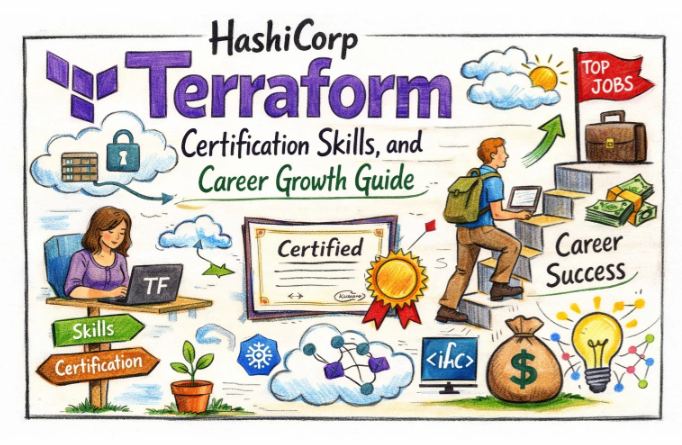
HashiCorp Terraform is one of the most widely used IaC tools in modern DevOps, SRE, and platform engineering teams. A focused Terraform training and certification journey helps you build confidence, prove your capability to employers, and create a structured roadmap for your cloud and automation career.
A Quick Primer on HashiCorp Terraform
Terraform is a tool that lets you define your infrastructure using configuration files and then apply those definitions to real cloud environments. You use a language called HCL (HashiCorp Configuration Language) to describe what you want—networks, instances, databases, security, and more.
Terraform then takes these configurations, compares them with the current state of your infrastructure, and generates an execution plan. With a single apply, it can create, update, or remove resources consistently across one or many providers (AWS, Azure, GCP, and others). This brings repeatability, traceability, and collaboration to infrastructure changes.
Overview of HashiCorp Terraform Training and Certification
This HashiCorp Certified: Terraform Associate certification validates that you understand how Terraform works, why IaC matters, and how to apply Terraform to real projects. Training providers like DevOpsSchool package the exam syllabus with lab-heavy courses, practice questions, and guided projects to help you move from “knowing the theory” to “using it in real life.”
HashiCorp Certified: Terraform Associate
What this certification is about
The HashiCorp Certified: Terraform Associate exam checks whether you can work confidently with Terraform in practical scenarios. It goes beyond memorizing commands and asks if you understand how Terraform fits into real-world infrastructure delivery.
The exam blueprint spans key areas like IaC concepts, Terraform configuration syntax, providers and resources, modules, state and backends, workspaces, and Terraform Cloud/Enterprise features. Passing it signals that you can design and manage infrastructure safely and consistently using Terraform.
Who should consider this certification
- DevOps and platform engineers who build and maintain environments for development and production.
- Site Reliability Engineers (SREs) who care about reliable, repeatable changes and disaster‑ready infrastructure.
- Cloud engineers responsible for provisioning resources across AWS, Azure, GCP, or hybrid setups.
- Security, Data, and FinOps practitioners who need predictable, auditable infrastructure definitions and policies.
- Engineering managers and tech leads who want a solid understanding of Terraform and IaC to guide architecture and team skills.
Capabilities you will develop
- Strong grasp of why Infrastructure as Code is essential and how Terraform implements it.
- Comfort writing and organizing HCL configurations using variables, outputs, and modules.
- Fluency in the Terraform lifecycle: initialize, format, validate, plan, apply, and destroy.
- Understanding of providers, resources, and data sources for different clouds and services.
- Effective state management, including remote backends, locking, and workspace strategies.
- Familiarity with Terraform Cloud/Enterprise concepts for collaboration, policy, and governance.
Real-world tasks you should be able to handle
- Design and implement network topologies (VPCs, subnets, routing, firewalls/security groups) as Terraform code.
- Provision a full application stack (compute, database, load balancer, DNS, and monitoring) using Terraform.
- Set up and manage remote state with proper separation for development, staging, and production.
- Express IAM roles, policies, and other security primitives as code to avoid manual drift.
- Integrate Terraform into CI/CD pipelines to automate infrastructure changes with peer review and approvals.
How to Prepare: 7–14 / 30 / 60‑Day Plans
Your preparation plan should match your starting point and your schedule.
7–14 Day Intensive Plan
Great for experienced cloud or DevOps engineers who already touch Terraform:
- Review the official exam objectives and map them to your current skills.
- Use an intensive training program or focused content that emphasizes labs and scenario-based learning.
- Build or refresh 2–3 complete environments using Terraform, covering network, compute, and security.
- Take multiple mock exams to calibrate your thinking to how questions are asked and timed.
30 Day Standard Plan
Suitable for engineers with cloud exposure but fresh to Terraform:
- Week 1: Build foundations—Linux basics, Git workflows, cloud concepts, and IaC principles.
- Week 2: Learn HCL structure, variables, locals, outputs, and resource relationships.
- Week 3: Dive into providers, modules, state, backends, and workspaces; practise multi‑environment design.
- Week 4: Explore Terraform Cloud, revise each exam domain, and complete several mock exams and lab reviews.
60 Day Deep-Dive Plan
Ideal for career changers or leaders who want broad, solid understanding plus hands‑on practice:
- Month 1: Strengthen fundamentals in networking, cloud services, version control, DevOps concepts, and shell usage.
- Month 2: Build complex Terraform projects (multi‑region, multi‑environment), master modules, remote state, and CI/CD integration, then revise and take practice tests.
Common Pitfalls to Avoid
- Treating Terraform as a purely academic topic instead of writing and applying real configurations.
- Ignoring state, remote backends, and workspaces until the end, even though they are central to exams and real work.
- Relying only on notes or slide decks and skipping labs, which leads to weak practical understanding.
- Focusing on command memorization rather than understanding how Terraform calculates and applies plans.
- Not reviewing the official exam blueprint and spending time on topics that are low priority or out of scope.
Smart Next Steps After Terraform Associate
Once you have the Terraform Associate credential, you can strengthen your profile in three main ways.
1) Deepen within the same track
- Pick a cloud associate certification (AWS, Azure, or GCP) so you combine IaC competence with cloud‑platform depth.
- Add Docker/Kubernetes certifications to position yourself for platform and container‑oriented roles.
2) Expand across complementary tracks
- Move into DevSecOps or cloud security certifications to integrate security controls and policy as code into your Terraform workflows.
- Explore data and analytics certifications if you want to specialize in data platforms and analytical infrastructure.
3) Grow into architecture and leadership
- Aim for cloud architect or solutions architect credentials focused on system design, governance, and trade‑offs.
- Consider SRE or observability-focused programs that emphasize reliability, resilience, and service-level thinking.
Choose Your Path: Six Terraform-Based Learning Routes
Terraform can be the common basis for several specialized career paths. Here’s how to frame it.
DevOps Path
- Terraform Associate → Cloud associate → Docker/Kubernetes.
- Focus: CI/CD pipelines, environment automation, standardized development and production setups.
DevSecOps Path
- Terraform Associate → DevSecOps/cloud security certifications.
- Focus: security as code, policy‑as‑code, compliance automation, integration of security tools with Terraform and pipelines.
SRE Path
- Terraform Associate → SRE/observability/monitoring certifications.
- Focus: reproducible infrastructure, SLO/SLA/SLE thinking, incident response, capacity planning.
AIOps / MLOps Path
- Terraform Associate → cloud data/ML certifications.
- Focus: provisioning ML platforms, monitoring ecosystems, and data pipelines to support intelligent operations and automation.
DataOps Path
- Terraform Associate → data engineer or analytics certifications.
- Focus: defining warehouses, data lakes, pipeline infrastructure, and governance patterns as code.
FinOps Path
- Terraform Associate → FinOps or cost-optimization training.
- Focus: tagging strategies, budgets, quotas, and cost controls implemented in Terraform to align technical usage with financial goals.
Mapping Roles to Recommended Certifications
Use this table to quickly align Terraform with your current or target role.
| Role | Core Terraform Certification | Recommended Supporting Certifications |
|---|---|---|
| DevOps Engineer | Terraform Associate | Cloud associate, Docker/Kubernetes, CI/CD & DevOps credentials |
| SRE | Terraform Associate | SRE/observability, cloud associate, monitoring & incident response programs |
| Platform Engineer | Terraform Associate | Kubernetes admin, cloud architect, security/DevSecOps certifications |
| Cloud Engineer | Terraform Associate | Cloud associate/professional, networking and security specializations |
| Security Engineer | Terraform Associate | DevSecOps, cloud security, application security-focused certifications |
| Data Engineer | Terraform Associate | Cloud data engineer/analytics certifications, big‑data platform credentials |
| FinOps Practitioner | Terraform Associate | FinOps or cloud cost optimization, cloud architect or admin programs |
| Engineering Manager | Terraform Associate | Cloud architect, SRE/DevOps leadership and strategy-oriented certifications |
Leading Institutions for Terraform Training and Exam Support
DevOpsSchool
DevOpsSchool delivers structured programs around HashiCorp Terraform training & certification that combine theory, detailed labs, and exam‑oriented practice. Learners get guided support, recorded content, and practical assignments designed to mirror real project environments.
Cotocus
Cotocus powers multiple DevOps and cloud training initiatives, including Terraform‑focused offerings. Their model emphasizes practical exposure, project-style exercises, and interview readiness, helping professionals connect certification content with actual job expectations.
ScmGalaxy
ScmGalaxy offers courses centered around DevOps, SCM, and release automation, with Terraform introduced as a key tool in the automation toolkit. Training shows how Terraform works alongside Git, build systems, configuration management, and deployment pipelines.
BestDevOps
BestDevOps operates as a knowledge and training hub around modern DevOps practices. Terraform is covered as part of a broader push to equip engineers with cloud, container, and IaC skills that match current industry expectations.
devsecopsschool.com
devsecopsschool.com specializes in integrating security into DevOps workflows, making Terraform an important element in building secure-by-default environments. Programs typically demonstrate how to codify security controls, scanning, and compliance rules using IaC and modern toolchains.
sreschool.com
sreschool.com trains professionals on SRE principles and real-world reliability practices. Terraform appears here as a way to consistently create and maintain resilient infrastructure that supports SLOs, error budgets, and robust incident response patterns.
aiopsschool.com
aiopsschool.com focuses on intelligent operations and operational automation. Terraform plays a supporting role by provisioning monitoring stacks, data pipelines, and platforms on which AIOps solutions run, enabling more automated insight and action.
dataopsschool.com
dataopsschool.com focuses on the lifecycle of data systems, from ingestion to analytics. Terraform is highlighted as the tool that turns data infrastructure—warehouses, lakes, and ETL/ELT platforms—into reproducible, governed code.
finopsschool.com
finopsschool.com brings together cloud financial management and engineering practices. Terraform fits here as a way to enforce cost-conscious standards—such as tagging, quotas, and resource policies—at the infrastructure definition level.
FAQs: HashiCorp Terraform Training and Certification
1. What does HashiCorp Terraform training and certification cover?
It covers the full lifecycle of using Terraform in real environments, from basic concepts and HCL syntax to providers, modules, state management, workspaces, and collaboration in Terraform Cloud or Enterprise.
2. How challenging is the Terraform Associate exam?
The exam is approachable with focused preparation and hands‑on practice. Engineers with prior Terraform experience usually find it moderate; newcomers need more deliberate practice but can still succeed with a structured plan.
3. How much study time should I realistically plan for?
Experienced practitioners often need 1–2 weeks of targeted work, while those new to Terraform usually plan for 4–8 weeks, depending on their comfort with cloud, CLI tools, and IaC.
4. Do I need coding experience to use Terraform effectively?
Terraform is configuration-driven rather than fully programmatic, so deep coding skills are not required. Basic familiarity with declarative syntax, variables, and the command line is usually enough to get productive.
5. Which cloud platform should I start with before attempting this certification?
Any major provider is fine. Understanding core ideas—compute instances, networking, access control, storage—is more important than mastering one cloud in depth before you start.
6. How does Terraform training fit into my long-term career?
Terraform training gives you a solid IaC foundation, which you can then extend with cloud, security, SRE, data, or FinOps certifications. It’s a building block for many senior technical paths.
7. Is this certification valuable for engineering managers?
Yes. Managers who understand Terraform and IaC can plan better roadmaps, evaluate technical proposals more accurately, and ensure their teams adopt sustainable infrastructure practices.
8. What kind of practice work should I prioritize?
Focus on end‑to‑end projects: building networks, deploying multi‑tier applications, setting up remote state, managing multiple environments, and integrating Terraform into CI/CD pipelines.
9. Will Terraform remain relevant in the future?
Terraform continues to be widely used due to its strong ecosystem and multi‑cloud support. Even as cloud providers evolve their own IaC tools, Terraform’s provider model and community keep it highly relevant.
10. In which order should I plan Terraform and other certifications?
A practical order is: learn cloud basics → complete Terraform Associate → move into cloud associate/professional levels → add Kubernetes, security, data, or SRE certifications based on your chosen path.
11. What impact can this certification have on my job prospects?
Demonstrating IaC skills with a recognized Terraform certification strengthens your profile for DevOps, SRE, platform, cloud, and related roles. It shows that you can handle infrastructure in a disciplined, repeatable way.
12. Is self-study enough, or should I join a structured course?
Self-study can work if you are disciplined and comfortable designing your own lab exercises. A structured course reduces uncertainty, speeds up learning, and usually gives access to curated labs and practice questions.
Conclusion
HashiCorp Terraform training and certification give working professionals a clear, practical route to mastering Infrastructure as Code and proving those skills in a way the industry recognizes. Whether you are hands-on with infrastructure today or leading teams that depend on it, building Terraform expertise and earning the Terraform Associate credential can anchor your growth across DevOps, SRE, security, data, FinOps, and engineering leadership paths.

