
Introduction
The Certified Site Reliability Professional is a comprehensive validation for engineers who want to master the art of maintaining high-availability systems. This guide is designed for professionals navigating the complexities of DevOps, cloud-native architectures, and platform engineering, where uptime and scalability are non-negotiable. As the industry moves toward automated, self-healing infrastructures, understanding the core tenets of SRE becomes essential for making informed architectural and career decisions. By following the pathways outlined at sreschool, engineers and managers can effectively bridge the gap between development speed and system reliability.
What is the Certified Site Reliability Professional?
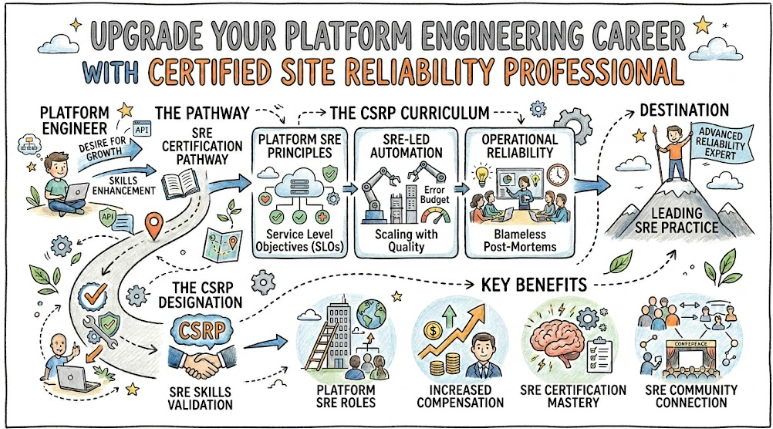
The Certified Site Reliability Professional represents a shift from theoretical knowledge to production-grade competency in modern infrastructure management. It exists to standardize the practices that keep global digital services running, focusing on the intersection of software engineering and systems administration. Unlike traditional certifications that focus on a single tool, this program emphasizes the principles of error budgets, service level objectives, and toil reduction. It aligns directly with modern enterprise workflows by treating operations as a software problem, ensuring that practitioners can handle the scale and complexity of cloud-native environments.
Who Should Pursue Certified Site Reliability Professional?
This certification is highly beneficial for DevOps engineers, systems administrators, and cloud architects who are responsible for the stability of production environments. It also provides significant value to security and data professionals who must ensure their specialized pipelines are resilient and scalable. For beginners, it offers a structured roadmap into the high-demand field of reliability engineering, while experienced seniors and engineering managers gain a framework for leading large-scale technical teams. Whether you are working within the growing tech hubs of India or for a global enterprise, this credential proves you can handle mission-critical systems.
Why Certified Site Reliability Professional is Valuable and Beyond
The demand for reliable digital services continues to grow as businesses move more core functions to the cloud, making SRE skills some of the most sought-after in the industry. This certification ensures longevity in a professional’s career because it teaches foundational principles that remain relevant even as specific tools and cloud providers evolve. By mastering the ability to balance feature velocity with system stability, engineers provide a high return on investment for their organizations. Ultimately, pursuing this path helps professionals stay ahead of the curve, shielding them from the volatility of short-term tech trends through deep architectural expertise.
Certified Site Reliability Professional Certification Overview
The program is delivered via the Certified Site Reliability Professional and is hosted on sreschool. It utilizes a multi-tiered assessment approach that combines theoretical understanding with practical, scenario-based evaluations. The certification is structured to cater to different stages of professional growth, ensuring that the ownership of the learning process remains with the practitioner. By focusing on practical application rather than rote memorization, the structure prepares candidates for the actual challenges they will face in high-pressure production environments.
Certified Site Reliability Professional Certification Tracks & Levels
The certification is divided into Foundation, Professional, and Advanced levels to mirror the typical career progression of a technical expert. The Foundation level introduces the core vocabulary and concepts, while the Professional level focuses on implementing SRE practices within specialized tracks like DevOps or FinOps. Advanced levels are designed for those aiming for principal or architect roles, focusing on organizational-scale reliability and strategy. This tiered approach allows engineers to build a solid base before specializing in niche domains that align with their specific career goals.
Complete Certified Site Reliability Professional Certification Table
| Track | Level | Who it’s for | Prerequisites | Skills Covered | Recommended Order |
| Core SRE | Foundation | Junior Engineers | Basic Linux/Cloud | SLIs, SLOs, Error Budgets | 1 |
| Engineering | Professional | Mid-level DevOps | Foundation Cert | Automation, Monitoring | 2 |
| Operations | Professional | SREs | Foundation Cert | Incident Response, On-call | 3 |
| Strategic | Advanced | Lead Engineers | Professional Cert | Scaling, SRE Culture | 4 |
| Specialized | Expert | Architects | Advanced Cert | Capacity Planning, AIOps | 5 |
Detailed Guide for Each Certified Site Reliability Professional Certification
Certified Site Reliability Professional – Foundation
What it is
This certification validates a candidate’s understanding of basic SRE terminology and the fundamental philosophy of reliability versus feature development.
Who should take it
It is suitable for junior developers, fresh graduates, or traditional systems administrators looking to transition into modern cloud-native roles.
Skills you’ll gain
- Understanding of SLIs, SLOs, and SLAs.
- Knowledge of the SRE Golden Signals (Latency, Traffic, Errors, Saturation).
- Basic understanding of automation and toil reduction.
Real-world projects you should be able to do
- Define and document service level objectives for a simple web application.
- Identify and categorize toil within a weekly operations schedule.
Preparation plan
- 7–14 days: Review official documentation and focus on core vocabulary and SRE definitions.
- 30 days: Read the primary SRE handbooks and participate in community forums to understand conceptual applications.
- 60 days: Complete mock exams and build a simple monitoring dashboard to visualize reliability metrics.
Common mistakes
- Confusing SLAs (legal) with SLOs (technical goals).
- Over-complicating the initial set of metrics.
Best next certification after this
- Same-track option: Certified Site Reliability Professional – Professional
- Cross-track option: DevOps Foundation
- Leadership option: Team Lead Essentials
Choose Your Learning Path
DevOps Path
The DevOps path focuses on the seamless integration of development and operations through the lens of reliability. It emphasizes CI/CD pipeline stability and ensuring that automated deployments do not compromise system integrity. Professionals on this path learn how to build “guardrails” rather than “gates,” allowing for high velocity with minimal risk.
DevSecOps Path
This path integrates security directly into the reliability workflow, treating security vulnerabilities as another form of system instability. It covers automated security scanning within pipelines and the implementation of “Security as Code.” The goal is to ensure that the system is not only up and running but also protected against external threats.
SRE Path
The pure SRE path is dedicated to the deep technical aspects of system uptime and performance optimization. It involves heavy coding for automation, advanced monitoring, and complex incident response strategies. This is the ideal route for those who want to specialize in high-scale infrastructure and distributed systems.
AIOps Path
The AIOps path explores the use of machine learning and artificial intelligence to automate the detection and resolution of IT issues. It focuses on using data-driven insights to predict outages before they occur. This path is perfect for engineers interested in the intersection of data science and systems engineering.
MLOps Path
The MLOps path is designed for those managing the lifecycle of machine learning models in production. It ensures that the infrastructure supporting AI models is reliable, scalable, and capable of handling large datasets. This path bridges the gap between data science and reliable production operations.
DataOps Path
DataOps focuses on the reliability and quality of data pipelines, ensuring that data is delivered accurately and on time to end-users. It applies SRE principles like monitoring and error budgeting to data flows. This is essential for organizations that rely on real-time data for decision-making.
FinOps Path
The FinOps path combines financial accountability with cloud engineering to optimize cloud spend without sacrificing performance. It teaches engineers how to manage the cost of reliability and make data-backed decisions on resource allocation. This is increasingly vital for maintaining sustainable business growth in the cloud.
Role → Recommended Certified Site Reliability Professional Certifications
| Role | Recommended Certifications |
| DevOps Engineer | SRE Professional + DevOps Expert |
| SRE | SRE Advanced + AIOps Foundation |
| Platform Engineer | SRE Professional + Cloud Architect |
| Cloud Engineer | SRE Foundation + Cloud Practitioner |
| Security Engineer | SRE Professional + DevSecOps Expert |
| Data Engineer | SRE Foundation + DataOps Specialist |
| FinOps Practitioner | SRE Foundation + FinOps Professional |
| Engineering Manager | SRE Foundation + Leadership Track |
Next Certifications to Take After Certified Site Reliability Professional
Same Track Progression
For those who wish to remain deep in the technical weeds, progressing to the Advanced or Expert levels of SRE is the logical step. This involves mastering complex topics like disaster recovery at scale, global load balancing, and building custom internal platforms. Deep specialization often leads to Principal SRE or Distinguished Engineer roles.
Cross-Track Expansion
Broadening your skills by moving into DevSecOps or FinOps can make you a more versatile asset to your organization. By understanding how security and cost management interact with reliability, you can take on more holistic architectural responsibilities. This is an excellent way to prepare for “T-shaped” professional roles.
Leadership & Management Track
If you are looking to move away from day-to-day coding, the leadership track focuses on the human and organizational side of SRE. It covers how to build blameless cultures, manage on-call rotations without burnout, and align technical metrics with business goals. This path leads to Engineering Manager or Director of Reliability positions.
Training & Certification Support Providers for Certified Site Reliability Professional
DevOpsSchool
This provider offers extensive resources and structured bootcamps tailored for those looking to master the full lifecycle of software delivery. Their programs are known for being intensive and hands-on, making them a popular choice for working professionals.
Cotocus
A specialized training provider that focuses on cloud-native technologies and modern infrastructure practices. They provide customized training modules that help teams align their technical skills with specific enterprise requirements.
Scmgalaxy
As a community-driven platform, this provider offers a wealth of knowledge regarding software configuration management and integrated DevOps workflows. It is an excellent resource for staying updated on the latest industry tools and best practices.
BestDevOps
This organization focuses on high-quality certification preparation and practical labs that simulate real-world production environments. Their curriculum is designed to bridge the gap between classroom learning and on-the-job application.
Devsecopsschool
Specializing in the intersection of security and operations, this provider helps engineers integrate security into every stage of the development pipeline. Their training is essential for organizations prioritizing “shift-left” security strategies.
Sreschool
The primary hub for SRE-specific learning, this provider offers targeted certifications that focus exclusively on reliability, performance, and scalability. Their programs are widely recognized for their technical depth and practical focus.
Aiopsschool
This provider focuses on the future of operations, teaching engineers how to apply artificial intelligence and machine learning to IT infrastructure. Their courses cover predictive analytics and automated incident remediation.
Dataopsschool
Dedicated to the reliability of data systems, this training provider helps professionals manage complex data pipelines with the same rigor as software code. Their focus is on data quality, speed, and reliability.
Finopsschool
This school addresses the growing need for cloud financial management, teaching engineers and finance professionals how to optimize cloud costs. Their training provides the tools needed for effective cloud resource stewardship.
Frequently Asked Questions (General)
- How difficult is the Certified Site Reliability Professional exam?
The difficulty is moderate to high, as it requires both conceptual knowledge and the ability to apply principles to practical scenarios. - How much time does it take to prepare for the certification?
Most professionals spend between 30 to 60 days preparing, depending on their existing experience with cloud environments. - Are there any specific prerequisites for the Foundation level?
There are no formal prerequisites, but a basic understanding of Linux, networking, and cloud computing is highly recommended. - What is the return on investment for this certification?
The ROI is significant, as SREs often command higher salaries and have greater job security due to the specialized nature of the role. - Should I take the SRE or DevOps certification first?
It depends on your goal; take DevOps if you focus on delivery speed, or SRE if you focus on system stability and uptime. - How long is the certification valid for?
Typically, the certification is valid for two to three years, after which recertification is required to ensure skills remain current. - Is the exam based on multiple-choice questions or practical labs?
The exam usually features a combination of both to test theoretical knowledge and practical problem-solving skills. - Can I take the exam online?
Yes, most providers offer proctored online exams that can be taken from any location with a stable internet connection. - Does this certification cover specific cloud providers like AWS or Azure?
While the principles are cloud-agnostic, the practical examples often use major cloud providers to illustrate the concepts. - How does this certification help an Engineering Manager?
It provides managers with the framework to measure team performance through reliability metrics rather than just feature output. - Is there a community or alumni network for this certification?
Yes, most providers host forums or Slack channels where certified professionals can share knowledge and job opportunities. - Are the study materials included in the certification fee?
This varies by provider, but many include basic study guides, while others offer separate premium training packages.
FAQs on Certified Site Reliability Professional
- What makes the Certified Site Reliability Professional different from other IT certifications?
It focuses on the unique balance of software engineering and operations, specifically targeting the reliability of large-scale systems. - Can this certification help me move into a remote role?
Absolutely, as SRE is one of the most common roles for remote work due to its focus on cloud-based infrastructure. - Does the program cover automated incident response?
Yes, a significant portion of the professional level is dedicated to reducing MTTR through automated detection and remediation. - Is coding required for the Certified Site Reliability Professional?
Yes, a basic understanding of scripting or programming is necessary as SRE involves treating operations as a software problem. - How does this certification address “toil”?
It teaches specific strategies for identifying, measuring, and eliminating repetitive manual tasks through automation and process improvement. - What is the focus of the Advanced level?
The Advanced level focuses on architectural design, global-scale reliability, and the organizational culture required to support SRE. - Are there regional versions of the exam?
The certification is global, meaning the standards and requirements are the same whether you are in India, Europe, or the US. - Can I use this certification to pivot from a developer role?
Yes, it is an excellent bridge for developers who want to take more responsibility for how their code performs in production.
Final Thoughts: Is Certified Site Reliability Professional Worth It?
From a mentor’s perspective, the value of a certification isn’t in the digital badge, but in the structured thinking it forces you to adopt. The Certified Site Reliability Professional pushes you to move past “keeping the lights on” and toward building systems that are inherently resilient. In an industry that often prioritizes speed at the cost of stability, having a deep understanding of reliability makes you an invaluable asset to any technical team. If you are committed to the long-term path of engineering excellence, this certification provides the roadmap you need to transition from a reactive administrator to a proactive reliability expert. It is a solid investment in your technical maturity and your career’s future.

