
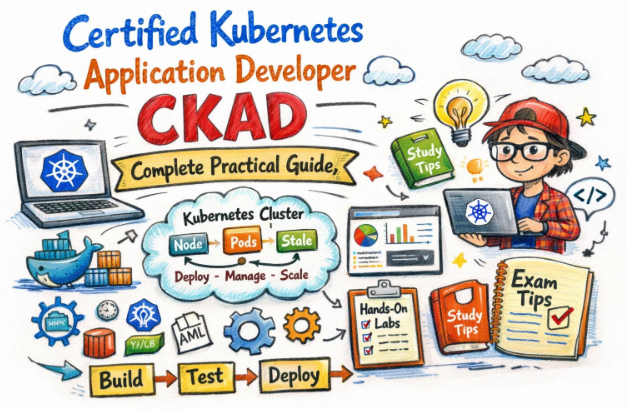
Introduction
Kubernetes has changed how teams build and run applications, especially microservices. Instead of thinking only about servers, modern engineers think in terms of pods, deployments, services, and configs. The Certified Kubernetes Application Developer (CKAD) certification is designed exactly for this new world: it checks whether you can design, build, and debug applications that run well on Kubernetes.
This master guide is for working engineers, software developers, SREs, platform and cloud engineers, and managers in India and globally. It explains what CKAD is, who should take it, what skills you gain, how to prepare in 7–14, 30, or 60 days, and how it fits into larger DevOps, DevSecOps, SRE, AIOps/MLOps, DataOps, and FinOps paths.
What Is the Certified Kubernetes Application Developer (CKAD)?
The Certified Kubernetes Application Developer (CKAD) is a hands‑on certification created by the Cloud Native Computing Foundation (CNCF) and The Linux Foundation. It focuses on how you design, build, configure, and expose cloud‑native applications on Kubernetes.
Key points about the exam:
- It is online and remotely proctored.
- It is fully performance‑based: you solve tasks on a live Kubernetes cluster using the terminal.
- It is time‑bound (around 2 hours) and you must be quick and accurate with
kubectland YAML.
Typical CKAD domains include:
- Application design and build.
- Configuration (ConfigMaps, Secrets, environment variables).
- Observability (logs, probes).
- Pod design and multi‑container patterns.
- Services, networking, and ingress.
- State persistence basics.
Who Should Take the CKAD Certification Training?
CKAD is aimed at people who write, deploy, and support applications on Kubernetes, not just those who manage clusters. It suits:
- Backend and full‑stack developers building microservices.
- DevOps Engineers and SREs who own application deployment and rollout strategies.
- Platform Engineers who help teams adopt Kubernetes‑friendly app patterns.
- Engineering Managers and tech leads who want a deep, practical view of cloud‑native app design.
You should ideally have:
- Good programming experience in at least one language (for example Java, Go, Python, Node.js).
- Comfort with Linux, containers (e.g., Docker), and basic networking.
- Some exposure to Kubernetes concepts like pods, deployments, and services before deep diving.
What You Will Learn in a CKAD Training Course
A strong CKAD training course (like the one from DevOpsSchool) focuses on how applications behave on Kubernetes, with lots of task‑based labs. You can expect to learn:
- Core app resources
- Pods, Deployments, ReplicaSets, and Jobs/CronJobs.
- Multi‑container pod patterns (sidecar, adapter, ambassador).
- Configuration and secrets
- ConfigMaps and Secrets.
- Environment variables, command‑line arguments, and mounted configuration files.
- Observability and health
- Liveness and readiness probes.
- Checking logs and basic metrics.
- Services and networking for apps
- Exposing services using ClusterIP, NodePort, and LoadBalancer.
- Basics of Ingress to route traffic to your app.
- State and storage from the app point of view
- Using volumes and PersistentVolumeClaims inside your manifests.
- Designing apps to handle restarts and rescheduling.
- Security and best practices (at app level)
- Resource requests and limits.
- Basic security context settings in pod specs.
Real‑World Projects After CKAD
After completing CKAD training and certification, you should be able to:
- Containerise a simple or microservices application, write Kubernetes manifests, and deploy it using Deployments and Services.
- Add configuration through ConfigMaps and Secrets, supporting different environments (dev, test, production).
- Implement proper liveness and readiness probes so your application restarts and traffic routing behave correctly.
- Use Jobs and CronJobs to run background tasks and scheduled work.
- Implement basic canary or rolling update patterns and roll back when something goes wrong.
CKAD in the CNCF Certification Landscape
CKAD sits alongside the other major Kubernetes certifications:
- KCNA / KCSA: entry‑level cloud‑native and Kubernetes awareness.
- CKA: focus on cluster administration, installation, and troubleshooting.
- CKAD: focus on application design, deployment, and debugging on Kubernetes.
- CKS: focus on Kubernetes security.
Many engineers find this flow very natural: learn basics → do CKA or CKAD based on role → move to CKS or architecture and security‑focused learning.
Certification Table – CKAD and Related Tracks
| Track | Level | Who it’s for | Prerequisites (recommended) | Skills covered (summary) | Recommended order |
|---|---|---|---|---|---|
| Certified Kubernetes Application Developer (CKAD) | Professional | Application and backend developers, DevOps, SRE | Programming skills, containers, basic Kubernetes concepts | App design on Kubernetes, config, secrets, probes, multi‑container pods, services, jobs, ingress | First main app‑focused Kubernetes certification |
| Certified Kubernetes Administrator (CKA) (reference) | Professional | Kubernetes admins, DevOps, SRE, platform engineers | Linux, containers, Kubernetes basics | Cluster install and configuration, workloads, networking, storage, troubleshooting | Before/alongside CKAD for platform‑heavy roles |
| Certified Kubernetes Security Specialist (CKS) (reference) | Professional | Security engineers, DevSecOps specialists | Strong Kubernetes skills (CKA/CKAD level) | Kubernetes and container security, network security, runtime and supply chain security | After CKAD/CKA for security‑focused engineers |
Certified Kubernetes Application Developer (CKAD)
What it is
The Certified Kubernetes Application Developer (CKAD) exam checks if you can design, build, and troubleshoot applications that run natively on Kubernetes. It is a task‑based, command‑line exam where you work directly in Kubernetes to solve app‑focused scenarios.
Who should take it
- Developers building microservices that run on Kubernetes.
- DevOps/SRE engineers responsible for application deployment and rollout.
- Platform engineers who help teams adopt good Kubernetes app patterns.
- Managers or tech leads who want practical knowledge of cloud‑native app behaviour.
Skills you’ll gain
- Write Kubernetes manifests for pods, deployments, services, jobs, and cronjobs.
- Work with ConfigMaps, Secrets, and environment variables.
- Use liveness and readiness probes to keep apps healthy.
- Design multi‑container pods and understand sidecar patterns.
- Use basic ingress and service types to expose applications.
Real‑world projects you should be able to do after it
- Convert a monolithic app into a simple set of services running in Kubernetes.
- Create a deployment that can safely roll out new versions and roll back if needed.
- Add configuration and secrets to support different environments without changing code.
- Implement scheduled jobs for housekeeping or batch tasks.
- Debug issues like failing pods, misconfigured environment variables, or bad probes.
Preparation Plan for CKAD
7–14 Day Plan – Fast Track
For experienced Kubernetes users and developers:
- Days 1–2: Review exam domains and list weak areas (for example probes, jobs, or multi‑container pods).
- Days 3–6: Do short labs focused only on these weak spots; use a real cluster or practice environment.
- Days 7–10: Take timed mock exams; practise
kubectlshortcuts, using--dry-run, and using templates. - Remaining days: Light review, especially of YAML patterns, and more trouble‑shooting exercises.
30 Day Plan – Working Professional
For developers and DevOps engineers with some Kubernetes exposure:
- Week 1:
- Learn/refresh pods, deployments, services, and basic config.
- Deploy a sample app and expose it with a service.
- Week 2:
- Deep‑dive configuration and secrets: ConfigMaps, Secrets, env vars, and mounted files.
- Practise liveness and readiness probes and see how they affect traffic.
- Week 3:
- Work with jobs, cronjobs, and multi‑container pods.
- Practise using ingress and different service types.
- Week 4:
- Focus heavily on debugging app issues and performing timed mock exams.
- Polish speed, accuracy, and comfort with the exam environment.
60 Day Plan – Deep‑Dive
For people new to both containers and Kubernetes:
- Weeks 1–2: Learn containers and basic Kubernetes (pods, deployments, services) using a simple app.
- Weeks 3–4: Add more topics: config, secrets, probes, jobs, multi‑container pods.
- Weeks 5–6: Practise end‑to‑end scenarios: full deployment, rollout, rollback, debugging, and multiple timed practice exams.
Common Mistakes in CKAD Preparation
- Only reading or watching videos instead of practising in a terminal.
- Underestimating configuration and secrets, which appear often in real tasks.
- Forgetting or ignoring probes, which can cause apps to flap or stay offline.
- Not practising under time pressure and not learning fast YAML and
kubectlworkflows.
Best Next Certification After CKAD
Taking cues from popular software engineer certification trends:
- Same track:
Certified Kubernetes Administrator (CKA) to add strong cluster and platform skills on top of app skills. - Cross‑track:
Certified Kubernetes Security Specialist (CKS) to focus on securing your Kubernetes apps and clusters. - Leadership:
cloud or solutions architect‑focused certifications that help you design complete systems and lead teams.
Choose Your Path: 6 Learning Paths Around CKAD
DevOps path
CKAD gives you strong app‑on‑Kubernetes skills. Combine it with CI/CD and cloud provider knowledge so you can design pipelines that build, test, and deploy microservices to Kubernetes with confidence.
DevSecOps path
Here you mix CKAD with security and later CKS. You design applications that follow security best practices, use secrets correctly, and support policy checks, image scanning, and secure configuration in pipelines.
SRE path
In an SRE path, CKAD helps you understand how apps behave under failure, scaling, and restarts. You pair this with SRE skills like SLOs, error budgets, and incident response to keep Kubernetes‑based services reliable.
AIOps/MLOps path
With this path, CKAD helps you operate application containers for data and ML workloads. Combine it with data/ML learning to manage model serving, feature services, and related microservices in Kubernetes.
DataOps path
Many modern data platforms run their services on Kubernetes. CKAD lets you build and debug the application side, while DataOps skills focus on data quality and pipelines. Together, you build robust data services on Kubernetes.
FinOps path
Here, CKAD helps you write applications that respect resource requests and limits, which directly affect cost. Combined with FinOps knowledge, you can help teams keep clusters efficient and bills under control.
Role → Recommended Certifications
| Role | Recommended certification flow (with CKAD) |
|---|---|
| DevOps Engineer | Kubernetes basics → CKAD → CKA or cloud DevOps/architect certification |
| SRE | Kubernetes basics → CKAD → SRE/observability training + CKA for platform depth |
| Platform Engineer | Kubernetes basics → CKA → CKAD for app‑platform collaboration |
| Cloud Engineer | Cloud fundamentals → CKA or CKAD → cloud provider specialist certification |
| Security Engineer | Kubernetes basics → CKAD + CKA → CKS and cloud security paths |
| Data Engineer | Data platform basics → CKAD (for app services) → data/analytics certification |
| FinOps Practitioner | Cloud basics → CKAD (resource usage view) → FinOps/cost optimisation programs |
| Engineering Manager | Cloud and Kubernetes basics → CKAD/CKA → architecture and leadership‑oriented training |
Training Institutions for CKAD Certification
- DevOpsSchool:
Offers a focused Certified Kubernetes Application Developer (CKAD) training with hands‑on labs, practice tasks, and guidance mapped closely to the exam and real project needs. - Cotocus:
Provides structured cloud and Kubernetes programs where CKAD is paired with DevOps and platform skills for a broader role. - Scmgalaxy:
Concentrates on practical DevOps and container workflows, showing how CKAD topics appear in real CI/CD and release processes. - BestDevOps:
Curates DevOps and cloud courses, including Kubernetes learning tracks that support CKAD preparation. - devsecopsschool.com:
Focuses on DevSecOps; helps learners apply CKAD app practices with security scanning, policies, and safe configuration. - sreschool.com:
Targets SRE topics such as SLOs, incidents, and reliability, which blend well with CKAD‑level knowledge of app behaviour. - aiopsschool.com:
Teaches AIOps concepts using telemetry and automation, where well‑instrumented Kubernetes apps are important. - dataopsschool.com:
Focuses on DataOps and analytics; CKAD skills help build and troubleshoot data services running on Kubernetes. - finopsschool.com:
Works on cloud cost and governance; CKAD learners can apply cost‑aware app design to support FinOps practices.
FAQs – Certified Kubernetes Application Developer (CKAD)
- Is the CKAD exam very difficult?
It is challenging because it is hands‑on and timed, but with good practice and a clear plan, most developers and DevOps engineers can pass. - How long does CKAD preparation usually take?
Many people need 3–8 weeks, depending on their Kubernetes and container experience and how much time they can study each week. - Do I need Kubernetes experience before starting CKAD training?
Basic Kubernetes knowledge is strongly recommended. A good course will include a short foundation section, but you should at least know pods, deployments, and services. - Should I take CKAD or CKA first?
If you are more focused on applications, start with CKAD. If you are closer to infrastructure and platform work, you may start with CKA. Some people do both back‑to‑back. - How does CKAD help my career?
CKAD shows that you can design and run applications properly on Kubernetes, which is a key requirement for many modern developer and DevOps roles. - Is CKAD useful for people using managed Kubernetes like EKS, AKS, or GKE?
Yes. The Kubernetes concepts are the same, and CKAD focuses on the application layer, which applies across all managed services. - Is CKAD only for developers?
It is ideal for developers, but DevOps engineers, SREs, and platform engineers working closely with applications also gain a lot from it. - How is CKAD different from multiple‑choice exams?
CKAD is fully practical. You runkubectlcommands, edit YAML, and fix apps in a live cluster instead of choosing answers. - Why do some people fail CKAD on the first attempt?
Common reasons are not enough hands‑on practice, slow typing orkubectlusage, weak knowledge of configuration and probes, and poor time management. - Does CKAD expire?
Yes, CKAD is valid only for a set period, after which you must recertify to prove you are up to date with the current Kubernetes version. - Do employers value CKAD?
Many companies that use Kubernetes recognise CKAD and list it as a plus in job descriptions for developers, DevOps, and SRE roles. - Can I pass CKAD by self‑study alone?
It is possible with good discipline, labs, and practice exams, but many busy professionals choose a structured training course to reduce trial and error.
Conclusion
The Certified Kubernetes Application Developer (CKAD) certification is one of the best ways to prove that you understand how to build and run applications the “Kubernetes way.” It focuses on real skills: writing manifests, configuring apps, adding probes, exposing services, and debugging problems in a live cluster. For engineers and managers in India and globally, CKAD is a powerful addition to DevOps, DevSecOps, SRE, AIOps/MLOps, DataOps, and FinOps paths and fits easily into a bigger roadmap that includes CKA, CKS, and cloud provider certifications.
