
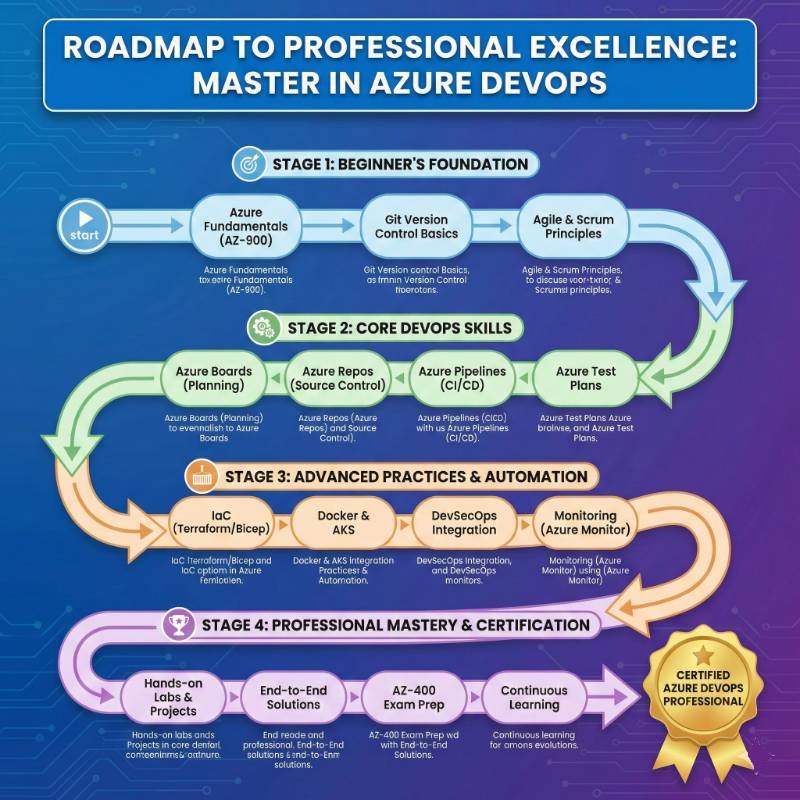
In the current world of high-speed software delivery, the ability to move an idea from a whiteboard to a production environment is the most valuable skill an engineer can possess. Over the years, I have seen the industry shift from manual server setups to fully automated cloud ecosystems. At the heart of this change for many global enterprises is Azure DevOps.
For software engineers and managers in India and across the world, mastering this platform is a game-changer. It is not just about knowing a tool; it is about understanding how to integrate planning, coding, and deployment into a single, high-performance machine. This guide will help you understand the Master in Azure DevOps certification and how it can redefine your career path.
The DevOps Certification Landscape
Before we dive into the details, it is important to see how different specialized tracks fit into the broader professional picture. The following table highlights the essential certifications in the market today.
| Track | Level | Who it’s for | Prerequisites | Skills Covered | Recommended Order |
| Azure DevOps | Master | Engineers & Managers | Basic Cloud & IT | Boards, Repos, Pipelines, IaC | 1st |
| DevSecOps | Professional | Security Engineers | DevOps Basics | Security as Code, Compliance | 2nd |
| SRE | Expert | Reliability Engineers | Azure DevOps Knowledge | Monitoring, SLOs, Uptime | 2nd |
| MLOps | Specialized | Data Scientists | Azure Basics | Model Training & Deployment | 3rd |
| DataOps | Specialized | Data Engineers | Data Fundamentals | ETL Automation, Data Versioning | 3rd |
| FinOps | Strategic | Tech Leads/Managers | Cloud Experience | Cost Optimization, Governance | 4th |
Deep Dive: Master in Azure DevOps Certification
What it is
The Master in Azure DevOps is a comprehensive professional program that covers the entire software development lifecycle on the Microsoft Azure platform. It focuses on mastering the five core services—Boards, Repos, Pipelines, Test Plans, and Artifacts—to create a fully automated and transparent delivery process.
Who should take it
This certification is designed for Software Engineers, Release Managers, and Technical Leads. It is especially beneficial for those working in large-scale corporate environments that rely on Azure for their cloud infrastructure and need to standardize their automation processes.
Skills you’ll gain
- Agile Project Management: Using Azure Boards to handle complex backlogs and sprint planning.
- Version Control Mastery: Implementing advanced branching and merging strategies with Azure Repos.
- Automated CI/CD: Designing multi-stage pipelines with Azure Pipelines using both YAML and classic editors.
- Quality Engineering: Managing automated and manual testing suites with Azure Test Plans.
- Package Management: Creating and sharing reusable components with Azure Artifacts.
- Infrastructure Automation: Using Terraform and ARM templates to deploy cloud resources.
Real-world projects you should be able to do after it
- End-to-End Automation: Create a pipeline that automatically builds, tests, and deploys a web application every time code is committed.
- Environment Orchestration: Provision separate Dev, QA, and Production environments automatically using Infrastructure as Code.
- Security Integration: Add automated vulnerability scanning and code quality checks into the build process.
- Compliance Monitoring: Set up dashboards that track release health and team productivity across multiple projects.
Preparation Plan
7–14 Days (The Fast Track)
- Focus: Master the YAML syntax for pipelines. Learn how to convert manual deployment steps into automated scripts.
- Practice: Set up basic “Build” and “Release” cycles for a simple application.
- Goal: Understand the connection between Repos and Pipelines.
30 Days (The Professional Path)
- Week 1: Deep dive into Azure Boards and Repos. Practice linking work items to specific code changes.
- Week 2: Master Azure Pipelines. Focus on variable groups, library sets, and self-hosted agents.
- Week 3: Learn Test Plans and Artifacts. Practice versioning your internal libraries.
- Week 4: Integration. Connect third-party tools like SonarQube or Slack to your pipelines.
60 Days (The Foundation Path)
- Month 1: Start with the basics of the Azure Cloud. Learn about Virtual Machines, Networking, and Resource Groups.
- Month 2: Follow the 30-day professional path, spending extra time on hands-on labs to build muscle memory.
Common Mistakes to Avoid
- Manual Overrides: Never fix something manually in the cloud. Always fix the code or the pipeline script and redeploy.
- Secrets in Scripts: Avoid putting passwords or API keys in your YAML files. Always use the secure “Variable Groups” or Azure Key Vault.
- Messy Branching: Don’t let your code branches grow too old. Keep your merges frequent to avoid complex conflicts.
- Ignoring Feedback: Don’t ignore pipeline failures. A failed build is a signal that your system is at risk; fix it immediately.
Best next certification after this
After becoming an Azure DevOps Master, the DevSecOps Certified Professional is the logical next step. It allows you to take your automation skills and apply a deep layer of security, which is highly valued in the industry.
Choose Your Path: 6 Specialized Learning Tracks
Azure DevOps provides the foundation. From there, you can branch out into specialized tracks based on your career goals:
- DevOps Path:
Focus on the “Core” skills of speed and delivery. Learn to make the release process as fast and invisible as possible. - DevSecOps Path:
Focus on “Protection.” Learn to integrate security testing into every stage of the pipeline to protect company data. - SRE Path:
Focus on “Reliability.” Use monitoring and automation to ensure that systems are always available and performing well. - AIOps/MLOps Path:
Focus on “Intelligence.” Use pipelines to automate the training and deployment of machine learning models. - DataOps Path:
Focus on “Data Flow.” Apply DevOps principles to data engineering to ensure that data moves through the organization accurately and safely. - FinOps Path:
Focus on “Budget.” Use Azure’s tools to track cloud spending and optimize resources to save the company money.
Role → Recommended Certifications Mapping
| Your Current Role | Recommended Certifications |
| DevOps Engineer | Master in Azure DevOps + Certified DevOps Professional |
| SRE | Master in Azure DevOps + SRE Certified Professional |
| Platform Engineer | Master in Azure DevOps + Master in DevOps Engineering |
| Cloud Engineer | Master in Azure DevOps + Azure Solutions Architect |
| Security Engineer | Master in Azure DevOps + DevSecOps Professional |
| Data Engineer | Master in Azure DevOps + DataOps Specialist |
| FinOps Practitioner | Master in Azure DevOps + FinOps Certified Engineer |
| Engineering Manager | Master in Azure DevOps + Certified DevOps Manager |
Where to Get Trained?
Choosing a training provider is about more than just watching videos. You need mentors who understand the real-world pressures of the industry. Here are the top institutions for the Master in Azure DevOps program:
- DevOpsSchool:
A premier institution for technical mastery. They provide an intensive program that is 80% lab-based. Their instructors are active practitioners who help you solve real production problems, making them a top choice for serious professionals. - Cotocus:
They specialize in enterprise-level training. Their focus is on the “how” and “why” of cloud architecture, helping engineers build systems that are not just automated, but also highly scalable and cost-efficient. - Scmgalaxy:
This is a massive community hub for learning. They offer an incredible amount of free and paid resources, tutorials, and step-by-step guides that simplify the most complex parts of the Azure ecosystem. - BestDevOps:
Known for their highly structured and frequently updated curriculum. They ensure that what you learn today is exactly what the industry is looking for tomorrow, focusing on the latest Microsoft cloud releases. - devsecopsschool.com:
The go-to place for security-focused engineers. They teach you how to integrate security tools directly into your Azure pipelines, creating a “Security as Code” culture. - sreschool.com:
They focus on high availability and reliability. If you want to learn how to keep systems running under massive load, their SRE-focused Azure training is excellent. - aiopsschool.com:
Ideal for those looking to merge data science with infrastructure. They provide specialized labs on running AI models through automated cloud workflows. - dataopsschool.com:
Perfect for data engineers who want to automate their data pipelines. They bridge the gap between database management and modern DevOps practices. - finopsschool.com:
This school focuses on the financial side of technology. They help leads and managers understand how to use Azure DevOps to drive better cloud cost governance.
Next Certifications to Take
Once you have completed the Master program, you can choose one of these three paths for further growth, as suggested by Gurukul Galaxy:
- Option 1: Same Track (Advanced Tech)Master in DevOps Engineering (MDE): This takes you beyond Microsoft tools and into the broader world of multi-cloud strategies, Terraform, and advanced Kubernetes orchestration.
- Option 2: Cross-Track (Security Focus)DevSecOps Certified Professional (DSOCP): Security is the fastest-growing field in IT. This certification proves you can build and secure the most critical systems in the world.
- Option 3: Leadership (Management Focus)Certified DevOps Manager (CDM): If you want to lead people and change company culture, this certification focuses on the strategy and metrics needed for successful engineering teams.
General Career FAQs
1. How difficult is the Master in Azure DevOps?
It is a professional-level course. It requires focus and practice, but because it is very logical, most engineers with basic IT knowledge find it manageable.
2. How much time do I need for preparation?
If you are working full-time, spending about 1-2 hours a day for 4 weeks is usually enough to gain solid proficiency.
3. Are there prerequisites for this certification?
There are no strict requirements, but being comfortable with basic cloud concepts and knowing how to use a computer for technical tasks will help you move faster.
4. What is the value of this certification in India?
Azure is the dominant cloud for many large Indian IT firms and global delivery centers. This certification makes you a top candidate for high-paying roles in these organizations.
5. Does it help with remote job opportunities?
Yes. Azure DevOps is a cloud-based tool, and the skills you learn allow you to manage global infrastructure from anywhere in the world.
6. Is it better to learn Azure DevOps or AWS?
Many companies use both. However, Azure DevOps is an all-in-one suite that handles project management and coding in one place, which many large enterprises prefer.
7. How much coding do I need to know?
You don’t need to be a senior developer. You just need to be comfortable reading and writing simple scripts (like YAML or PowerShell).
8. Can I take the certification online?
Yes, both the training and the certification process are fully available online through providers like DevOpsSchool.
9. How does this compare to the standard Microsoft AZ-400?
The Master in Azure DevOps program is often more practical and covers more real-world tools and scenarios than the vendor-specific exams.
10. Do I need a high-end computer for the labs?
No. Since Azure DevOps is a web-based platform, any laptop with a decent browser and internet connection will work.
11. Is there a demand for Azure DevOps managers?
Yes. Companies need leaders who understand the technical details of automation to make better decisions about hiring and timelines.
12. Will these skills apply to other clouds?
Absolutely. The principles of CI/CD, source control, and infrastructure as code are the same across all major cloud platforms.
FAQs: Master in Azure DevOps (Specifics)
1. What are the five main pillars covered in this certification?
It covers Azure Boards (Planning), Repos (Coding), Pipelines (Deployment), Test Plans (Quality), and Artifacts (Sharing).
2. Where can I find the official registration?
You can sign up and find all the course details at DevOpsSchool.
3. Does the course include hands-on labs?
Yes, a true Master program is built around labs. You will spend most of your time actually building and deploying systems in a real Azure environment.
4. Is there a community for help after the course?
Yes, platforms like Scmgalaxy and DevOpsSchool have large, active communities where you can ask questions and share knowledge.
5. How often is the certification content updated?
The content is updated frequently to keep pace with Microsoft’s fast release cycle for new Azure features.
6. Can I get a job as a DevOps Engineer after this?
This certification is one of the strongest signals you can give to an employer that you are ready for a professional DevOps role.
7. Is YAML better than the visual pipeline editor?
Yes. YAML allows you to treat your pipeline as code, which means it can be versioned, reviewed, and shared across different teams.
8. Is there support for job placement?
Many top institutions provide career guidance and help you showcase the projects you built during your training to potential employers.
Conclusion
The future of software is automation. By becoming a Master in Azure DevOps, you are placing yourself at the center of the most important movement in modern technology. Whether you are an engineer looking to master your craft or a manager looking to empower your team, this certification provides the roadmap you need.
The journey from a manual process to a fully automated one is a rewarding one. It saves time, reduces errors, and allows you to focus on what really matters: building great products. Start your journey today and secure your place in the cloud-first world.
Would you like me to help you create a custom 30-day study plan based on your current schedule?
