
Introduction
DevOps is not just a set of tools; it is the engine that powers modern software companies. But here is the hard truth: knowing how to run a Docker container or write a Jenkins script is not enough anymore. The industry is full of people who know “tasks,” but it is desperate for people who understand the “lifecycle.”
The DevOps Certified Professional (DCP) is designed to bridge that specific gap.
This course is a rigorous, practitioner-focused program that moves you beyond theory. We don’t just teach you definitions; we teach you how to build a robust, automated factory for software delivery. You will learn to connect the dots between Development (writing code) and Operations (running code), mastering the art of Continuous Integration, Continuous Delivery, and Infrastructure as Code.
Master Certification Ecosystem Table
Here is the landscape of certifications you need to know about. The DCP is your solid starting point.
| Certification Name | Track | Level | Who it’s for | Prerequisites | Skills Covered | Recommended Order |
| DevOps Certified Professional (DCP) | DevOps | Professional | Software Eng, SysAdmins | Basic Linux & Git | CI/CD, Docker, K8s, Terraform | 1st (Foundation) |
| DevSecOps Certified Professional | Security | Specialist | Security Eng, DevOps Leads | DCP / DevOps Basics | Pipeline Security, Compliance, Auditing | 2nd (Specialization) |
| SRE Certified Professional | Reliability | Specialist | Ops Leads, Reliability Eng | Cloud & Ops Exp | SLOs, Error Budgets, Incident Mgmt | 2nd (Post-DevOps) |
| AIOps Certified Professional | AI/Ops | Specialist | Data Eng, DevOps Eng | Python, ML Basics | Auto-remediation, AI Monitoring | 3rd (Niche) |
| DataOps Certified Professional | Data | Specialist | Data Engineers, DBAs | SQL, Data Pipelines | Data Orchestration, Quality | 3rd (Niche) |
| FinOps Certified Professional | Finance | Specialist | Managers, Cloud Architects | Cloud Billing Basics | Cost Optimization, Budgeting | 3rd (Leadership) |
What it is DevOps Certified Professional (DCP)
The DCP is a practitioner-focused program designed to validate your ability to build, manage, and scale modern software delivery pipelines. Unlike theoretical exams, the DCP focuses on the “how-to” of the DevOps ecosystem, bridging the gap between writing code and running it in production.
Who should take it
- Software Developers who are tired of throwing code “over the wall” and want to own their deployments.
- System Administrators who know Linux but need to master modern automation and cloud tools.
- Technical Leads who need to architect CI/CD workflows for their teams.
Skills you’ll gain
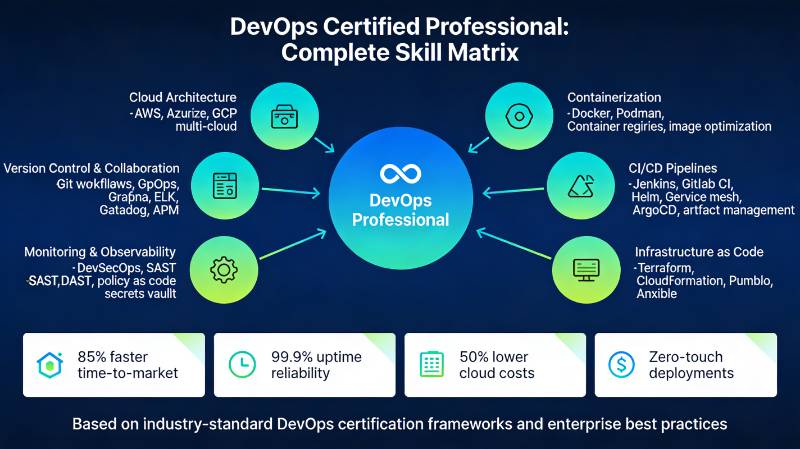
- Continuous Integration/Continuous Delivery (CI/CD): Build robust pipelines using Jenkins, GitLab, and GitHub Actions.
- Containerization: Master Docker to package applications and ensure consistency across environments.
- Orchestration: Deploy and manage scalable applications using Kubernetes (K8s).
- Infrastructure as Code (IaC): Use Terraform and Ansible to automate environment provisioning.
- Observability: Implement proactive monitoring and logging with Prometheus, Grafana, and ELK.
- Version Control Strategy: Advanced Git workflows for team collaboration.
Real-world projects you should be able to do after it
- Zero-Downtime Deployment: Design a “Blue-Green” deployment strategy for a high-traffic microservices application.
- Secure Pipeline: Build a fully automated pipeline that scans code for security vulnerabilities (SAST) before deployment.
- Multi-Cloud Provisioning: Write Terraform scripts to set up identical infrastructure on AWS and Azure simultaneously.
- Auto-Healing Cluster: Configure a Kubernetes cluster that automatically restarts failed services without human intervention.
Preparation plan
- 7–14 Day Sprint: Best for experienced practitioners. Focus on refining syntax for Terraform/K8s and taking full-length mock exams.
- 30-Day Steady Path: Recommended for working professionals. Dedicate 10 hours a week to hands-on labs and 5 hours to theoretical concepts.
- 60-Day Deep Dive: Ideal for beginners. Spend the first 30 days on foundations (Linux, Git, Cloud basics) and the next 30 days on tool-specific mastery.
Common mistakes
- Over-focusing on Tools: Learning the tool but not the “why” behind the process.
- Ignoring Scripting: Attempting to master DevOps without a working knowledge of Bash or Python.
- Neglecting Security: Building pipelines that prioritize speed over security (DevSecOps integration is key).
- Skipping Basics: Jumping straight to Kubernetes without understanding Docker or Networking.
Best next certification after this
- Same Track (Technical Mastery): Certified DevOps Engineer (CDE) or Master in DevOps Engineering (MDE).
- Cross-Track (Security Focus): DevSecOps Certified Professional.
- Leadership (Managerial Focus): Certified DevOps Manager.
Choose Your Path: 6 Strategic Learning Journeys
DevOps is a big umbrella. Once you have the DCP, you must specialize.
1. The DevOps Path
- Focus: Automation & Flow.
- Goal: Master the art of delivering software rapidly and reliably.
- Key Tech: Jenkins, Kubernetes, Docker, Ansible.
2. The DevSecOps Path
- Focus: Security & Compliance.
- Goal: Integrate security at every stage of the pipeline (“Shift Left”).
- Key Tech: SonarQube, Vault, OWASP, Trivy.
3. The SRE (Site Reliability Engineering) Path
- Focus: Stability & Scalability.
- Goal: Apply software engineering to infrastructure and operations problems.
- Key Tech: Terraform, Prometheus, Chaos Engineering, Datadog.
4. The AIOps/MLOps Path
- Focus: AI & Data Lifecycle.
- Goal: Automate IT operations using AI and manage ML model lifecycles.
- Key Tech: Kubeflow, Python, TensorFlow, ELK Stack.
5. The DataOps Path
- Focus: Data Pipeline Efficiency.
- Goal: Bring DevOps agility to data analytics and engineering.
- Key Tech: Airflow, DBT, Snowflake, Kafka.
6. The FinOps Path
- Focus: Cloud Cost Management.
- Goal: Maximize business value by optimizing cloud spend.
- Key Tech: Cloud Cost Explorer, Anodot, Excel.
Role → Recommended Certifications Mapping
Identify your current role to find your next step.
| Current Role | Recommended Certification Path |
| DevOps Engineer | DCP → Master in DevOps Engineering (MDE) |
| SRE | DCP → SRE Certified Professional |
| Platform Engineer | DCP → Certified Kubernetes Administrator (CKA) |
| Cloud Engineer | AWS/Azure DevOps → DCP |
| Security Engineer | DCP → DevSecOps Certified Professional |
| Data Engineer | DCP → DataOps Certified Professional |
| FinOps Practitioner | DCP → FinOps Certified Professional |
| Engineering Manager | DCP → Certified DevOps Manager |
Top Institutions for Training & Certification
These are the leading providers where you can get trained and certified for the DCP program.
DevOpsSchool
- The primary provider for the DCP. They offer a community-centric approach with deep, hands-on labs. Their “Master in DevOps Engineering” program is highly respected in the industry for its comprehensive curriculum.
Cotocus
- Known for corporate training, Cotocus excels in delivering customized DevOps bootcamps for large enterprises. Their training is rigorous and aligned with strict industry standards.
Scmgalaxy
- A veteran community in the DevOps space. Scmgalaxy provides excellent tutorials and a collaborative learning environment. Their certification tracks are built on years of community feedback and real-world use cases.
BestDevOps
- Ideal for beginners, BestDevOps focuses on simplifying complex concepts. They break down the DCP curriculum into manageable chunks, making it easier for newcomers to grasp the fundamentals.
devsecopsschool.com
- If you plan to move from DCP to a security role, this is the place. They specialize entirely in securing pipelines and infrastructure, offering the best follow-up training to the DCP.
sreschool.com
- Dedicated to Site Reliability Engineering. Their curriculum bridges the gap between the DCP and advanced SRE roles, focusing on observability and incident management.
aiopsschool.com
- The leader in AIOps training. They teach you how to leverage AI to automate the skills you learned in the DCP, moving toward “NoOps” environments.
dataopsschool.com
- Focuses on applying DCP principles to Big Data. They are the go-to institute for Data Engineers who need to master CI/CD for data pipelines.
finopsschool.com
- Specializes in the financial aspect of DevOps. They teach you how to take the cloud skills from DCP and apply them to cost optimization and budgeting.
General FAQs (DevOps Career & Certification)
Q1: Is the DCP difficult for a beginner?
A: It is challenging but manageable. If you have basic Linux knowledge, the learning curve is steep but steady. The hands-on labs are key to understanding the concepts.
Q2: How long does it take to prepare?
A: On average, 4 to 6 weeks. If you are already working in IT, 30 days of focused study (1-2 hours daily) is usually sufficient.
Q3: Do I need coding skills?
A: You don’t need to be a developer, but you must be comfortable with scripting (Bash/Python) and reading code (YAML/JSON).
Q4: What is the value of this certification?
A: It proves you have practical skills, not just book knowledge. It is highly valued by employers looking for engineers who can hit the ground running.
Q5: What are the prerequisites?
A: Basic understanding of Linux commands and the Software Development Life Cycle (SDLC). No formal degree is required.
Q6: Can I take the exam online?
A: Yes, most providers, including DevOpsSchool, offer online proctored exams that you can take from home.
Q7: Is it better than AWS/Azure certifications?
A: It is different. AWS/Azure certs are vendor-specific. DCP is vendor-agnostic, teaching you skills applicable to any cloud provider.
Q8: What is the passing score?
A: Typically 70% to 75%. The exam often includes scenario-based questions to test your practical understanding.
Q9: Does the certification expire?
A: Most technical certifications have a validity of 2-3 years due to the rapid change in tools. Renewal often requires a shorter update exam.
Q10: Will this help me get a job?
A: Yes. DevOps is one of the most in-demand skill sets globally. A certification like DCP validates your resume and gets you past the initial HR screen.
Q11: Can I move to a management role later?
A: Absolutely. The DCP gives you the technical foundation needed to lead engineering teams effectively.
Q12: Is the training hands-on?
A: Yes. The DCP curriculum is heavily weighted toward labs and projects. You cannot pass by just reading slides.
FAQs: DevOps Certified Professional (DCP) Specifics
Q1: What is the official URL for the DCP?
A: The official link is: DevOps Certified Professional (DCP)
Q2: Is the training live or recorded?
A: DevOpsSchool offers both instructor-led live sessions (for interactive learning) and self-paced recorded videos (for flexibility).
Q3: What are the core tools covered in the DCP?
A: The “Core Five” are Docker, Kubernetes, Jenkins, Terraform, and Ansible. You will also cover Git and monitoring tools.
Q4: How is the DCP different from a Cloud Provider certification (e.g., AWS DevOps)?
A: Cloud certifications are vendor-specific. The DCP is tool-agnostic, teaching you skills that apply across any cloud or on-prem environment.
Q5: Is there a community for DCP holders?
A: Yes, DevOpsSchool has a large alumni network and community forums where you can ask questions and network with other professionals.
Q6: How often is the DCP curriculum updated?
A: The curriculum is updated regularly (usually quarterly) to include the latest tool versions and industry best practices.
Q7: Are there retake options if I fail?
A: Most training providers offer at least one retake option, but it is always best to check the specific terms at the time of registration.
Q8: Does the DCP cover Artificial Intelligence?
A: The core DCP focuses on automation and infrastructure. For AI-specific operations, you would look at the AIOps Certified Professional.
Conclusion
DevOps Certified Professional (DCP) is a practical certification for working engineers and managers who want real DevOps skills, not only theory. It helps you build strong delivery habits—CI/CD automation, repeatable deployments, consistent environments, basic monitoring, and clear troubleshooting—so releases become faster, safer, and less stressful.
If you prepare the right way by building one complete end-to-end project, you gain two big outcomes: job-ready confidence and better interview performance. After completing DCP, the smart move is to pick one clear direction—DevOps, DevSecOps, SRE, AIOps/MLOps, DataOps, or FinOps—and keep improving with practical projects. That steady focus is what turns a certification into long-term career growth.
