
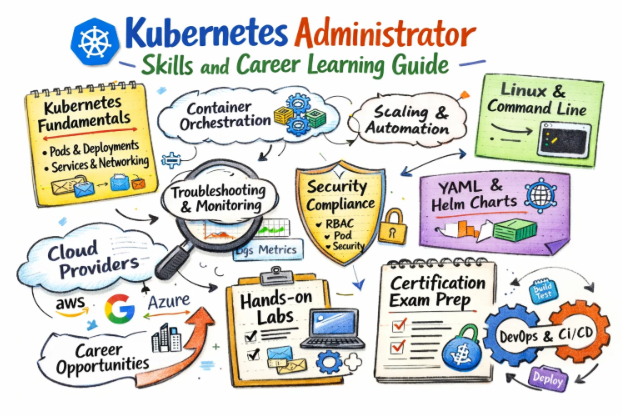
Introduction
Kubernetes is now the common way to run containers in many companies. It runs many services together and keeps them up and running.
Because of this, teams need people who really know how to set up, manage, and fix Kubernetes clusters, not just write sample files or run small demos.
The Certified Kubernetes Administrator (CKA) Certification Training Course helps you build these real skills and prepare for the CKA exam. In this guide, you will see what the course is, who should join, what you will learn, how to study, what mistakes to avoid, what to do after CKA, different learning paths, role mapping, training options, and common questions.
What Is the Certified Kubernetes Administrator (CKA) Training Course?
The Certified Kubernetes Administrator (CKA) Certification Training Course from DevOpsSchool is made to match this style. You learn by doing labs and solving real‑type problems on Kubernetes clusters. The course covers how clusters work, how to install and configure them, how to run apps, how networking and storage work, and how to troubleshoot issues.
Who Should Take the CKA Certification Training Course?
You should consider this course if you use containers or plan to work with Kubernetes. It is a good fit for:
- DevOps Engineers who manage deployments and CI/CD with containers
- Platform and Cloud Engineers who run shared clusters for many teams
- SREs who take care of uptime and reliability of services
- System Administrators moving from VM‑based systems to Kubernetes
- Software Engineers who want to control deployment and runtime of their apps
- Engineering Managers who want to understand how their teams use Kubernetes
If Kubernetes is part of your current or future stack, CKA helps you become the “go‑to” person for running and fixing clusters.
Skills You Will Learn in the CKA Training Course
The course and exam are based on a few main areas:
- Cluster basics and setup
- Plan and create Kubernetes clusters (for example, using kubeadm)
- Set up control plane and worker nodes, networking, and add‑ons
- Upgrade clusters and back up and restore etcd
- Workloads and scheduling
- Run apps using Deployments, ReplicaSets, and DaemonSets
- Do rollouts, rollbacks, and scale services up or down
- Use ConfigMaps, Secrets, and control CPU and memory limits
- Services and networking
- Understand how Pods talk to each other (basic CNI ideas)
- Expose apps using ClusterIP, NodePort, and LoadBalancer services
- Configure Ingress controllers, Ingress rules, and CoreDNS
- Storage
- Work with StorageClasses, PersistentVolumes, and PersistentVolumeClaims
- Choose correct access modes and reclaim rules
- Attach storage to apps that need to keep data
- Troubleshooting
- Find and fix problems in Pods, nodes, services, network, and core components
- Use kubectl, logs, and events to see what is wrong
- Solve issues with broken deployments, bad configs, and resource limits
Real‑World Projects You Should Handle After CKA
Once you complete this training and practice well, you should be able to:
- Install and configure a Kubernetes cluster ready for real‑world apps
- Take existing apps and move them into Kubernetes with deployments, services, and storage
- Set up basic logging and monitoring for clusters and applications
- Do safe rolling updates and rollbacks for important microservices
- Troubleshoot and fix common cluster and workload problems quickly
Preparation Plan (7–14 Days / 30 Days / 60 Days)
7–14 Days (Fast Track, for people already using Kubernetes)
- Days 1–3: Revise basics: Pods, Deployments, Services, ConfigMaps, Secrets, simple storage.
- Days 4–6: Practice cluster admin tasks: install with kubeadm, upgrade clusters, set RBAC, back up and restore etcd.
- Days 7–10: Do only troubleshooting labs: fix Pods, services, nodes, and control plane issues.
- Days 11–14: Take full mock exams with a timer and review every mistake carefully.
30 Days (Balanced Plan for working engineers)
- Week 1: Learn or refresh core Kubernetes concepts and run small labs for workloads and services.
- Week 2: Focus on cluster architecture, installation, upgrades, and RBAC tasks.
- Week 3: Study networking (services, Ingress) and storage (PV, PVC, StorageClass) with practice.
- Week 4: Spend most of the time on troubleshooting labs and practice exams.
60 Days (Slow and deep plan, if you are new)
- Month 1: Learn container basics, understand Kubernetes from the start, and do small labs to get used to kubectl and YAML.
- Month 2: Follow all CKA topics one by one with labs, then do multiple full mock exams and work on your weak areas.
Common Mistakes in CKA Preparation
- Starting CKA without knowing basic Linux commands and simple networking.
- Watching videos and reading notes but not using a real Kubernetes cluster.
- Not checking the official exam topics and their importance.
- Not learning fast ways to use kubectl (short flags, filters, JSON/YAML output).
- Ignoring networking or storage because they feel hard or less interesting.
Best Next Certification After CKA
After CKA, you can choose your next step based on your goals:
- Same track (Kubernetes / containers):
- Take more advanced Kubernetes or container security certifications to deepen your cluster and platform knowledge.
- Cross‑track (cloud / DevOps / platform):
- Take a cloud provider or DevOps certification to show that you can run Kubernetes as part of full cloud and CI/CD setups.
- Leadership (architecture / strategy):
- Take architecture‑focused certifications so you can design full systems and guide multiple teams that run on Kubernetes.
Choose Your Path: 6 Learning Paths Around CKA
DevOps Path
You use CKA to become great at running container platforms. You manage clusters that support CI/CD, GitOps, and automation, so code moves to production quickly and safely.
DevSecOps Path
You mix CKA skills with security. You focus on network policies, secure images, secrets, role‑based access, and make sure security is part of how the cluster and pipelines work.
SRE Path
You combine CKA with SRE thinking. You care about SLIs, SLOs, error budgets, alerts, and incidents on the Kubernetes platform and keep services reliable.
AIOps / MLOps Path
You use Kubernetes for ML and data workloads. With CKA, you can run training jobs, batch jobs, and model services with proper scheduling, scaling, and rolling updates.
DataOps Path
You run data pipelines and analytics jobs on Kubernetes. CKA helps you manage stateful sets, storage, and network paths so your data flows are stable and observable.
FinOps Path
You look at cost and value. With CKA, you understand how resource limits, node types, and scaling rules affect cloud bills and you help design clusters that cost less but still perform well.
Role → Recommended Certifications Mapping
| Role | How CKA helps | Recommended direction after CKA |
|---|---|---|
| DevOps Engineer | Gives strong skills in running Kubernetes clusters and deployments | Add cloud or DevOps certifications and advanced Kubernetes exams |
| SRE | Helps understand cluster behavior and failure modes | Add reliability or architecture certifications |
| Platform Engineer | Enables design and operation of shared Kubernetes platforms | Add architecture, security, or networking certifications |
| Cloud Engineer | Links cloud infrastructure with Kubernetes workloads | Move towards cloud architect or DevOps certifications |
| Security Engineer | Provides base knowledge for securing clusters and workloads | Add cloud or Kubernetes security certifications |
| Data Engineer | Supports running data services and pipelines on Kubernetes | Add data or cloud‑data certifications |
| FinOps Practitioner | Shows how Kubernetes uses compute and storage cost | Add architecture or FinOps‑specific certifications |
| Engineering Manager | Gives clear view of how teams use Kubernetes in production | Add architecture‑focused certifications for better leadership decisions |
Top Institutions for CKA Training and Support
DevOpsSchool
DevOpsSchool offers a complete CKA training course with live teaching, labs, and practice tasks. The course follows official CKA topics and includes real‑type examples, so you can use what you learn in both the exam and your job.
Cotocus
Cotocus offers DevOps and Kubernetes training and consulting. They help you understand how CKA topics apply to real migrations, platform builds, and day‑to‑day cluster operations.
Scmgalaxy
Scmgalaxy focuses on DevOps tools, CI/CD, and automation. This helps you connect CKA cluster skills with build, deployment, and configuration tools used in real projects.
BestDevOps
BestDevOps provides content and community around DevOps and cloud. For CKA learners, it gives more examples, discussions, and shared experiences from teams using Kubernetes.
devsecopsschool.com
devsecopsschool.com teaches DevSecOps. Combined with CKA, this helps you apply security checks, policies, and good practices inside Kubernetes clusters and pipelines.
sreschool.com
sreschool.com teaches SRE methods. Together with CKA, you can run Kubernetes with a strong focus on reliability, observability, and good incident response.
aiopsschool.com
aiopsschool.com works on AIOps and smart operations. With CKA, you can feed Kubernetes data (metrics, logs) into smart systems that help you find and fix problems automatically.
dataopsschool.com
dataopsschool.com teaches DataOps. Along with CKA, this helps you build data platforms and pipelines on Kubernetes that are reliable and easy to change.
finopsschool.com
finopsschool.com teaches FinOps and controlling cloud spend. With CKA, you see how cluster design affects costs and can work with teams to keep Kubernetes use efficient.
FAQs on Certified Kubernetes Administrator (CKA) Certification Training Course
1. Is the CKA exam very tough?
CKA is challenging because it is practical and timed, but with good practice and a clear plan, many working engineers pass it.
2. How long should I plan for study?
Most people need from a few weeks up to two months, depending on their starting level and how many hours they can study each week.
3. What should I know before I start?
You should know Linux basics, simple networking, what containers are, and how to read and write simple YAML. Some basic playing with Kubernetes is very helpful.
4. What is a good topic order?
Start with containers and Kubernetes basics, then deployments and services, then cluster admin tasks, then networking and storage, and finally lots of troubleshooting and mock exams.
5. Is CKA useful if I am a developer?
Yes. It helps you see how your code runs in Kubernetes, how it scales, and how issues are fixed in production, which is important for DevOps and SRE‑style work.
6. What kind of career results can I expect?
CKA shows strong Kubernetes skills, which are in demand for DevOps, SRE, Platform, and Cloud roles. It can help you get interviews and better job options.
7. Can I prepare for CKA while working full‑time?
Yes. Many people study in the evenings and weekends, using a 30‑ or 60‑day plan with regular labs and a few full mocks at the end.
8. Is hands‑on practice really required?
Yes. Because the exam is fully hands‑on, you must be comfortable running commands and fixing issues in real clusters. Theory alone is not enough.
9. Do I need CKA if my current company does not use Kubernetes?
If you want to move to a company that uses Kubernetes or your company plans to adopt it, CKA can give you a strong head start.
10. Will CKA still matter in the next few years?
Kubernetes is widely used and likely to stay important. CKA gives you solid base skills that remain useful even as tools and cloud platforms change.
11. Does CKA help with moving into tech lead or manager roles?
Yes. If you understand how Kubernetes works in detail, you can better guide architecture decisions, risk planning, and team practices.
12. How is CKA different from many other IT exams?
Most exams ask theory questions. CKA is all about doing real tasks in a cluster. This makes it more practical and respected in teams that care about real skills.
Conclusion
The Certified Kubernetes Administrator (CKA) Certification Training Course is one of the most practical ways to prove that you understand Kubernetes beyond theory and tutorials. It trains you to install, configure, run, and repair real clusters under time pressure, which matches exactly what the hands‑on CKA exam expects from you in a live shell environment.
For working engineers, software developers, and managers, CKA adds strong weight to your profile because Kubernetes is now a core platform for microservices and cloud‑native systems across many companies. It opens doors to roles in DevOps, SRE, platform engineering, and cloud operations where employers need people who can keep clusters healthy, support smooth deployments, and solve production issues without guesswork.
When you combine a clear study plan, steady lab practice, and focused support from training providers like DevOpsSchool and related institutes, CKA becomes more than just a badge. It becomes a solid foundation you can build on with advanced Kubernetes, cloud, security, and architecture certifications as you grow into senior technical and leadership roles in modern infrastructure and platform teams.
