
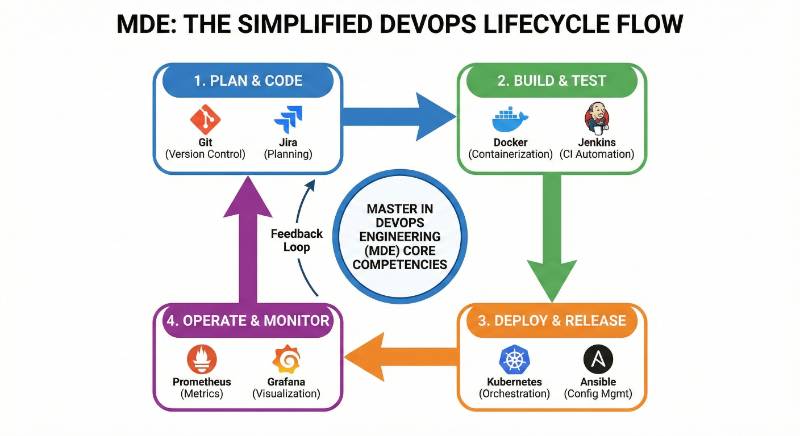
Introduction
In the ever-evolving world of software development, DevOps is an essential methodology that combines software development and IT operations to streamline the process of developing, testing, and deploying software. As the demand for DevOps professionals continues to grow globally, obtaining the Master in DevOps Engineering (MDE) certification has become a game changer for engineers and managers looking to elevate their careers. This certification provides in-depth knowledge and hands-on experience with the latest DevOps tools, best practices, and methodologies.
This guide will give you all the information you need about the MDE certification: what it is, who should pursue it, the skills you’ll gain, how to prepare, and more. Whether you’re an experienced engineer or a manager, this guide is your key to understanding why the MDE certification can propel you to the next level in your career.
What is Master in DevOps Engineering (MDE)?
The Master in DevOps Engineering (MDE) is a comprehensive certification that equips professionals with the skills and expertise to implement and manage DevOps practices effectively. It covers key aspects such as continuous integration (CI), continuous delivery (CD), containerization, orchestration, cloud computing, infrastructure automation, and security (DevSecOps). This certification is ideal for anyone aiming to excel in DevOps roles, such as DevOps Engineers, Site Reliability Engineers (SREs), and Engineering Managers.
Who Provides the Master in DevOps Engineering (MDE) Certification?
The Master in DevOps Engineering (MDE) certification is provided by DevOpsSchool, a recognized leader in the field of DevOps training and certifications. DevOpsSchool is known for offering a range of specialized programs that cater to professionals at various stages of their DevOps journey. They provide expert-led training, practical labs, and industry-focused learning experiences designed to help professionals gain the skills needed to succeed in DevOps roles.
DevOpsSchool has a reputation for delivering high-quality courses that focus on hands-on learning and real-world applications, preparing learners to excel in the rapidly evolving world of DevOps. The certification also includes career support and placement assistance to help learners advance in their careers post-certification.
Who Should Take the MDE Certification?
The MDE certification is designed for:
- Software Engineers who want to specialize in DevOps practices and enhance their skills in automation and CI/CD pipelines.
- DevOps Engineers who want to deepen their knowledge and take on more advanced responsibilities in automation and cloud technologies.
- Cloud Engineers and Platform Engineers who wish to manage scalable systems and infrastructure more effectively.
- SREs (Site Reliability Engineers) looking to improve system reliability and scalability.
- Engineering Managers who want to oversee DevOps teams and implement best practices in their organizations.
- Security Engineers looking to integrate security into the DevOps pipeline (DevSecOps).
- IT professionals transitioning into DevOps roles.
Skills You’ll Gain
After completing the MDE certification, you will gain the following critical skills:
- Automation of Software Development Pipelines: Set up CI/CD pipelines and automate testing, building, and deployment.
- Containerization and Orchestration: Master Docker and Kubernetes to manage and deploy microservices.
- Infrastructure as Code (IaC): Use tools like Terraform, Ansible, and CloudFormation to automate infrastructure management.
- Cloud Platforms: Work with cloud services like AWS, Azure, and Google Cloud to manage and deploy applications.
- Security (DevSecOps): Integrate security practices into every stage of the DevOps lifecycle.
- Monitoring and Logging: Use monitoring tools such as Prometheus, Grafana, and ELK Stack to track system performance and troubleshoot issues.
- Collaboration: Promote collaboration between development and operations teams to improve overall efficiency and reduce time-to-market.
Real-World Projects You Should Be Able to Do After the MDE Certification
Upon completion of the MDE certification, you should be able to execute the following projects:
- Set up CI/CD pipelines using Jenkins, GitLab CI, or CircleCI for automated code testing, building, and deployment.
- Deploy and manage microservices using Docker and Kubernetes, ensuring smooth container orchestration.
- Automate infrastructure provisioning on AWS using Terraform or CloudFormation.
- Implement security practices (DevSecOps) into your DevOps pipeline using tools like SonarQube and Snyk.
- Monitor system performance and troubleshoot issues using tools like Prometheus and Grafana.
- Build scalable cloud infrastructure on AWS or Azure using Infrastructure as Code (IaC) principles.
Preparation Plan
7-14 Days Preparation Plan (for professionals with prior experience)
- Day 1-7: Refresh foundational DevOps principles and tools (Git, Jenkins, Docker, Kubernetes).
- Day 8-14: Focus on hands-on practice with cloud platforms, container orchestration, and IaC tools like Terraform.
30 Days Preparation Plan (for intermediate professionals)
- Day 1-7: Study the fundamentals of CI/CD, Docker, and Kubernetes.
- Day 8-14: Dive deeper into cloud platforms (AWS, GCP, Azure) and automation tools (Terraform, Ansible).
- Day 15-30: Focus on security (DevSecOps), monitoring tools, and real-world project simulations.
60 Days Preparation Plan (for beginners)
- Day 1-15: Learn the basics of DevOps, version control systems (Git), and project management tools.
- Day 16-30: Get hands-on with CI/CD tools like Jenkins and Docker.
- Day 31-45: Work with Kubernetes for container orchestration and practice using cloud platforms (AWS, Azure).
- Day 46-60: Explore DevSecOps practices and security tools, and gain experience with monitoring tools like Prometheus.
Common Mistakes to Avoid
- Skipping hands-on practice: DevOps is highly practical; theoretical knowledge alone won’t help.
- Neglecting security: DevSecOps is crucial—integrate security practices throughout the pipeline.
- Overcomplicating workflows: Stick to proven tools and practices instead of overloading your system with too many tools.
- Lack of collaboration: DevOps is about team collaboration; avoid siloed work.
Best Next Certification After MDE
After completing the MDE certification, consider the following certifications for further specialization:
- DevSecOps Master: Dive deeper into security practices and their integration into the DevOps lifecycle.
- Certified Kubernetes Administrator (CKA): Master Kubernetes for container orchestration and management.
- AWS Certified DevOps Engineer: Specialize in cloud automation and DevOps practices using AWS.
Choose Your Path: Learning Paths
You can specialize further in one of the following learning paths based on your interests:
DevOps
Focus on mastering the complete DevOps lifecycle, automating the software delivery process from development to deployment and monitoring.
DevSecOps
Learn how to integrate security practices into DevOps pipelines, ensuring secure software delivery throughout the entire lifecycle.
SRE (Site Reliability Engineering)
Focus on system reliability, scalability, and incident management to ensure that services run efficiently and remain available under high traffic.
AIOps/MLOps
Combine artificial intelligence and machine learning with DevOps practices to enhance automation, operations, and infrastructure management.
DataOps
Learn to automate and optimize data workflows, data pipeline management, and analytics to support real-time decision-making.
FinOps
Manage and optimize cloud spending while implementing DevOps practices to ensure financial efficiency and cost optimization.
Role → Recommended Certifications
| Role | Recommended Certifications |
|---|---|
| DevOps Engineer | MDE, Certified Kubernetes Administrator, AWS Certified DevOps Engineer |
| SRE (Site Reliability Engineer) | MDE, Google Cloud Professional Cloud Architect, SRE Certification |
| Platform Engineer | MDE, AWS Solutions Architect, HashiCorp Certified Terraform Associate |
| Cloud Engineer | AWS Certified DevOps Engineer, MDE, Google Cloud Professional Cloud Architect |
| Security Engineer | MDE, CISSP (Certified Information Systems Security Professional) |
| Data Engineer | MDE, Microsoft Azure Data Engineer Associate |
| FinOps Practitioner | MDE, Certified FinOps Practitioner |
| Engineering Manager | MDE, Leadership in DevOps, Certified ScrumMaster (CSM) |
Top Institutions Offering MDE Training and Certification
- DevOpsSchool: Offers expert-led training with hands-on labs and real-world case studies, plus career support.
- Cotocus: Focuses on practical learning, cloud fundamentals, and CI/CD automation tools.
- Scmgalaxy: Provides extensive training with real-time project simulations and hands-on labs.
- BestDevOps: Delivers tool-based learning with a focus on practical implementation.
- devsecopsschool.com: Specializes in DevSecOps, focusing on security practices throughout the DevOps lifecycle.
- sreschool.com: Offers training for Site Reliability Engineers, focusing on system reliability, incident management, and scalability.
- aiopsschool.com: Focuses on AIOps, combining AI and machine learning with DevOps.
- dataopsschool.com: Specializes in DataOps, automating data workflows and analytics.
- finopsschool.com: Focuses on financial operations for cloud management and cost optimization.
General DevOps FAQs
- What is the core principle behind DevOps?
The core principle of DevOps is to foster collaboration between software development and IT operations teams, with the goal of automating and improving the software delivery process. By integrating both areas, DevOps enables faster and more reliable software deployment. - How does DevOps impact the speed of software development?
DevOps accelerates software development by automating repetitive tasks, improving collaboration, and integrating continuous testing and delivery. This reduces the time it takes to develop, test, and deploy software, ensuring faster releases and more frequent updates. - What are the key challenges in implementing DevOps practices?
Common challenges include resistance to change, aligning cross-functional teams, integrating legacy systems, and ensuring the right tools are in place. Overcoming these requires strong leadership, training, and proper change management. - What is the role of automation in DevOps?
Automation plays a critical role in DevOps by reducing manual intervention, increasing efficiency, and enabling faster, more reliable software delivery. It automates processes like testing, deployment, infrastructure provisioning, and monitoring. - How does DevOps help in scaling applications and infrastructure?
DevOps allows for the automated provisioning of scalable infrastructure using tools like Kubernetes, Docker, and cloud platforms. This helps organizations manage large-scale applications with ease, ensuring that infrastructure grows in sync with application demands. - What is the difference between Continuous Delivery (CD) and Continuous Deployment (CD)?
Continuous Delivery ensures that code is always in a deployable state and ready for production, but the actual deployment to production is a manual decision. Continuous Deployment, on the other hand, automates the deployment to production, making updates go live automatically after passing tests. - What are some common DevOps tools for managing infrastructure?
Common tools include Terraform (IaC), Ansible (automation), Kubernetes (orchestration), Docker (containerization), and Jenkins (CI/CD). These tools help automate infrastructure provisioning, configuration, and management. - How does DevOps improve collaboration between developers and IT operations?
DevOps encourages shared responsibilities between development and operations teams. It enables both teams to work together on the entire software delivery lifecycle, from code writing to deployment, promoting open communication and a culture of continuous improvement. - What are the key metrics to measure the success of DevOps?
Key metrics include deployment frequency, lead time for changes, mean time to recovery (MTTR), change failure rate, and system uptime. These metrics help track the performance of DevOps practices and ensure continuous improvement. - How does DevOps address the need for continuous testing and integration?
DevOps promotes continuous testing and integration by automating tests within the CI/CD pipeline. This ensures that code is continuously integrated into the main branch and tested for quality, helping catch issues early and improving code quality. - What are the best practices for implementing DevOps in an organization?
Best practices include fostering a culture of collaboration, automating as many processes as possible, setting up a strong CI/CD pipeline, using version control, and continuously monitoring and improving system performance. - How do DevOps practices affect software maintenance and updates?
DevOps practices ensure that software maintenance and updates happen more frequently and efficiently. Automated pipelines allow for quicker testing, deployment, and rollback if necessary, enabling continuous updates without disrupting the user experience.
MDE Certification-Specific FAQs
- What is the main focus of the MDE certification program?
The MDE certification focuses on mastering DevOps tools, practices, and principles, particularly in automation, cloud management, containerization, continuous integration, and continuous delivery (CI/CD). It prepares you to implement and manage full DevOps pipelines. - How is the MDE certification different from other DevOps certifications?
The MDE certification offers a comprehensive, hands-on approach to learning DevOps. It provides in-depth knowledge and real-world experience with a wide range of tools and practices, preparing you for advanced DevOps roles. Many other certifications focus on specific tools or roles. - What career opportunities are available after earning the MDE certification?
After completing the MDE certification, you can pursue roles like DevOps Engineer, Cloud Engineer, Site Reliability Engineer (SRE), Platform Engineer, and Engineering Manager. The certification qualifies you for leadership positions and senior roles in DevOps. - What is the structure of the MDE certification exam?
The MDE exam consists of multiple-choice questions, practical case studies, and hands-on exercises. It tests both theoretical knowledge and the ability to apply DevOps principles in real-world scenarios. - How should I balance my work while preparing for the MDE certification?
The MDE certification can be prepared for while working full-time by dedicating 1–2 hours a day for study. Organize your study time around your work schedule, and focus on hands-on practice to reinforce your learning. - What tools will I need to be proficient in for the MDE certification?
You will need to be proficient in tools like Jenkins (CI/CD), Docker (containers), Kubernetes (orchestration), AWS/Azure (cloud platforms), Terraform (IaC), and Prometheus/Grafana (monitoring). - How can I integrate the skills learned in the MDE certification into my current job?
You can integrate the skills by automating your current workflows, implementing CI/CD pipelines, managing cloud resources more efficiently, containerizing applications, and incorporating monitoring systems into your infrastructure. - What are the prerequisites to take the MDE certification exam?
Basic knowledge of software engineering, version control (Git), and cloud platforms (AWS, Azure) is recommended. Experience with automation tools like Jenkins or Docker is beneficial but not mandatory.
Conclusion
The Master in DevOps Engineering (MDE) certification is a powerful gateway to advancing your career in the fast-paced world of software development and operations. Whether you’re a software engineer, DevOps practitioner, or engineering manager, this certification equips you with the critical skills needed to succeed in today’s DevOps-driven environment.
By mastering the key tools, techniques, and principles of DevOps, you’ll gain the expertise necessary to automate software delivery, manage scalable systems, and integrate cloud and container technologies. With this knowledge, you’ll be well-positioned to take on roles such as DevOps Engineer, Cloud Engineer, Site Reliability Engineer (SRE), and more.
