
Introduction
Kubernetes is now a standard platform for running modern, container‑based applications across startups, large enterprises, and government projects. As more critical workloads move onto clusters, attackers also focus on misconfigured pods, open dashboards, weak RBAC, and insecure images rather than just traditional servers. In this context, knowing Kubernetes is not enough; being able to secure Kubernetes end‑to‑end has become a key skill for senior engineers and technical leaders.
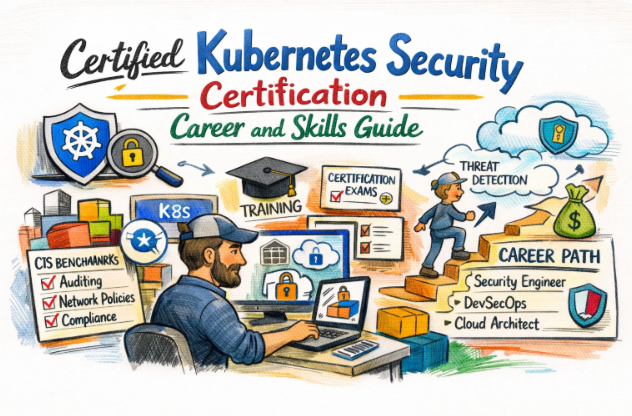
The Certified Kubernetes Security Specialist (CKS) certification was created to validate exactly this skill set. It proves you can harden clusters, lock down workloads, secure the container supply chain, and respond to security incidents in real time using the command line. This guide is written for working engineers and managers in India and globally who want a clear, practical understanding of the CKS program—what it covers, who it is for, how to prepare, and how it fits into long‑term careers in DevOps, DevSecOps, SRE, AIOps/MLOps, DataOps, and FinOps.
Kubernetes Certifications Landscape
Before we dive deep into the CKS, it helps to understand where it fits in the broader ecosystem. The table below maps out the key certifications available today.
| Track | Level | Who it’s for | Prerequisites | Skills Covered | Recommended Order |
|---|---|---|---|---|---|
| Cloud Native Foundations | Associate | Beginners, Managers | General IT knowledge | Cloud-native concepts, containers, CNCF landscape | 1st |
| Kubernetes Application Developer | Professional | Software Engineers, DevOps | Basic container knowledge | App design, deployment, config, networking, observability | 2nd (Developer track) |
| Kubernetes Administrator | Professional | SREs, Platform Engineers | Linux, networking | Cluster architecture, installation, maintenance, troubleshooting | 2nd (Admin track) |
| Kubernetes Security Specialist | Specialist | Security Engineers, DevSecOps | Active CKA certification | Cluster hardening, supply chain security, runtime security, policies | 3rd (Must have CKA first) |
| Infrastructure as Code | Associate | DevOps, Platform Engineers | Basic cloud usage | Terraform, automation, state management | 2nd or later |
| Cloud Leadership | Foundation | Engineering Managers | Delivery experience | DevOps culture, metrics, team building | Anytime |
As you can see, the CKS sits at the top of the Kubernetes certification pyramid. It assumes you already know how to administer Kubernetes (CKA) and builds security expertise on top of that foundation.
Certified Kubernetes Security Specialist (CKS)
What It Is
The Certified Kubernetes Security Specialist (CKS) is the most advanced Kubernetes certification from the Cloud Native Computing Foundation (CNCF) and The Linux Foundation. It is a performance-based exam that runs for two hours in a live terminal. You are tested on your ability to secure container-based applications and Kubernetes clusters against real-world threats. This is not theory—you must demonstrate you can harden systems, detect vulnerabilities, and respond to security incidents in real time.
Who Should Take It
This certification is built for Security Engineers, DevSecOps practitioners, Platform Engineers, and experienced Kubernetes Administrators. If your job involves keeping production systems safe, this is your certification.
Engineering Managers should also understand what the CKS represents. When you have team members with this certification, you know they understand the deepest levels of cloud-native security. They can design secure systems, train other engineers, and respond when things go wrong.
Prerequisites: The Non-Negotiable Rule
Here is something you absolutely must understand. You cannot take the CKS without holding an active CKA (Certified Kubernetes Administrator) certification. This is not a recommendation—it is a hard requirement from the Linux Foundation. The CKS builds directly on CKA knowledge. If you try to attempt it without that foundation, you will struggle.
Skills You Will Gain
The CKS curriculum is deep and practical. You will master the following domains:
- Cluster Hardening (20%): Secure Kubernetes API servers, etcd clusters, and kubelet configurations. Implement Role-Based Access Control (RBAC) with least privilege principles. Use service accounts properly.
- System Hardening (15%): Minimize host operating system vulnerabilities. Use container-optimized operating systems. Implement kernel hardening tools like AppArmor and seccomp.
- Minimize Microservice Vulnerabilities (20%): Implement secure container images. Use static analysis to find vulnerabilities. Set up proper pod security standards and policies.
- Supply Chain Security (20%): Secure the entire pipeline from code to cluster. Sign and verify container images. Analyze image vulnerabilities. Use admission controllers to enforce security policies.
- Monitoring, Logging, and Runtime Security (25%): Detect malicious behavior at runtime. Implement forensic analysis tools. Configure audit logging properly. Respond to security incidents.
Real-World Projects You Should Be Able to Do After
Once you master the CKS curriculum, you will be ready for serious security work.
- Harden a Production Cluster: Take an existing Kubernetes cluster and lock it down—secure etcd, restrict API server access, implement proper RBAC, and remove unnecessary permissions.
- Build a Secure CI/CD Pipeline: Create a pipeline that scans containers for vulnerabilities, signs images with cryptographic keys, and only allows verified images into production.
- Implement Pod Security Standards: Migrate a legacy cluster to use Pod Security Admission, ensuring no pod runs with excessive privileges.
- Detect and Respond to a Breach: When a container starts mining cryptocurrency (a common attack), you will know how to detect it, contain it, and trace how it happened.
- Secure Multi-Tenancy: Build a cluster that safely hosts multiple teams or customers, ensuring complete isolation between workloads.
Preparation Plan: Three Timelines
The CKS requires serious preparation. Here are three realistic plans based on your starting point.
The 14-Day “Intensive” Track (For Experienced CKA Holders)
If you passed your CKA recently and work with Kubernetes security daily, you might be ready for a sprint.
- Days 1-5: Review every CKS domain. Focus on tools you do not use daily—Falco, Trivy, kube-bench, and OPA policies.
- Days 6-10: Take multiple mock exams daily. The CKS timing is brutal. You need to move fast.
- Days 11-14: Focus on weak areas. Practice incident response scenarios until they feel automatic.
The 30-Day “Standard” Plan (For Working Engineers)
This is the most common path for someone with a solid CKA foundation.
- Week 1: Master cluster hardening and RBAC. Rebuild your understanding of authentication and authorization.
- Week 2: Dive into supply chain security. Learn image scanning, signing with Cosign, and admission control.
- Week 3: Focus on runtime security. Install and configure Falco. Learn to interpret its alerts.
- Week 4: Take mock exams daily. Simulate the pressure. Identify gaps and fix them.
The 60-Day “Foundation” Plan (If CKA Was a While Ago)
If you passed your CKA a year ago and have not touched Kubernetes since, you need more time.
- Month 1: Refresh your CKA knowledge completely. Rebuild clusters, troubleshoot issues, get comfortable again.
- Month 2: Follow the 30-day plan above. Spend extra time on hands-on security labs.
Common Mistakes to Avoid
The CKS exam is notoriously difficult. Here is what trips up even experienced engineers.
- Forgetting the CKA prerequisite: You cannot register without an active CKA. Check your expiration date before planning.
- Not practicing with the right tools: The exam expects you to know specific tools—Falco, Trivy, kube-bench, kube-hunter, and OPA. If you have never used them, you will struggle.
- Ignoring the time pressure: Two hours feels long until you are in the exam. Practice under timed conditions. Learn when to skip a question and come back.
- Missing the small details: Did you set the right namespace? Did you use the exact filename required? The exam graders are strict. Details matter.
- Only studying theory: You cannot read your way through the CKS. You need hours in a real terminal, solving real problems.
Best Next Certification After CKS
Once you have earned the CKS, you are at the peak of Kubernetes certifications. Here are your best options for continued growth.
- Same Track – Deepen Technical Security: Go for CISM or CISSP. These are broader security management certifications that complement your deep technical skills.
- Cross-Track – Expand Your Platform Knowledge: Learn Terraform (Infrastructure as Code) . Understanding how to secure infrastructure code is the next logical step.
- Leadership Track – Move into Security Leadership: Take a DevSecOps Foundation or Security Leadership course. This helps you build the skills to lead security teams and design organizational security strategy.
Choose Your Path: 6 Career Directions
Mastering Kubernetes security through the CKS opens doors to specialized roles. Here is how to choose your direction.
1. The DevOps Path
Focus on automating security. You will build pipelines that scan, test, and deploy securely without slowing down development.
2. The DevSecOps Path
Focus on shifting left. You will bring security practices into every phase of development, from design to deployment to operations.
3. The SRE Path
Focus on reliability through security. You will understand that insecure systems cannot be reliable, and you will build both into your practice.
4. The AIOps/MLOps Path
Focus on securing AI workloads. Machine learning models have unique security needs—protecting training data, preventing model poisoning, and securing inference endpoints.
5. The DataOps Path
Focus on data protection. You will ensure that sensitive data in pipelines and databases is encrypted, access-controlled, and auditable.
6. The FinOps Path
Focus on security cost optimization. You will learn to balance security investments against risk, ensuring you get maximum protection for every dollar spent.
Role → Recommended Certifications: Your Career Map
If you are targeting a specific role, here is the certification roadmap that makes sense.
| Your Target Role | Must-Have Certification | Next Step for Growth |
|---|---|---|
| Security Engineer | CKS | CISM or CISSP |
| DevSecOps Engineer | CKS | DevSecOps Foundation |
| DevOps Engineer | CKA + CKS | Terraform Associate |
| Site Reliability Engineer (SRE) | CKA | CKS |
| Platform Engineer | CKA | CKS |
| Cloud Engineer | Cloud Associate + CKA | CKS |
| Data Engineer | DataOps Foundation | CKA |
| FinOps Practitioner | FinOps Practitioner | Cloud Associate |
| Engineering Manager | CKA (conceptual) | Cloud Leadership |
Top Training Partners for CKS Success
Here’s a medium‑length version you can use directly.
Top Training Partners for Certified Kubernetes Security Specialist Success
DevOpsSchool
DevOpsSchool offers a dedicated Certified Kubernetes Security Specialist (CKS) program that closely follows the official exam domains. The training is very hands‑on, with live labs on cluster hardening, NetworkPolicies, Pod security, image scanning, and incident response. It is designed for busy engineers and managers, with clear study plans and exam‑oriented practice tasks.
Cotocus
Cotocus focuses on structured, role‑based learning paths around Kubernetes and DevOps. Their tracks usually combine CKA, CKAD, and CKS along with cloud and automation topics, so you build security skills on top of strong platform knowledge. This is a good choice if you want a guided, multi‑month roadmap rather than a single short course.
Scmgalaxy
Scmgalaxy emphasises real‑world DevOps and Kubernetes work, including security controls that matter in production. Their content shows how RBAC, NetworkPolicies, admission controls, and image scanning fit into CI/CD pipelines and day‑to‑day operations. This helps CKS aspirants see how exam topics map to practical DevSecOps workflows.
BestDevOps
BestDevOps curates a range of DevOps and cloud‑native courses, where Kubernetes security is treated as part of a complete senior‑engineer skill set. You can pair CKS‑oriented topics with courses on CI/CD, observability, and cloud platforms, which is useful if you want CKS to support a broader career move into lead DevOps, SRE, or platform roles.
devsecopsschool.com
devsecopsschool.com specialises in DevSecOps, making it a natural fit for CKS candidates. Training typically covers secure pipelines, image scanning, policy‑as‑code, and shift‑left practices around Kubernetes and containers. This is ideal if your goal is to embed security checks into every step of the delivery process, not just harden clusters once.
sreschool.com
sreschool.com is focused on Site Reliability Engineering, with topics like SLOs, incident response, and production‑grade operations. For CKS learners, it helps connect Kubernetes security with reliability and on‑call life: you learn how to treat security issues as first‑class incidents and design safer, more stable platforms.
aiopsschool.com
aiopsschool.com works on AIOps and intelligent operations, using metrics, logs, and events from systems like Kubernetes. Combined with CKS study, this helps you understand how security signals—suspicious pods, denied connections, policy violations—can feed into automation and smart alerting.
dataopsschool.com
dataopsschool.com focuses on DataOps and modern data platforms, many of which run on Kubernetes. As a CKS‑oriented engineer, you can learn how to secure data services, ETL workloads, and analytics APIs with the right mix of RBAC, NetworkPolicies, and supply‑chain controls.
finopsschool.com
finopsschool.com teaches FinOps and cloud cost management, which pairs well with CKS for security‑conscious platform owners. You learn how security decisions—like logging depth, isolation, and redundancy—affect cloud spend, and how to balance strong security with efficient resource usage on Kubernetes.
Frequently Asked Questions on Certified Kubernetes Security Specialist
Here are the most common questions I get about the Certified Kubernetes Security Specialist certification.
1. How difficult is the CKS compared to CKA?
The CKS is significantly harder than the CKA. The CKA tests your ability to administer Kubernetes. The CKS tests your ability to secure it under pressure. The tasks are more complex, the tools are less familiar, and the time pressure is just as intense. Many engineers report needing 2-3x more preparation time for CKS than CKA.
2. How much time do I need to prepare realistically?
For someone with a strong CKA foundation, plan for 30-60 days of focused study. The 30-day track works if you work with Kubernetes security daily. The 60-day track is safer if you are balancing a full-time job and family commitments.
3. What are the exact prerequisites for the CKS?
You must hold an active CKA certification. Your CKA cannot be expired. If your CKA expires before you take the CKS, you must recertify the CKA first. There are no other formal prerequisites, but deep Linux knowledge and container security experience are assumed.
4. Can I take the CKS without the CKA if I have security experience?
No. This is a firm rule from the Linux Foundation. The CKA prerequisite is non-negotiable. The exam builds directly on CKA concepts, and you will not pass without that foundation.
5. What tools do I need to know for the exam?
You must be comfortable with: Falco, Trivy, kube-bench, kube-hunter, OPA/Gatekeeper, Cosign, and AppArmor/seccomp profiles. The exam expects you to use these tools to complete tasks. If you have never installed or configured them, you need to practice extensively.
6. Is the CKS exam open book like CKA?
Yes, the same rules apply. You can access kubernetes.io, the Kubernetes blog, and GitHub repos. You cannot access other sites. Knowing how to navigate the docs quickly for security-specific topics is critical.
7. What is the business value of CKS for my company?
For employers, a CKS-certified engineer means reduced risk and stronger compliance posture. You can help pass security audits, prevent breaches, and respond effectively when incidents occur. In regulated industries (finance, healthcare, government), this certification is increasingly required for senior security roles.
8. What career outcomes can I expect after passing?
The CKS qualifies you for senior security roles: Security Engineer, DevSecOps Lead, Platform Security Architect, and Cloud Security Manager. It is one of the highest-paying Kubernetes certifications because it represents a rare combination of deep technical and security skills.
9. How long is the certification valid, and how do I renew?
The CKS is valid for two years. To renew, you must retake and pass the current version of the exam. Kubernetes security evolves rapidly, so this ensures certified professionals stay current.
10. What is the exam’s passing score and format?
You need a score of 67% to pass. The exam consists of 15-20 performance-based tasks completed in a live terminal environment over two hours. There are no multiple-choice questions.
11. How much does the CKS exam cost?
The standard cost is $445 USD, which includes one free retake if needed. Remember, you must also maintain your active CKA certification, which has its own cost.
12. What is the single most important tip for passing?
Practice the tools until they are muscle memory. In the exam, you do not have time to read man pages for Falco or remember Trivy syntax. You need to know the most common commands by heart. Set up a lab and run through security scenarios repeatedly until they feel automatic.
Frequently Asked Questions (FAQs) on CKS Course & Training
1. Do I need a specialized course for CKS, or can I use my CKA materials?
You need a dedicated CKS course. CKA materials do not cover security tools like Falco, OPA, or image signing. The mindset is also different—CKA teaches you to make things work; CKS teaches you to make them safe. You need specific training for that shift.
2. What makes DevOpsSchool’s CKS training different?
DevOpsSchool focuses on the practical, exam-focused skills you actually need. Their instructors are active practitioners who have passed the CKS. You get real labs, real mock exams, and real debugging help—not just recorded lectures.
3. How much hands-on practice do courses from devsecopsschool.com provide?
Courses from devsecopsschool.com are heavily lab-based. Expect to spend 70% of your time in a terminal, running security tools, breaking and fixing clusters. This is exactly what you need to build muscle memory for the exam.
4. I am from a security background but new to Kubernetes. Can I take a CKS course?
You should start with CKA training first. Jumping straight to CKS without Kubernetes administration experience will be overwhelming. Many training partners offer bundles that take you from CKA to CKS in a structured path.
5. Do courses from sreschool.com cover incident response?
Yes, and this is a strength. sreschool.com approaches security from an SRE perspective—meaning they emphasize detection, response, and recovery. This aligns well with the runtime security section of the CKS exam.
6. How do Cotocus courses handle corporate teams?
Cotocus specializes in team training. They assess your team’s current skill level, customize the curriculum, and schedule sessions around your workload. For organizations needing to upskill multiple engineers, this is often the most efficient path.
7. Are there courses that combine CKS with cloud security?
Providers like BestDevOps often integrate cloud-specific security topics into their CKS training. While the exam itself is cloud-agnostic, understanding how Kubernetes security maps to AWS, Azure, or GCP is valuable for real-world work.
8. What if I take a course and still fail the exam?
Reputable providers like DevOpsSchool offer support until you pass. They will help you identify weak areas, provide additional practice, and guide you through retaking the exam. Always ask about their pass guarantee before enrolling.
9. How much does CKS training cost?
Pricing varies by format:
- Self-paced courses: $100 – $300 USD
- Live instructor-led (public): $500 – $1000 USD
- Corporate/private training: Custom pricing based on team size
The exam voucher ($445) is typically separate unless bundled.
10. Do courses from aiopsschool.com include AI-specific security scenarios?
Yes. aiopsschool.com tailors their CKS content to AI/ML workloads. You learn standard Kubernetes security plus unique topics like securing model training pipelines and protecting inference endpoints.
11. How do I choose between different training providers?
Look for three things:
- Instructor credentials: Have they passed the CKS themselves?
- Practice exams: Do they offer realistic mock exams under timed conditions?
- Support: Can you ask questions and get help when you are stuck?
12. Is training worth it, or can I pass with free resources?
You can pass with free resources if you are extremely disciplined and have unlimited time. But for working professionals, training pays for itself by accelerating your preparation and giving you a structured path. The cost of failing the exam once ($445) plus the lost time often exceeds the cost of quality training.
Conclusion
The Certified Kubernetes Security Specialist (CKS) is not just another certification. It is the highest recognition of cloud-native security expertise available today. Let me be honest with you. This exam is hard. It will push you. There will be moments when you stare at the terminal and have no idea what to do next. But that is exactly why it matters. When you pass, you are not just proving you memorized some facts.
You are proving you can secure real systems against real threats. For security engineers, the CKS is the natural next step after years of building experience. For DevOps and SRE professionals, it is the path to mastering the full lifecycle of applications—from development to production to defense. And for managers, having CKS-certified engineers on your team means sleeping better at night, knowing your systems are in capable hands.
The cloud-native world is not getting less complex. Attacks are not getting less frequent. The need for people who truly understand Kubernetes security is only growing. The path is clear. Get your CKA if you do not have it. Choose your training partner. Put in the hours. And join the small group of engineers who have earned this credential.
Your clusters will be safer for it. Your career will be stronger for it. And honestly? The industry needs more people like you who care about getting security right.
