
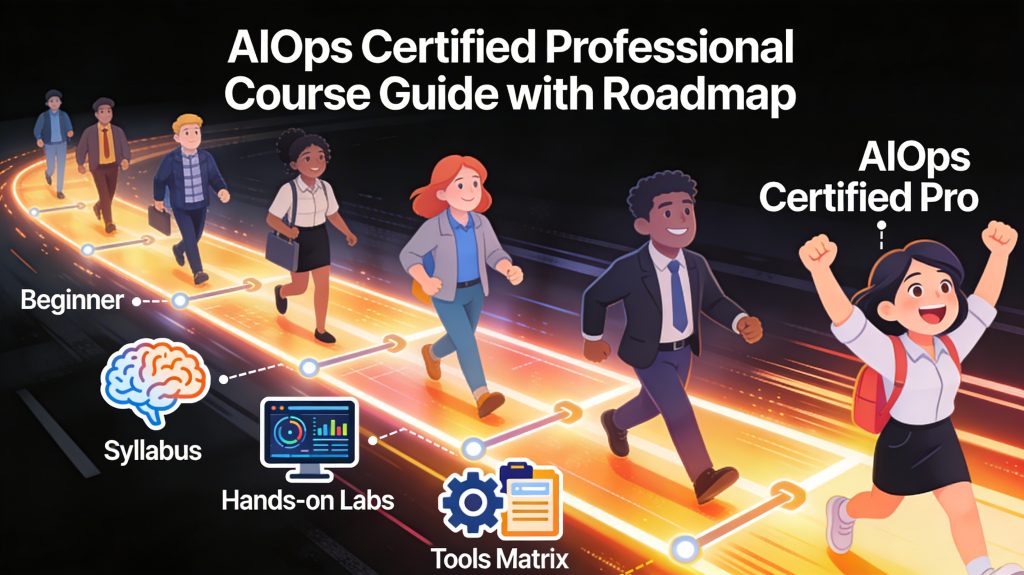
Introduction
Modern IT systems generate a huge amount of signals—logs, metrics, traces, alerts, tickets, and user experience data. The problem is not “lack of monitoring.” The real problem is too much noise and too little clarity. Teams spend hours chasing false alerts, repeating the same incident steps, and reacting late to issues that could have been predicted.
That is where AIOps (Artificial Intelligence for IT Operations) becomes practical. AIOps applies data, machine learning, and automation to help operations teams detect anomalies faster, reduce alert fatigue, find root causes, and trigger remediation actions.
The AIOps Certified Professional (AIOps) program is designed to build these skills in a structured, job-ready way—so engineers and managers can implement AIOps workflows in real environments and measure results.
Provider: Devopsschool
What is AIOps Certified Professional (AIOps)?
AIOps Certified Professional validates your ability to apply AI/ML to IT operations so you can move from reactive firefighting to proactive operations. It covers core areas like anomaly detection, predictive analytics, root cause analysis, and automation for issue resolution.
It is built for people who want practical, production-focused capability—not just theory.
Certification Table
Below is a certification-focused view that helps you understand where AIOps fits in a broader career roadmap. Only the AIOps certification link is included (as requested). Other links are intentionally not shown.
| Track | Certification | Level | Who it’s for | Prerequisites | Skills covered | Recommended order |
|---|---|---|---|---|---|---|
| AIOps | AIOps Certified Professional (AIOps) | Professional | Ops/DevOps/SRE/Platform engineers + managers | Monitoring basics, logs/metrics familiarity, incident handling basics | event correlation, anomaly detection, RCA thinking, automation workflows | 1 |
| DevOps | DevOps certification track (related) | Mixed | DevOps engineers, release/platform teams | CI/CD and basic cloud knowledge | pipelines, release automation, infra automation | After AIOps (optional) |
| DevSecOps | DevSecOps certification track (related) | Mixed | Security + DevOps teams | security basics + CI/CD | policy, hardening, compliance automation | After AIOps (optional) |
| SRE | SRE certification track (related) | Mixed | SREs, reliability owners | monitoring + incident response | SLOs, error budgets, reliability practices | After AIOps (optional) |
| MLOps | MLOps certification track (related) | Mixed | ML platform + data teams | ML basics helpful | model lifecycle, monitoring ML systems | After AIOps (optional) |
| DataOps | DataOps certification track (related) | Mixed | data engineers + platform teams | data pipelines basics | workflow automation, data reliability | After AIOps (optional) |
| FinOps | FinOps certification track (related) | Mixed | cost owners + platform engineers | cloud billing awareness | cost governance, optimization | After AIOps (optional) |
Who Should Take AIOps Certified Professional?
This certification is a strong fit if you want to reduce operational chaos and build calm, predictable operations.
You should consider it if you want to:
- Work in environments with lots of alerts and frequent incidents
- Reduce MTTR (mean time to resolve) using correlation and automation
- Improve reliability without increasing headcount
- Build proactive detection and prevention workflows
It is especially suitable for:
- DevOps Engineers (who handle deployments + ops problems)
- SREs (who own reliability, incident response, and observability)
- Platform Engineers (who run internal platforms and clusters)
- Cloud Engineers (who manage cloud operations at scale)
- Engineering Managers (who need measurable ops outcomes)
Skills You’ll Gain
You will learn how to turn raw operational data into decisions and actions. That includes how to spot patterns in logs/metrics, detect anomalies early, connect related alerts into one incident story, and build automation steps that reduce repetitive work.
Skills you’ll gain
- Event and alert correlation (reduce noise)
- Anomaly detection basics (spot unusual behavior early)
- Root cause analysis approach (faster diagnosis)
- Predictive monitoring concepts (prevent repeats)
- Automation and “self-healing” workflow design
- Better use of observability data (logs, metrics, traces)
Real-World Projects You Should Be Able to Do After This
These projects are practical and map directly to real AIOps work:
- Build an alert noise reduction pipeline (group duplicates, suppress low-signal alerts)
- Create an anomaly detection workflow for latency, error rates, or resource spikes
- Implement a basic RCA playbook using correlation + change events (deployments/config)
- Build an incident timeline view from logs, alerts, and tickets
- Automate common remediation actions (restart, rollback, scale, isolate)
- Create proactive health checks and early-warning signals for key services
Preparation Plan (7–14 Days / 30 Days / 60 Days)
7–14 Days (Fast Track)
Best if you already work in ops and want focused certification prep.
- Refresh: logs vs metrics vs traces, incident lifecycle
- Practice: anomaly patterns (CPU/memory, latency, error rate)
- Learn: correlation basics and RCA thinking
- Build: 1 mini project (alert grouping + simple anomaly rules)
30 Days (Balanced)
Best for most engineers and working professionals.
- Week 1: AIOps concepts + operational data fundamentals
- Week 2: anomaly detection + noise reduction + correlation
- Week 3: RCA workflows + incident automation patterns
- Week 4: end-to-end AIOps mini-pipeline + review + mock tasks
60 Days (Advanced)
Best if you want real implementation readiness.
- Add a stronger data layer (cleaning, enrichment, tagging)
- Add predictive signals (trend-based warnings)
- Improve RCA depth (dependencies + change events + topology thinking)
- Build 2–3 projects: incident correlation, automated remediation, reliability dashboards
Common Mistakes (and How to Avoid Them)
- Studying AIOps as only “tools” instead of workflows and outcomes
- Ignoring data quality (bad tagging/dirty logs = bad automation)
- Trying to automate everything first (start with top 3 repeat incidents)
- Not defining success metrics (noise reduced by X%, MTTR improved by Y%)
- Skipping incident basics (AIOps works best on strong incident practices)
- Treating correlation as magic (needs context: services, changes, owners)
Best Next Certification After This
A good next step depends on your job goal:
- If you want stronger reliability ownership → go toward SRE track
- If you want stronger AI/ML lifecycle operations → go toward MLOps track
- If you want stronger platform + cloud architecture → go toward DevOps/Cloud track
(These directions align with common certification paths listed for software engineers, including DevOps, SRE, MLOps, DataOps, Kubernetes, and cloud architect tracks.)
Next Certifications to Take
Based on the broader “top certifications” set that includes DevOps, SRE, MLOps, DataOps, Kubernetes, Terraform, and cloud architect tracks, here are three smart options.
1) Same Track (Deeper AIOps)
- AIOps Foundation / AIOps Engineer style progression
- Focus: deeper operational analytics, automation maturity, implementation patterns
2) Cross-Track (Broaden Your Impact)
Pick one depending on your daily work:
- SRE track (reliability + SLO mindset)
- MLOps track (operate ML systems + pipelines)
- DataOps track (better data pipelines, quality, and governance)
These tracks commonly appear alongside AIOps in modern engineering certification roadmaps.
3) Leadership Track (Lead Teams and Transformation)
- DevOps Manager / DevOps Architect style progression
- Focus: operating model, metrics, governance, and scaling across teams
Choose Your Path (6 Learning Paths)
- DevOps Path
Use AIOps to stabilize CI/CD-driven environments. Connect deployment events with incidents, reduce rollback time, and automate repeat recovery steps. - DevSecOps Path
Use AIOps signals to detect security-relevant anomalies (suspicious spikes, unusual access patterns) and automate first-response actions with guardrails. - SRE Path
Use AIOps to protect SLOs: detect early symptoms, correlate incidents across dependencies, and reduce MTTR with proven runbooks. - AIOps/MLOps Path
Combine operational AI with ML operations. Manage model-driven systems, monitor model behavior, and build feedback loops for continuous improvement. - DataOps Path
Improve data reliability and pipeline health. Use AIOps practices to catch pipeline failures early, reduce data downtime, and automate fixes. - FinOps Path
Use AIOps insights to control cloud waste: detect abnormal cost spikes, correlate them with workload changes, and optimize resources safely.
Role → Recommended Certifications Mapping
| Role | Recommended direction (starting from AIOps) |
|---|---|
| DevOps Engineer | AIOps + DevOps track for CI/CD stability and automation |
| SRE | AIOps + SRE track for reliability, SLOs, MTTR improvement |
| Platform Engineer | AIOps + Kubernetes/Platform direction for scalable ops |
| Cloud Engineer | AIOps + Cloud architecture direction for proactive ops in cloud |
| Security Engineer | AIOps + DevSecOps direction for secure automation |
| Data Engineer | AIOps + DataOps direction for pipeline health and data reliability |
| FinOps Practitioner | AIOps + FinOps direction for anomaly-based cost control |
| Engineering Manager | AIOps + leadership/manager direction for metrics + transformation |
Top Institutions Providing Kubernetes Training
Below are training ecosystems that typically help learners with instructor-led sessions, hands-on labs, and certification support in DevOps/AIOps-related tracks:
- DevOpsSchool
Strong for structured certification learning with practical labs. Focus is usually on real operational scenarios, guided practice, and job-aligned outcomes. Good fit if you want a guided path from basics to implementation. - Cotocus
Often positioned for practical enterprise learning. Useful if you want hands-on mentoring, structured learning plans, and applied projects to build confidence. - ScmGalaxy
Typically focuses on practical training and learning-by-doing. Works well for learners who want repetition through labs, exercises, and guided troubleshooting. - BestDevOps
Good for step-by-step learning tracks. Often includes practice guidance, exam readiness approach, and workflow-driven learning. - DevSecOpsSchool
Useful if your AIOps work sits close to security operations. Helps you think about safe automation, policy controls, and secure operational processes. - SRESchool
Strong if you want reliability-first learning. Helps connect AIOps with SLOs, incident response maturity, and production resilience. - AIOpsSchool
A focused place for AIOps-oriented learning. Helpful when you want a direct AIOps progression mindset (foundation → engineer → professional). - DataOpsSchool
Best if your AIOps outcomes depend heavily on data pipelines and data quality. Supports skills around data reliability and automation. - FinOpsSchool
Helpful if your organization is cost sensitive and you want to apply AIOps signals for cost anomaly detection and governance.
FAQs (Minimum 12) — Difficulty, Time, Prerequisites, Sequence, Value, Career Outcomes
- Is AIOps difficult to learn?
It is manageable if you already work with monitoring, incidents, or production systems. The key is practice with real signals, not only theory. - How long does it take to prepare?
Many working engineers can prepare in 30 days with steady hands-on practice. A deeper job-ready level often takes 60 days. - Do I need coding to learn AIOps?
Basic scripting helps, but AIOps is more about workflows, data, and operational reasoning. Many tasks are configuration + analysis + automation design. - Do I need ML knowledge?
Not advanced ML. You should understand what anomalies and patterns mean, and how to apply ML outputs responsibly. - What are the prerequisites?
Understanding logs/metrics, basic troubleshooting, and incident process awareness is enough to start. - Should I learn monitoring before AIOps?
Yes. AIOps depends on good observability signals. If monitoring is weak, AIOps outcomes will be weak too. - What is the biggest value of AIOps?
Reduced alert noise, faster RCA, faster recovery, and more proactive operations. - Is this valuable for managers too?
Yes—because AIOps needs metrics, prioritization, and automation governance. Managers who understand AIOps can drive measurable ops improvement. - What jobs can this help with?
DevOps Engineer, SRE, Platform Engineer, Cloud Ops, Observability Engineer, AIOps Engineer, and operations-focused Engineering Manager roles. - Does AIOps replace SRE/DevOps roles?
No. AIOps supports teams. It improves speed and consistency, but humans still define goals, guardrails, and decisions. - What should I learn next after AIOps?
If reliability is your focus: SRE. If AI systems are your focus: MLOps. If data pipelines are your focus: DataOps. - How do I prove AIOps value in my company?
Track measurable outcomes: alert reduction %, MTTR improvement, incident recurrence reduction, and automation adoption rate.
FAQs (8 Questions & Answers) — AIOps Certified Professional (AIOps)
- What exactly does this certification validate?
It validates that you can apply AIOps concepts like anomaly detection, correlation, RCA thinking, and automation to real ops problems. - Is it more tool-based or concept-based?
It is workflow-based: understand the concepts, then apply them using real operational signals and practical steps. - What should I practice daily?
Read logs/metrics, identify patterns, simulate incidents, correlate alerts, and write small automation actions for common fixes. - What is the fastest way to fail the exam or assessment?
Doing only theory and skipping hands-on tasks—AIOps skill is proven through application. - What projects should I build for confidence?
Alert deduplication, anomaly detection for latency/errors, incident timeline building, and automated remediation for repeat issues. - Can I use this to move into SRE?
Yes. AIOps skills help SRE work by reducing noise and improving incident response outcomes. - How does it help in cloud-heavy environments?
Cloud environments change fast. AIOps helps detect abnormal behavior early and connects cost/performance changes to workload events. - What is a practical outcome I can show on my resume?
“Reduced alert noise by X%” or “Improved MTTR by Y% using correlation + automated runbooks” is a strong outcome statement.
Conclusion
AIOps Certified Professional (AIOps) is a strong step if you want to operate modern systems with less noise, faster diagnosis, and smarter automation. The best way to succeed is to treat AIOps like a practical discipline: start from real operational signals, build repeatable workflows, measure improvements, and then scale automation safely.
If you follow the 30–60 day plan and build a few realistic projects, you will not only be ready for certification—you will also be ready to deliver measurable reliability and operational efficiency in your job.

