
Introduction
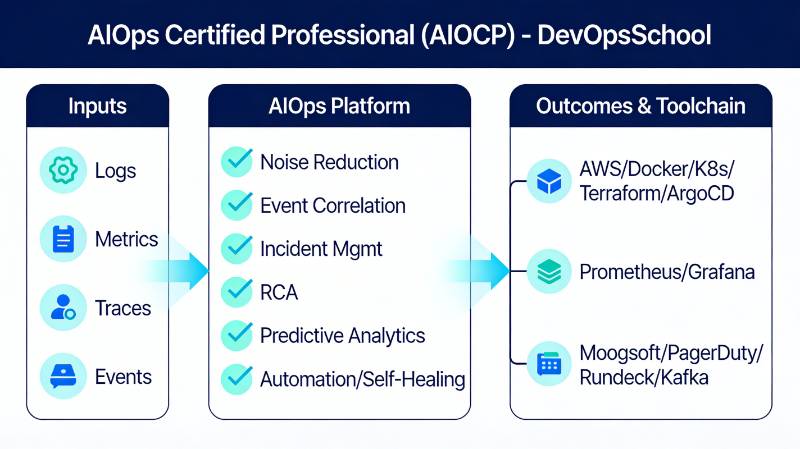
IT operations are becoming more complex every year. Modern systems run on cloud platforms, microservices, containers, and distributed architectures. These systems generate massive amounts of logs, metrics, traces, and alerts. Managing them manually is slow, reactive, and often inefficient. This is where AIOps (Artificial Intelligence for IT Operations) changes the game.
The DevOps AIops Certified Professional (AIOCP) certification is designed for engineers and managers who want to bring intelligence and automation into operations. Instead of reacting to incidents, AIOps helps teams predict failures, reduce alert noise, automate responses, and improve overall system reliability.
In this guide, you will understand what AIOCP is, who should take it, what skills you will gain, how to prepare, and how it can support your career growth in modern DevOps, SRE, and AI-driven operations environments.
Why AIOps Matters in Modern Engineering
As systems scale, monitoring tools generate massive volumes of logs, metrics, and alerts. Manual analysis becomes slow and error-prone. AIOps uses machine learning, analytics, and automation to detect anomalies, predict failures, reduce alert noise, and automate incident response.
Professionals with AIOps skills can improve system reliability, automate operations, and build intelligent observability platforms.
Comparison Table
| Option | Primary focus | Best for | What you learn most | What you can deliver after learning | When you should choose this |
|---|---|---|---|---|---|
| MLOps Certified Professional (MLOCP) | Production ML lifecycle | ML Engineers, DevOps/Platform engineers supporting ML, Managers owning ML delivery | Model & data versioning, ML pipelines, CI/CD for ML, deployment, monitoring & drift handling | Train→package→deploy a model service with rollout + monitoring + retraining triggers | You want to move from notebooks to reliable production ML |
| DevOps (general professional path) | Software delivery automation | DevOps Engineers, Cloud Engineers, Platform Engineers | CI/CD, release automation, infra basics, environment management | Build and operate delivery pipelines for services | Your focus is shipping software faster & safer (not ML-specific) |
| SRE (reliability path) | Reliability + operations | SREs, Platform Engineers, On-call owners | SLOs, observability, incident response, capacity, resilience | Reduce outages, create SLO dashboards, incident playbooks | You own uptime, latency, stability, including ML systems |
| DevSecOps (security path) | Secure software supply chain | Security Engineers, DevOps with security ownership | Secure CI/CD, secrets, policy, scanning, compliance controls | Secure pipelines with gates, approvals, audits | Your org is strict on security/compliance for production |
| DataOps (data pipeline path) | Reliable data workflows | Data Engineers, Analytics Engineers, Data Platform teams | Data quality checks, orchestration, governance, pipeline reliability | Stable data pipelines with testing + monitoring | Your pain is data breaks models more than code does |
| AIOps (ops automation path) | Smart operations + automation | Ops/SRE teams using automation, ML-driven ops | Alert noise reduction, correlation, automation patterns | Faster incident triage and operational automation | You want intelligent operations, beyond manual on-call |
| FinOps (cost path) | Cloud cost governance | FinOps Practitioners, Platform/Engineering Managers | Cost allocation, optimization, usage visibility, budgeting | Cost controls + optimization policies for workloads | Your workloads (especially ML) are expensive and need control |
What is AiOps Certified Professional (AIOCP)
AIOCP is a professional certification focused on using AI and machine learning to automate IT operations. It teaches how to analyze logs, metrics, and events, detect anomalies, predict failures, and automate incident response in modern production systems.
Who should take it
- DevOps Engineers managing large-scale systems
- Site Reliability Engineers (SRE)
- Platform Engineers
- Cloud and Infrastructure Engineers
- Monitoring and Observability Engineers
- Engineers moving toward AIOps roles
- Engineering Managers leading operations teams
Skills you’ll gain
- AIOps fundamentals and architecture
- Anomaly detection and pattern recognition
- Event correlation and noise reduction
- Predictive monitoring and failure detection
- Observability and intelligent alerting
- Automation and self-healing systems
- Log and metric analytics
- ML for operations
- Reliability and performance optimization
Real-world projects you should be able to do after it
- Build anomaly detection system for metrics
- Implement intelligent alert correlation
- Reduce monitoring noise using ML
- Predict system failures using historical data
- Automate incident response workflow
- Implement self-healing infrastructure automation
- Build observability dashboard with analytics
- Implement performance anomaly detection
Preparation plan
Preparing for AIOCP requires both theory and hands-on practice.
Preparation Plan (Compressed) for MLOCP
7–14 Days (Fast Track)
- Revise MLOps lifecycle + versioning basics
- Build 1 mini project: train → package → deploy → basic monitoring
- Add rollout/rollback notes + finalize README + mock interview answers
30 Days (Balanced)
- Week 1: Lifecycle + repo setup + repeatable training pipeline
- Week 2: Versioning + CI pipeline (tests + validations + artifact publish)
- Week 3: Deploy model service + configs + health checks + rollback plan
- Week 4: Monitoring + drift signals + polish 2 projects + interview practice
60 Days (Deep + Portfolio)
- Weeks 7–8: Monitoring + drift playbook + 3 projects + mock interviews
- Weeks 1–2: Strong foundations + reproducibility discipline
- Weeks 3–4: CI/CD maturity + quality gates + release notes habit
- Weeks 5–6: Production-style deployment + safe rollout + failure drills
Common mistakes
- Ignoring observability fundamentals
- Focusing only on tools instead of concepts
- Not learning automation workflows
- Weak understanding of logs and metrics
- Skipping anomaly detection practice
Best next certification after this
- Same track: Advanced AIOps / Observability Engineering
- Cross-track: SRE Professional or MLOps Professional
- Leadership: DevOps Manager / Reliability Architect
Choose Your Path
DevOps Path
- Focus
- Automation, CI/CD, containers, and infrastructure delivery.
- Best for
- DevOps Engineers, Cloud Engineers, Platform Engineers.
- Learn in order
- Linux → Git → CI/CD → Docker → Kubernetes → IaC → Monitoring.
- Outcome
- You can ship software faster with stable releases and repeatable deployments.
DevSecOps Path
- Focus
- Secure pipelines, secrets, policy, scanning, and compliance controls.
- Best for
- Security Engineers, DevOps engineers owning security, Platform teams.
- Learn in order
- CI/CD basics → secrets management → SAST/DAST → container scanning → policy-as-code → secure releases.
- Outcome
- You can build secure delivery pipelines that reduce risk and meet audit needs.
SRE Path
- Focus
- Reliability, observability, SLOs, incident response, and resilience.
- Best for
- SREs, Platform Engineers, On-call owners.
- Learn in order
- Monitoring → logging → alerting → SLO/SLI → incident playbooks → capacity planning → chaos drills.
- Outcome
- You can keep services reliable and respond fast when production breaks.
AIOps/MLOps Path
- Focus
- ML lifecycle automation, model delivery, drift handling, and intelligent operations.
- Best for
- MLOps Engineers, ML Platform Engineers, DevOps supporting ML.
- Learn in order
- ML workflow basics → versioning → ML CI/CD → deployment → monitoring → drift → retraining triggers.
- Outcome
- You can run models in production safely, repeatedly, and with measurable quality.
DataOps Path
- Focus
- Reliable data pipelines, orchestration, testing, and governance.
- Best for
- Data Engineers, Analytics Engineers, Data Platform teams.
- Learn in order
- SQL + pipelines → orchestration → data testing → lineage → governance → monitoring → SLAs.
- Outcome
- You can deliver clean, trusted data that powers analytics and ML reliably.
FinOps Path
- Focus
- Cloud cost visibility, optimization, and governance for engineering workloads.
- Best for
- FinOps Practitioners, Platform leaders, Engineering Managers.
- Learn in order
- Cost allocation → tagging → dashboards → budgets/alerts → optimization → policy + guardrails.
- Outcome
- You can reduce cloud spend without hurting performance or delivery speed.
Role → Recommended Certifications
| Role | Recommended Certifications |
|---|---|
| DevOps Engineer | DevOps Professional → AIOCP |
| SRE | SRE Professional → AIOCP |
| Platform Engineer | DevOps Architect → AIOCP |
| Cloud Engineer | Cloud + DevOps → AIOCP |
| Security Engineer | DevSecOps Professional |
| Data Engineer | DataOps Professional |
| FinOps Practitioner | FinOps Professional |
| Engineering Manager | DevOps Manager / Reliability Architect |
Next Certifications to Take
- Same Track: Advanced AIOps / Observability Engineering
- Cross Track: SRE Professional / MLOps Professional
- Leadership Track: DevOps Manager / Reliability Architect
Training & Certification Support Institutions
DevOpsSchool
Provides structured, hands-on training with real-world labs and mentor support for working professionals. Strong focus on practical implementation, not just theory, so you build projects you can explain in interviews. Helps you stay exam-ready through guided practice, revision, and workflow-based learning.
Cotocus
Helps professionals connect learning with real production challenges and delivery realities. Emphasizes automation mindset, cloud practices, and practical engineering habits that improve on-job performance. Useful if you want learning that feels close to actual project work.
ScmGalaxy
Focuses on building strong foundations in CI/CD, automation, and modern DevOps toolchains. Works well for learners who want structured learning and repeatable practice. Good choice when your goal is to strengthen core delivery skills before advanced specializations.
BestDevOps
Offers job-oriented training with a project-first approach and certification preparation support. Helps learners convert knowledge into practical outcomes like pipelines, deployments, and troubleshooting. A solid option when you want skills that directly map to interviews and day-to-day roles.
DevSecOpsSchool
Focused on securing the DevOps lifecycle with compliance-ready practices and governance thinking. Helps you learn how to build secure pipelines, handle secrets safely, and reduce supply-chain risk. Best when your organization expects security to be built into delivery from day one.
SRESchool
Specializes in reliability engineering, observability, and production stability. Teaches how to think in SLOs, incident response, and resilient design—skills that make MLOps stronger in real production. Ideal if you want to become the person who keeps systems stable under pressure.
AIOpsSchool
Focused on AI-driven operations, predictive monitoring, and intelligent automation patterns. Helps you understand how operations can become proactive instead of reactive. Useful if you want to bridge MLOps with operational intelligence and automation.
DataOpsSchool
Supports learning around data pipelines, orchestration, testing, and governance. Strengthens the “data reliability” side that directly impacts model quality and trust. Best for people working close to data engineering, analytics engineering, or ML data pipelines.
FinOpsSchool
Focused on cloud cost optimization and financial governance for engineering workloads. Helps you build cost-awareness, budgeting controls, and optimization habits—very useful for expensive ML training and inference workloads. Great for platform teams and managers who must balance performance with spend.
General FAQs
1) What is MLOps in simple words?
MLOps is the practice of delivering ML models like production software—versioned, tested, deployed safely, and continuously monitored.
2) Is MLOCP good for working professionals?
Yes. It suits working engineers and managers because it focuses on practical workflows you can apply directly in real projects.
3) How difficult is MLOCP?
Moderate. If you already know Linux, Git, and basic CI/CD, it feels smooth. If those are new, spend time on fundamentals first.
4) How much time do I need to prepare?
With consistent effort, you can prepare in 7–14 days (fast revision), 30 days (balanced), or 60 days (deep + portfolio).
5) What are the prerequisites for MLOCP?
Basic Linux, Git, understanding of ML workflow (data → training → model), and basic deployment concepts. Docker/Kubernetes knowledge is helpful but can be learned alongside.
6) Do I need to be a data scientist to do MLOCP?
No. Software engineers and DevOps/platform engineers can do it. The key is learning how ML systems behave in production.
7) What is the best learning sequence before MLOCP?
Linux → Git → CI/CD basics → Docker → Kubernetes basics → then full MLOps lifecycle and monitoring.
8) What real skills will I gain from MLOCP?
You learn how to make ML delivery repeatable: versioning, CI/CD for ML, deployment patterns, monitoring, drift handling, and retraining triggers.
9) What career roles does MLOCP support?
MLOps Engineer, ML Platform Engineer, DevOps for AI/ML teams, SRE for ML systems, Data/AI Platform Engineer, and technical program owners for ML delivery.
10) How do I prove MLOps skills to recruiters?
Build 1–2 end-to-end projects: training pipeline + CI/CD + deployment + monitoring + rollback notes, with a clean README.
11) Is Kubernetes mandatory for MLOps jobs?
Not always, but it is very common in industry. Even if you don’t master it, you should understand container-based deployment and scaling basics.
12) What is model drift and why is it important?
Model drift happens when real-world data changes. If you don’t detect it, your model can silently become inaccurate and harm business decisions.
AIOCP Specific FAQs
- What is AIOps Certified Professional (AIOCP) actually about?
AIOCP focuses on using analytics and automation to improve IT operations—reducing alert noise, correlating events, speeding up incident response, and enabling proactive operations. - Is AIOCP only for people doing Machine Learning?
No. You don’t need to be an ML expert. You need a strong operations mindset: monitoring, incidents, reliability, and automation. The “AI” part is about smarter operations outcomes. - Who benefits the most from AIOCP?
SREs, DevOps engineers, NOC/IT Ops engineers, platform engineers, and managers who own uptime, MTTR, and operational efficiency. - What prerequisites help before starting AIOCP?
Basic monitoring concepts (metrics/logs/traces), incident handling, Linux fundamentals, and scripting/automation basics. Knowledge of ITSM processes is a plus. - How is AIOCP different from SRE?
SRE focuses on engineering reliability using SLOs, observability, and incident practices. AIOCP focuses on making operations smarter using correlation, anomaly detection, and automation to reduce toil and alert fatigue. They complement each other well. - How is AIOCP different from MLOps (MLOCP)?
MLOps is about running ML models in production (versioning, deployment, drift). AIOps is about running IT operations better (event correlation, anomaly detection, automated remediation). One is “ML product delivery,” the other is “ops intelligence.” - What practical outcomes should I be able to show after AIOCP?
You should be able to demonstrate alert reduction, event correlation, incident triage improvements, root-cause analysis workflows, and automation/runbooks that reduce MTTR. - Does AIOCP help with career growth and salary?
It can, especially if you can show measurable ops outcomes like lower incident volume, faster resolution time, fewer false alerts, and stronger reliability reporting.
Conclusion
AIOps is transforming modern IT operations by bringing intelligence and automation into monitoring and reliability. Organizations need professionals who can manage complex systems using data-driven automation.
The AiOps Certified Professional (AIOCP) certification provides practical skills to build intelligent monitoring, automate operations, and improve system reliability. With consistent practice and learning, this certification can help you grow into modern AI-driven operations and reliability engineering roles.
